Before You Press Play
- Performance: Scott Brick commands the material with authority and measured pacing, giving Musashi's terse strategic wisdom room to land without over-dramatizing the prose.
- What it covers: Strategy and adaptability, the philosophy of mastery, defeating adversity through clarity
- Feel: Spare and contemplative, with a clean intensity
- Our call: Scott Brick's narration of William Scott Wilson's translation makes this the audiobook version of A Book of Five Rings to reach for, scholarly, precise, and surprisingly applicable to modern life.
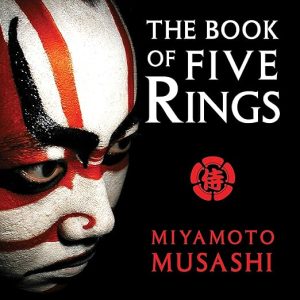
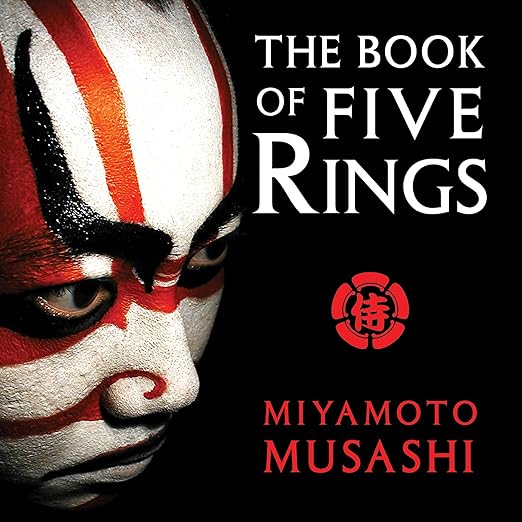
Miyamoto Musashi wrote A Book of Five Rings in 1645, a year before his death, intending it for his immediate disciples. He had no way of knowing it would eventually share shelf space with Sun Tzu's The Art of War as one of the most widely read treatises on strategy in human history. The audiobook version presented here, translated by William Scott Wilson and narrated by Scott Brick, brings particular care to a text that has often been poorly served by loose translations and rushed interpretations. I came to this recording after years of seeing the book cited across contexts ranging from business strategy to martial arts philosophy, and I wanted to hear whether the actual text could live up to the reputation. In Scott Brick's hands, under Wilson's rigorous translation, it does.
At two hours and forty-one minutes, A Book of Five Rings is among the shortest audiobooks in any library, but the density of the material makes brevity feel like precision rather than limitation. Musashi was not writing for a general audience or for commercial success; he was writing instructions for his students. The compression is intentional, and a narrator who understood that would let the words do their work rather than fill the space with interpretive performance. Scott Brick understands that.
The Review
The Wilson translation is the reason to choose this particular edition. Earlier translations of the text, and there are many, have a tendency to smooth over the ambiguities in the original seventeenth-century Japanese, producing prose that reads more fluently but loses something essential in the process. Wilson, who also translated Hagakure and The Unfettered Mind, works differently: he adheres rigorously to the original text and addresses points of ambiguity directly in his extensive introduction, explaining what the source allows and what it does not.
That introduction is one of the audiobook's significant additions to the main text. It provides the historical and biographical context that a listener needs to understand who Musashi was, what the tradition he was writing within demanded, and why his approach to swordsmanship was considered revolutionary rather than conventional. The rarely published The Way of Walking Alone, translated and included here, extends the listener's understanding of Musashi's philosophy beyond the strategic into the more personal.
Scott Brick handles the tonal shift between the introduction, the main text, and the supplementary material with real skill. His voice is authoritative without being heavy, and he gives each of the five books, Earth, Water, Fire, Wind, and Void, the distinct quality their titles suggest. The Void section, which deals with the transcendent dimension of Musashi's philosophy, is particularly well handled.
Why A Book of Five Rings Works as an Audiobook
The audiobook format does something interesting for this text: it restores the oral dimension that the original transmission implied. Musashi wrote for students who would have discussed and practiced these ideas with him in person. The audio version places the listener in something closer to that relationship than a printed page does, particularly when the narrator brings the authority that Brick consistently brings.
The strategic advice in the text is genuinely applicable beyond the specific context of samurai sword training. Musashi's observations about creating confusion in an opponent, about reading the mood of a situation before committing to action, about the difference between visible technique and invisible mastery, translate to the modern battles of professional life with more clarity than most contemporary business books achieve through hundreds more pages. One listener noted that approaching the text as applying to everyday ordeals, rather than historical swordfighting, reveals its full depth.
The two-hour-plus runtime also makes this an unusually practical audiobook for busy listeners. The core text, absorbed once with full attention and then revisited, rewards the kind of engagement that a short, dense classic invites in a way that a ten-hour business memoir rarely does.
The Caveats
The text is terse by design and sometimes opaque. Musashi writes in compressed, aphoristic prose that requires active interpretation. Passive listeners who want ideas delivered with explicit application will find the material frustratingly elliptical in places. The Wilson translation minimizes this where possible and the introduction helps contextualize the harder passages, but some interpretive effort is required of the listener.
The audiobook's brevity, while a feature, also means that listeners drawn to the book expecting extended narrative or biography will be surprised. This is not a life of Musashi; it is the text Musashi wrote, with a scholarly apparatus around it. The biography has to be assembled from the introduction and from outside reading.
The philosophical territory in the later books, particularly the Void, may feel abstract to listeners who want concrete strategic instruction. Musashi's late-career thinking moves toward the transcendent, and that dimension of his work requires a particular kind of patience to engage with productively.
Who Should Pick Up A Book of Five Rings
This audiobook is for listeners who want to encounter Musashi's actual text rather than a summarized or adapted version, and who want that encounter with a reliable translation and a narrator who takes the material seriously. Martial arts practitioners, students of strategic thinking, and listeners interested in Japanese history and philosophy will all find this edition worthwhile.
Skip it if you want a purely accessible, contemporary take on strategy that uses Musashi as a jumping-off point. For that, there are many adjacent business books that do the interpretive work for you. This edition gives you the original text, which is the point.