Quick Take
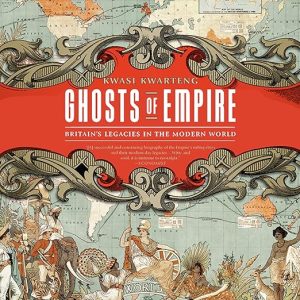
- Narration: Kwarteng narrating his own book carries the dual authority of personal experience, his parents were Ghanaian subjects of the empire, and Cambridge-trained historian, and that combination shapes every page.
- Themes: British imperial administration as anarchic individualism, the long shadow of colonial improvisation, postcolonial instability as an imperial inheritance
- Mood: Cerebral and somewhat contrarian, refusing easy condemnation in favor of a more uncomfortable structural argument
- Verdict: Kwarteng’s thesis about the empire as a series of eccentric individual fiefdoms rather than a coherent project is original and persuasive, the self-narration lends the argument a personal weight it would otherwise lack.
I came to Ghosts of Empire already knowing something about Kwasi Kwarteng the politician, he had a brief and turbulent stint as British Chancellor of the Exchequer in 2022 that did not end well, but the Kwarteng who wrote this book is something different: a trained historian with serious academic credentials and a genuinely unusual perspective on the British Empire. His parents were Ghanaian, subjects of that empire who eventually immigrated to Britain, and he brings to this narrative a quality that almost no other author in this territory can claim: the capacity to analyze from both inside and outside simultaneously.
The book’s central argument is delivered early and clearly. There was no coherent model for how the British Empire administered its territories. What there was instead was a collection of eccentric, often independently minded individuals, viceroys, administrators, soldier-diplomats, district officers, who were trained in the culture of the British public school to think for themselves and act on that individual judgment. The result was what Kwarteng calls anarchic individualism: a system that produced both genuine achievement and genuine catastrophe, often from the same people, and that left behind the borders and political arrangements we are still living with today.
Six Case Studies and What They Reveal
Kwarteng structures the argument around six former British colonies, each receiving an extended case study: Iraq, Kashmir, Burma, Sudan, Nigeria, and Hong Kong. This is a somewhat unusual selection, and one Audible reviewer noted that the book shows how each of the six former colonies continued to be plagued by the chaos of a poorly planned decolonization. That description is accurate but somewhat gentler than Kwarteng’s own framing, which is less about planning failure than about structural inevitability: because the empire was administered by individuals rather than by coherent policy, decolonization could not produce coherent successors.
The Iraq chapter is probably the most immediately relevant to contemporary concerns, Kwarteng traces how British decisions in the 1920s about the borders and political structure of the Iraqi mandate created tensions that have been worked out in blood ever since. The Sudan chapter deals with the Mahdi uprising and the Gordon disaster at Khartoum, and then with the reconquest and its aftermath. Both chapters demonstrate Kwarteng’s method: close attention to the specific individuals involved, analysis of their motivations and their relationship to imperial culture, and resistance to retrospective teleology about what was inevitable.
The Argument That Refuses Easy Condemnation
Kwarteng is quite explicit that he is not writing a sweeping condemnation of the British Empire. He acknowledges that some academic reviewers and some general readers will find this frustrating. His point is that condemnation, while morally satisfying, is not analytically useful, it tells us what we already know (the empire involved coercion and exploitation) without helping us understand how it actually worked and why it produced the specific consequences it did.
The argument that the empire was driven by individual temperament rather than coherent policy is not apologetics. If anything, it is a more disturbing account than the conspiracy version, because it suggests that the harm done was not the product of deliberate design that could have been differently designed, but of structural conditions, the culture of a particular English class at a particular historical moment, that produced chaos as naturally as it produced the people who navigated it. This is a harder argument to dismiss than simple indictment, and that is part of what makes the book worth the time it takes.
Self-Narration and the Dual Perspective
Kwarteng narrating his own text gives the book a quality that a professional narrator could not replicate. He is writing about an empire that affected his own family directly, Ghana was a British colony until 1957, and his parents’ entire formation was shaped by that fact, and his narration carries that awareness even when the prose is at its most analytical. He reads with the controlled formality of an academic trained at Eton and Cambridge, but there is an undercurrent of personal investment that surfaces in certain passages and gives the argument a weight it would otherwise have to work harder to achieve.
At 15 hours and 45 minutes, the book asks for patience. Kwarteng is thorough, and the six case studies each require substantial historical setup before the analytical argument can do its work. Listeners who find themselves wanting the argument accelerated will need to settle into the pace, this is a book that earns its length. At 53 ratings, this is one of the less-reviewed titles in this batch, almost certainly a catalog artifact rather than a reflection of quality.
Who Should Listen / Who Should Skip
Listen if you are interested in a non-standard analytical account of the British Empire that engages with structural causes rather than moral verdicts. Listen if you have an existing interest in any of the six countries covered, the case studies are valuable as individual historical accounts even apart from the book’s broader argument. Listen if the author’s dual perspective, son of Ghanaian immigrants, British historian, strikes you as a genuinely unusual and productive vantage point.
Skip if you want comprehensive coverage of the empire, six case studies, two of which are African, does not constitute a full account of British imperialism in Africa. Skip if you prefer history organized as narrative rather than as analytic argument. And be aware that the book’s refusal to condemn straightforwardly will frustrate readers who come expecting a reckoning rather than an explanation.
Frequently Asked Questions
Why does Kwarteng argue for anarchic individualism rather than blaming the empire as a deliberate system of exploitation?
Kwarteng’s argument is analytical rather than political: he found in the historical record that there was no consistent imperial policy, no single model for administration, no coordinating ideology that translated consistently from one colony to another. What there was instead was a culture of eccentric individual independence that produced radically different outcomes in different places. He believes understanding this structural reality is more useful for explaining the empire’s consequences than applying a predetermined interpretive framework.
The book covers Sudan and Nigeria from Africa, why is it tagged as Africa-relevant when four of six case studies are elsewhere?
The Sudan and Nigeria chapters deal extensively with British colonial administration in Africa, and the book’s broader argument about imperial improvisation is directly applicable to other African colonial histories. The tag reflects this relevance even though the book is not exclusively about Africa. Readers wanting a fuller treatment of British colonialism specifically in Africa should read Kwarteng alongside more Africa-focused works.
Does Kwarteng’s subsequent political career as a British Conservative politician affect how you should read his analysis of the empire?
Readers aware of his 2022 stint as Chancellor may notice that his historiographical instinct to resist sweeping condemnation of imperial structures aligns with certain political preferences. This is worth noting as context, though the scholarly apparatus of the book, the archival sources, the Cambridge historical methodology, is genuine regardless of Kwarteng’s subsequent political positions. The argument stands or falls on its evidence.
How does Ghosts of Empire compare to Shashi Tharoor’s Inglorious Empire as an account of British imperialism?
They are almost opposite in approach. Tharoor’s book is a prosecutorial argument about the damage British rule did to India, explicitly designed as a moral and economic reckoning. Kwarteng’s book is an analytical account of how imperial administration actually functioned, resistant to the prosecutorial mode on methodological grounds. Both are serious works representing genuinely different historiographical approaches to adjacent questions. Reading them together produces a more complete picture than either alone.