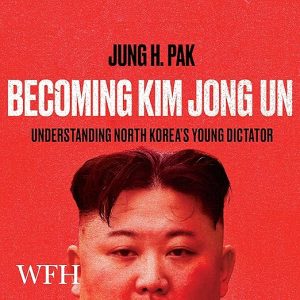
Kim Jong Un is everywhere in the news cycle and almost nowhere in serious analysis. Former CIA analyst Jung H. Pak's audiobook Becoming Kim Jong Un is an attempt to close that gap, and it does so with the kind of disciplined, evidence-grounded approach you would expect from someone who spent years professionally tracking North Korea's leadership. I picked this up after a period of watching geopolitical headlines cycle through North Korea coverage that was heavy on drama and light on structural understanding. Nearly ten hours later, I had a substantially different picture of who Kim Jong Un actually is and how he became the person running one of the world's most dangerous regimes.
Calculating Strategist Behind the Spoiled-Fool Myth
Pak's central insight is that Kim Jong Un is not a spoiled fool who stumbled into power. He is a patient, calculating strategist who understood from a very young age that his survival depended on mastering the political dynamics of the Kim dynasty. The book traces his upbringing with careful attention to what shaped his worldview: the privileges of being a Kim son, the particular instability of being the third and initially overlooked child, his years in Swiss boarding schools that gave him direct exposure to Western democratic norms, and the role his father Kim Jong Il played in tutoring him toward succession. The portrait that emerges is of someone who absorbed his circumstances and converted them into strategic assets.
The analysis of Kim's consolidation of power after his father's 2011 death is where the book is strongest. Pak walks through the series of purges and executions, most notably the killing of his uncle Jang Song Thaek, with a political scientist's clarity about what each move accomplished and what it signaled to the military and party elites watching from the edges of the court. The execution of Jang was not merely brutality; it was a message about the rules of the new leadership era and who would be allowed to exist close to the center of power. Pak reads the signaling clearly and explains it without sensationalizing it.
The book also addresses the question of Kim's personality in a way that most coverage avoids. Rather than simply cataloguing his decisions as evidence of irrationality, Pak applies a rational-actor framework: given his goals, his information environment, and the constraints of the system he inherited, most of Kim's decisions make strategic sense. That reframe does not excuse anything, but it makes the subject legible in a way that pure condemnation does not.
Pak's Measured Narration of a Nuclear Insurance Policy
The self-narration is one of this audiobook's quiet assets. Pak brings a controlled, measured quality to the reading that reflects her analytical background. She does not perform the drama of what she is describing. When she discusses executions, nuclear tests, or the ICBM program, her tone stays level, which actually makes the material feel more serious rather than less. A reviewer noted that the book provides "more nuance" than the defector memoir genre, and that description is apt. Pak is not writing from personal trauma or political advocacy; she is writing from a professional obligation to understand a subject that most people in her field agree is underanalyzed.
The nuclear dimension of the book is handled with particular seriousness. Pak explains why Kim Jong Un views the weapons program not as a bargaining chip but as an existential insurance policy, rooted in his reading of what happened to Saddam Hussein and Muammar Gaddafi when they either did not have or gave up weapons of mass destruction. That framework recontextualizes North Korean nuclear diplomacy in a way that makes the cycle of negotiations and breakdowns considerably more legible than the conventional narrative of miscommunication and miscalculation.
Real Gaps Between What's Known and Inferred
The book's limitations are inherent to the subject. Kim Jong Un is one of the least documented major political figures in the world, and Pak is frank about the gaps in available information. Intelligence assessments, defector accounts, and satellite imagery can only illuminate so much about a man who has spent his entire life inside one of the most controlled information environments ever constructed. Pak navigates this limitation by being precise about what is known versus inferred, but listeners should understand they are reading a sophisticated interpretation of limited data rather than a fully sourced biography.
The book was also published before several significant developments in North Korean diplomacy and weapons testing, which means some of the specific strategic assessments have been updated by events. The core analytical framework remains sound, but readers who want the most current picture of North Korean behavior will need to supplement with more recent reporting.
The book also handles the question of international leverage with care. Pak maps the ways Kim uses the nuclear program not only as domestic legitimacy but as a tool of regional coercion, demonstrating how the threat of miscalculation is itself a deliberate instrument rather than an accident of brinksmanship. That analysis illuminates why the standard diplomatic playbook has failed to produce durable agreements and why the cycle of negotiations and breakdowns follows such a predictable structure from both sides of the table.
Beyond the Headlines, More Analytical Than Intimate
This audiobook is the right listen for anyone who wants to move beyond the headlines and understand why North Korea behaves as it does under this particular leader. It will resonate with readers of international affairs, Cold War history, and political biography. Those looking for a more personal narrative, with the kind of ground-level human detail found in defector memoirs like Nothing to Envy, will find this more structurally analytical and less intimate, which is a feature for some listeners and a limitation for others. The self-narration by Pak is itself a reason to choose the audio version over print.