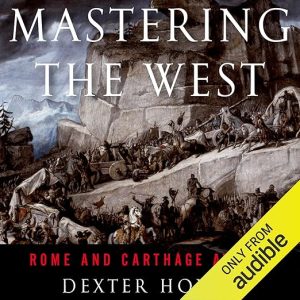
Quick Take
- Narration: Tom McElroy handles the Punic Wars’ complex cast, Roman consuls, Carthaginian generals, Numidian kings, with a clean academic register that keeps the geography navigable.
- Themes: Imperial competition, naval and land strategy, the mechanics of Rome’s rise to Mediterranean dominance
- Mood: Dense but rewarding, the careful pleasure of watching a century of conflict assembled into coherent argument
- Verdict: Hoyos’s account of the Punic Wars is among the best single-volume treatments in audio, giving both Rome and Carthage genuine scholarly evenhandedness.
I have a complicated relationship with ancient military history in audio format. The problem is usually names and geography: a battle narrative that relies on the listener tracking twenty Carthaginian commanders and eight Roman consuls across the same region, all with similarly constructed names, can collapse into an undifferentiated blur if the narrator doesn’t manage the complexity carefully. Tom McElroy does manage it, and Dexter Hoyos’s prose is clear enough that the hundred-year arc of the Punic Wars remains navigable even during the denser tactical sections. I listened to this one in the mornings over about two weeks, which turned out to be the right pacing: enough time between sessions to let the material settle before the next chapter added to it.
Hoyos is a recognized authority on Carthage and Rome, and the book benefits from genuine expertise rather than the kind of general synthesis that characterizes many popular ancient histories. His central argument is worth stating clearly: the Punic Wars were not inevitable, were not obviously going to end the way they did at the point they began, and were not simply a story of Roman virtue overcoming Carthaginian cunning. Both republics were sophisticated political and military organizations with genuine strengths and genuine vulnerabilities. Hoyos takes that evenhandedness seriously, and it produces a history that reads as genuinely analytical rather than retrospectively determined.
What Rome and Carthage Actually Had in Common
One of the book’s most illuminating threads concerns the structural similarities between the two antagonists, an observation that surprises first-time readers of serious Punic Wars history. Reviewer S. H. Wells notes being surprised by how deep the connection ran: both were republics dominated by aristocratic elites, both had significant reliance on Greek cultural frameworks, both organized military and naval power through systems that mixed citizen and allied forces. Hoyos uses these parallels not to flatten the differences but to explain why the wars were so protracted and so destructive. When two sophisticated, broadly similar political entities clash, the outcome is determined less by categorical superiority than by specific contingencies, logistics, alliance management, the decisions of particular commanders at particular moments.
Hannibal, Scipio, and the Limits of Genius
The book’s treatment of the two most famous figures in the conflict is carefully calibrated. Hannibal Barca is given full credit for the tactical brilliance of Trebia, Lake Trasimene, and Cannae, victories that remain among the most studied in military history, while Hoyos traces precisely why that brilliance was insufficient to achieve strategic victory. The logistical constraints, the refusal of Rome to capitulate after catastrophic losses, the failure of Italian allied cities to defect en masse: these structural factors are treated as explanatory rather than as excuses for Hannibal’s eventual defeat. Scipio Africanus receives a similarly analytical treatment, a genuinely innovative commander who understood how to fight in the Hannibalic mode better than most of his Roman predecessors, operating within an institutional framework that could sustain losses Carthage could not.
The Third War and What It Actually Tells Us
Hoyos does not treat the Third Punic War, the destruction of Carthage in 146 BC, as a foregone conclusion or as mere aftermath. He gives serious attention to the political dynamics in Rome that drove the decision for total war, and to the question of what, exactly, Rome was destroying. The city that fell in 146 BC was not the imperial rival that had threatened Italy a century before; it was a disarmed, tribute-paying former power that posed no military threat. The decision to destroy it anyway reveals something important about Roman political psychology of the period, and Hoyos makes that point with appropriate weight. For listeners who know the Punic Wars primarily through the Hannibalic war, this section provides essential context for understanding what the eventual outcome actually says about Rome.
Who Should Listen, Who Should Skip
The strongest choice in audio for listeners who want a scholarly but accessible single-volume treatment of the Punic Wars. Hoyos writes with what the synopsis accurately calls verve, and McElroy’s narration keeps the argumentative thread audible across ten-plus hours. The reviewer who found it overwhelming in its information density is not wrong, this is a serious historical study, not a popular narrative, but listeners who approach it as an analytical argument rather than a story will find the density rewarding rather than oppressive. Skip if you want character-driven narrative history; begin with a more accessible account of the wars if you’re new to the subject, then return to Hoyos for the analytical depth.
Frequently Asked Questions
Does Mastering the West cover all three Punic Wars or focus on the Second?
All three, treated with proportional depth. The First Punic War and the naval competition with Carthage get substantial attention, the Second (Hannibalic) War is the longest section, and the Third War and the destruction of Carthage in 146 BC are covered with serious analytical attention rather than treated as mere aftermath.
How does Hoyos treat Hannibal, as a heroic figure or more critically?
Analytically rather than heroically. Hoyos gives full credit to Hannibal’s tactical brilliance at Cannae and elsewhere while tracing precisely why those tactical victories failed to translate into strategic success. The logistical constraints and Rome’s institutional resilience are treated as explanatory rather than as excuses.
Is prior knowledge of Roman or Carthaginian history required?
Helpful but not essential. Hoyos writes for a general educated audience and provides enough context for readers new to the period. Listeners with no familiarity with the broader Roman Republican era may benefit from a shorter overview first.
What makes this account different from other Punic Wars histories?
Hoyos’s genuine expertise in Carthaginian history makes his treatment of the Carthaginian side unusually rigorous. Most popular accounts are written from a Roman perspective, treating Carthage as a foil. Hoyos gives both republics comparable analytical attention, which produces a more accurate picture of why the wars lasted as long as they did.