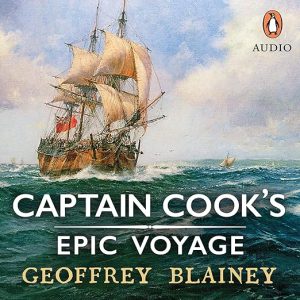
Geoffrey Blainey is one of Australia's most prominent historians, and Captain Cook's Epic Voyage carries both the advantages and the specific challenge of his approach: he writes history with a novelistic eye for scene and a scholar's insistence on precision, which means the audiobook rewards close attention more than it does casual background listening. Prepared for the 250th anniversary of Cook's 1770 arrival on the Australian eastern coast, the book draws from Blainey's earlier work Sea of Dangers while expanding and updating the argument in light of contemporary scholarship and the ongoing reassessment of Cook's legacy in Pacific history.
The Endeavour's Scientific Cover for Imperial Ambition
The departure point for this audiobook is 1768: a small British naval vessel, the Endeavour, setting out on a mission officially described as astronomical observation but carrying the secondary and ultimately more consequential aim of searching for a missing southern continent. That combination of scientific purpose and imperial ambition is the central tension Blainey mines throughout the twelve-plus hours of this account. Cook was a meticulous navigator and a disciplined commander, but he was also an agent of expansion whose voyages set in motion consequences that Pacific peoples and governments are still reckoning with in the 21st century. Blainey does not flatten either of those realities, and that refusal to simplify is part of what makes this audiobook valuable rather than merely celebratory.
Reviewer Amber described the work as thoroughly researched, comprehensively updated, and thoughtful in its articulation of research and hypotheses. That word, hypotheses, is telling. Blainey is not simply retelling a settled story. He is examining the place where myth, science, and exploration intersect, and identifying the places where what we have accepted as settled historical fact is more complicated than the standard account admits. Reviewer John L. Cribb noted several details that were new to them, including the significant death toll during the voyage's extended stop in Jakarta, and the degree to which naturalists Banks and Solander captured credit for discoveries when they returned to England, at some cost to Cook's own recognition.
John Gregg's Narration Carries Cook's Thirteen Hours
John Gregg's narration received explicit praise from reviewer Amber as excellent, and the characterization holds. Blainey's prose is descriptive and carefully observed, and it requires a narrator who can carry both the grandeur of open-sea passages and the detailed precision of historical argument without making either feel forced. Gregg brings enough energy and investment that the thirteen hours never lose their momentum, while resisting the temptation to over-dramatize sequences that the facts alone make sufficiently dramatic. At nearly thirteen hours, this is a substantial listening commitment, but Blainey structures his chapters to give the audiobook natural breathing points that work well for multi-session listening.
The material itself earns the length. The voyage covered an extraordinary range of geography: Pacific island chains, the New Zealand coastline, the eastern shore of Australia, and the treacherous passage through the Great Barrier Reef that nearly ended the expedition permanently. Blainey is as attentive to the practical realities of eighteenth-century navigation as he is to the political and scientific context of the expedition. What did it mean to sail a wooden vessel into waters no European had charted? What were the actual limits of Cook's instruments and maps? How did the crew understand the significance of what they were observing and recording? These questions give the audiobook depth beyond what a pure adventure narrative could achieve.
Missing Details and an Overwhelming Amount of Information
Reviewer John L. Cribb noted that some expected local details, including Magnetic Island, were absent from the account. This is worth flagging honestly: Blainey is not writing a comprehensive location-by-location chronicle of every place visited during the voyage. He is making a sustained argument about the historical significance and contested legacy of the expedition as a whole, which means some specific geographic details receive less attention than a dedicated regional history might give them. Listeners hoping for a port-by-port account of every landing will find the book focused on broader historical argument instead.
The reviewer who gave three stars and described the book as containing an overwhelming amount of information captures a real experience some listeners will have. Blainey writes dense historical argument and does not simplify it for the casual reader. This is not narrative popular history in the tradition of a documentary with a clear dramatic arc and a triumphant conclusion. It is rigorous scholarship made accessible by good prose, and the distinction matters when setting expectations for a thirteen-hour commitment.
Blainey's treatment of the natural science conducted during the voyage is worth mentioning specifically. Joseph Banks and Daniel Solander, the naturalists who traveled aboard the Endeavour, collected an extraordinary volume of botanical and zoological specimens during the voyage, and their work contributed substantially to European scientific knowledge of the Pacific region. Blainey examines the relationship between that scientific mission and the imperial one with the kind of analytical precision that separates this account from more romanticized treatments of the same journey.
Colonial History Buffs Get More Than Adventure
Listeners with an existing interest in Pacific history, Australian colonial history, or the Age of Exploration will find this audiobook genuinely rewarding rather than merely introductory. Those approaching the subject with no prior background will follow the narrative but may want supplementary reading for broader geographic and political context. Australian listeners in particular will find Blainey's reassessment of what Cook's arrival meant and did not mean for subsequent history directly relevant to ongoing national conversations about the colonial period. Listeners looking for a pure adventure story without historical analysis will find the scholarly scaffolding more present than they expected, and should adjust their approach accordingly.
Before You Press Play
- Read by: John Gregg's performance was praised as excellent in listener reviews, with descriptive clarity that matches Blainey's vivid historical prose.
- At its heart: Age of Exploration, myth versus historical evidence, colonial encounter and its contested Pacific legacy
- Vibe: Scholarly but vivid, like a well-researched documentary narrated by someone who genuinely cares about getting it right
- Short version: Listeners with serious interest in Pacific exploration history will find Blainey's willingness to challenge received narratives the most valuable quality in this audiobook.
Good to Know
Does this audiobook address the contested legacy of Cook's voyages in contemporary Pacific contexts?
Yes, though Blainey approaches the legacy question through historical evidence and the examination of received myth rather than explicit political framing. He identifies where the standard account has been simplified or distorted and examines what the evidence actually shows, making the audiobook relevant to contemporary debates without reducing the history to advocacy.
Is Captain Cook's Epic Voyage a good audiobook for someone new to Australian history?
It is accessible but not introductory. Blainey writes clearly and the narration is strong, but the book assumes interest in historical argument rather than basic orientation. Listeners new to Australian colonial history may benefit from a short overview of the period before starting, to have the necessary geographic and political framework in place.
At nearly thirteen hours, how does the audiobook maintain momentum across such a long runtime?
Blainey structures the account chronologically with chapter breaks that provide natural pausing points for multi-session listening. Gregg's narration keeps the pacing steady without becoming flat. The variety of material, covering navigation, natural history, political consequence, and questions of individual leadership, means the audiobook shifts register frequently enough to hold attention across the full length.