Quick Take
- Narration: Peter Noble brings quiet gravitas to Richard Steyn’s biography, his tone matches Botha’s own reputation for dignified pragmatism, and he handles Afrikaans names with evident care.
- Themes: Nation-building through magnanimity, the pragmatics of post-war reconciliation, Boer identity and imperial compromise
- Mood: Measured and deeply respectful, written by a biographer who clearly admires his subject
- Verdict: A well-researched biography of a figure almost unknown outside South Africa, Noble’s narration makes nearly 12 hours feel like exactly the right length.
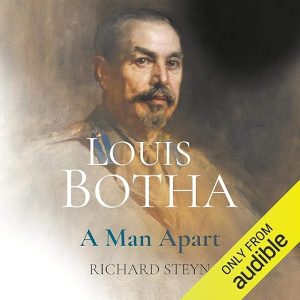
I came to Louis Botha knowing roughly nothing about him beyond a vague awareness that South Africa had post-Anglo-Boer War political figures who were not Jan Smuts. That is not a gap I am proud of, and Richard Steyn’s biography made me feel the cost of it. By the time Peter Noble finished the final chapter, I had spent eleven hours with a statesman who dealt with consequences that still shape southern Africa, and I understood why his absence from English-language popular history is a small but genuine scholarly failure.
Louis Botha died in 1919 at fifty-seven, having been a brilliant young Boer general, a peace negotiator, the architect of South African Union, and a World War I commander who captured German South West Africa. He was present at the Paris Peace Conference and argued unsuccessfully for magnanimity toward a defeated Germany, a position that, in retrospect, was correct in a way that makes his obscurity feel particularly unjust. The subtitle Richard Steyn gives the book is A Man Apart, and the biography earns that judgment through accumulated evidence rather than assertion.
The War That Made Him
The Anglo-Boer War sections are the most gripping in the book. Botha was twenty-seven when the war began and rapidly emerged as one of the most effective Boer commanders, winning significant engagements against British forces in Natal through tactical intelligence and the ability to inspire loyalty across factional lines. Steyn writes about the military campaigns with clarity and without the excessive detail that can make military history a slog for general readers. Noble’s narration carries these sections with appropriate momentum.
What makes Botha distinctive, and what Steyn captures well, is the transition from effective warrior to effective peacemaker. When the weight of British arms became impossible to overcome, Botha became one of the central figures in negotiating the Peace of Vereeniging in 1902, and his reasoning was not surrender but strategy. He understood that the survival of Afrikaner culture and political agency depended on finding accommodation with British governance rather than fighting to mutual exhaustion. That insight defined his entire subsequent career.
Building a Nation Across Its Own Fractures
The post-war period, culminating in South African Union in 1910, is where the biography becomes most substantively interesting to modern readers. Botha’s project was to create political unity between English-speaking South Africans and Afrikaners in the wake of a war that had left profound bitterness on both sides. The book is honest that this reconciliation project had a deeply problematic dimension: it was a reconciliation among white South Africans that explicitly excluded the Black African population from its political settlement. Steyn does not shy away from this, though the biography remains focused on Botha’s own political world rather than on the broader consequences of the racial exclusions he accepted.
Reviewer andyja notes that very little is known about this humble servant of South Africa, and the observation rings true. Botha is not a figure who appears in standard histories of either the First World War or of African decolonization, yet he was present at the founding moments of both those narratives. His role in the capture of German South West Africa in 1915, his relationship with David Lloyd George and Georges Clemenceau at Versailles, and his unsuccessful advocacy for a moderate peace all place him at the center of events whose consequences extended far beyond South Africa.
Peter Noble and the Demands of Political Biography
Peter Noble has narrated enough serious historical and biographical content to understand what this kind of material requires. He does not dramatize Botha or perform his qualities; he allows Steyn’s prose to establish the character and provides a steady, intelligent frame for it. His handling of Afrikaans names and South African place names is confident, which matters in a biography where the terminology is unfamiliar to most English-language listeners. At just under twelve hours, the runtime is exactly right for the scope of the material, long enough to develop genuine texture, short enough to maintain narrative tension.
Who Should Listen and Who Should Skip
Listen if you have any interest in South African history, the Anglo-Boer War, or the political settlement that created the modern South African state. Listen if you want biography that is rigorously researched without being academic in its demands. Skip if you are looking for a history that engages seriously with the experiences of Black South Africans during this period, the book’s focus is on Botha’s world, and that world was almost entirely white. As a portrait of a remarkable and neglected statesman, however, this is exactly what good biography should be.
Frequently Asked Questions
How does this biography handle the racial exclusion of Black South Africans from the Union of 1910?
Steyn acknowledges the exclusion without making it the book’s central focus. The biography is primarily concerned with Botha’s political world, which was the world of Boer-British reconciliation. Readers looking for a history that centers Black South African experience during this period will need additional sources.
Do I need background in South African history to follow this audiobook?
Some baseline familiarity with the Anglo-Boer War is helpful but not required. Steyn provides enough context that a new listener can follow the narrative, though the density of Afrikaner political history in the early sections may require patience from those encountering these events for the first time.
How does Louis Botha compare to Jan Smuts, with whom he is often paired historically?
The book treats Botha and Smuts as a complementary political double act, which they were historically. Botha was the more instinctive politician and the more personally magnetic figure; Smuts was the more intellectually systematic. Readers interested in both should note that Steyn also wrote a biography of Smuts.
Is Peter Noble’s narration a good fit for South African biographical content?
Yes. Noble’s measured, authoritative delivery suits the formal register of political biography, and his handling of Afrikaans terminology and South African place names is notably confident. He avoids the kind of overly dramatic reading that can make serious biography feel sensationalized.