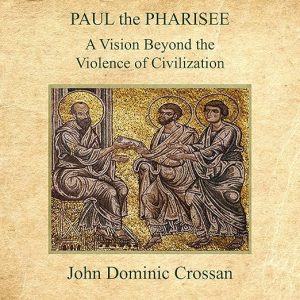
John Dominic Crossan built his reputation over decades of rigorous New Testament scholarship, the kind of work that takes the historical Paul seriously as a figure embedded in specific political, religious, and cultural matrices rather than abstracting him into pure theology. Paul the Pharisee is his most ambitious synthesis: it introduces a fourth matrix, Evolution, alongside the established frameworks of Christian, Jewish, and Roman interpretation, and argues that this addition changes everything we thought we understood about what Pauline resurrection means. This is a demanding audiobook, and it announces that demand in its opening pages. I came to it as someone who has followed Crossan's work from his earlier scholarship on the historical Jesus, and I arrived expecting to be challenged. I was not disappointed.
The Russian nesting dolls metaphor Crossan uses to describe his four matrices is one of the book's most clarifying structural moves: each new framework does not replace the previous ones but contains and reorganizes them. The Christian matrix sits inside the Jewish matrix, the Jewish inside the Roman, and Evolution is the outermost frame within which all three must now be understood. Chad Venters's narration gives this layered argument the clarity it needs to land in audio form, which is no small achievement.
Crossan's central argument is that understanding Paul as a Pharisee, specifically and substantially, not just as a biographical detail, changes how we read his theology. The Pharisaic tradition carries commitments about the relationship between law, community, resurrection, and the physical world that Pauline Christianity has often spiritualized away. Bringing those commitments into contact with evolutionary science produces what Crossan calls the New-New-Paul: not a rejection of tradition but a recovery of what was always implicit within it.
One reviewer described the book as Crossan's best, and that appraisal reflects the ambition of the synthesis rather than just its length. The evolutionary framework allows Crossan to engage Paul's language of resurrection with a seriousness about the actual material world that purely theological approaches cannot sustain. The subtitle, A Vision Beyond the Violence of Civilization, signals where this ultimately leads: toward a Pauline ethics of non-violence that Crossan argues is more consistent with both Paul's Pharisaic background and with what evolutionary science reveals about human behavior than the tradition has acknowledged.
Another reviewer described the book as raising the question of what Pauline resurrection has to do with human evolution, which is exactly the right question. Crossan's answer is intricate and takes the full nine hours of audio to unfold properly.
Venters's Pacing Lets a Dense Argument Breathe
The audiobook format suits the argumentative structure Crossan employs. This is a book built on the accumulation of a sustained argument rather than the presentation of discrete facts, and listening to that argument unfold in sequence, without the temptation to skip ahead or skim, produces something closer to the intellectual experience Crossan is aiming for. Chad Venters's pacing understands this: he does not rush through the dense passages, and he does not over-dramatize the moments of genuine insight. The material speaks for itself when given adequate time.
The evolutionary matrix Crossan introduces is not a capitulation to secular science; it is an engagement with science that takes theological claims seriously rather than defending them from behind a wall. Listeners who have felt the tension between their faith commitments and their understanding of evolutionary biology will find in Crossan a guide who refuses to resolve that tension by pretending it does not exist.
The reception among scholars and engaged lay readers has been consistently strong. The reviewer who expressed gratitude that Crossan lived long enough to write this reconciliation of Paul and Christian theology with evolutionary understanding captures something about the stakes the book claims and delivers on.
Assumes Real Background in Three Different Fields
This is not an introductory text. Crossan assumes listeners who bring some familiarity with New Testament scholarship, the basics of Pharisaic tradition, and the evolutionary biology he is drawing on. Listeners without that background can still engage with the book, but they will need to accept that some of the argument's foundations are being asserted rather than demonstrated from first principles.
The book's synopsis is among the most compressed in Crossan's bibliography for its argumentative scope, which means the audiobook does significant work in making the argument accessible. Some listeners will want a guide or study companion alongside the audio. The reviewer who notes the need to take time to digest and enjoy the analysis is offering practical advice.
The subtitle's reference to violence and civilization signals that the book takes strong positions on contemporary ethics as well as historical theology. Listeners who prefer their religious scholarship to stay at a safe distance from political implication will find Paul the Pharisee more challenging than they might expect.
Seminary Readers Yes, Crossan Newcomers Start Elsewhere
This audiobook is for listeners with a genuine interest in progressive Christian theology, historical New Testament scholarship, or the intersection of evolutionary science and religious thought. Seminary students, academics, clergy, and engaged lay readers who have followed Crossan's work will find this the synthesis his career has been building toward. The reviewer who described it as requiring time to enjoy the analysis is addressing exactly this audience.
Skip it if you are new to Crossan or to scholarly biblical studies, start with The Historical Jesus or Jesus: A Revolutionary Biography to establish the framework before tackling this fourth-matrix argument. And skip it if the prospect of nine hours of dense theological philosophy feels like more commitment than the material warrants for your purposes. For the right listener, it is among the most significant religious audiobooks of recent years.
Key Details
- Performance: Chad Venters delivers the dense theological and philosophical material with steady authority, keeping the argument audible without flattening its complexity.
- What it covers: Evolutionary theology, Paul's Pharisaic identity, violence and civilization
- Feel: Dense and intellectually demanding, with flashes of genuine urgency
- Our call: John Dominic Crossan's audiobook is essential for listeners engaged with progressive theology and the intersection of evolutionary science with Christian thought.