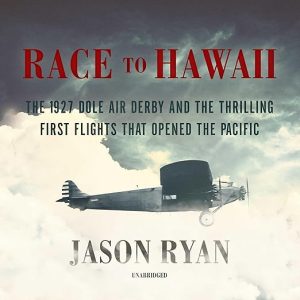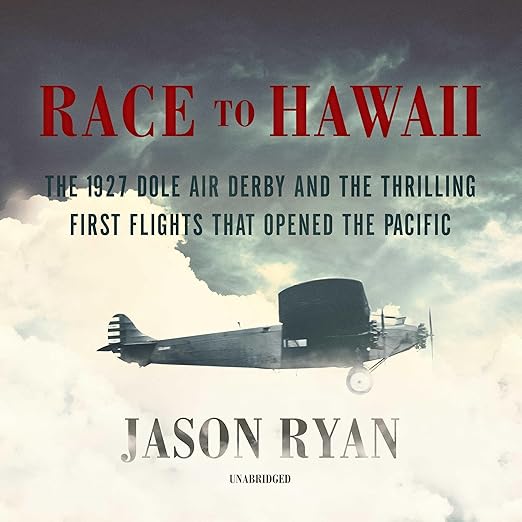
Quick Take
- Narration: Keith Sellon-Wright brings clean, authoritative narration to the aviation sequences. His pacing suits the open-ocean tension of a story where the outcome is uncertain until it is not.
- Themes: Pioneer aviation, ambition and risk, the Golden Age of flight, Pacific geography as existential challenge
- Mood: Tense and exhilarating, with the specific dread that long-distance aviation history generates when you understand what failure actually means
- Verdict: An expertly researched account of the forgotten air races that opened Hawaii to the world. Ryan finds the human drama inside the mechanical statistics and delivers something you want to finish in one sitting.
I came to Race to Hawaii knowing roughly nothing about the 1927 Dole Derby, and by the time I was halfway through the eleven hours I had the strong feeling that this was exactly the kind of history that should be better known. The book covers a period, the late 1920s and the Golden Age of Aviation, when pilots were attempting things that had no reliable precedent and frequently inadequate technology. The gap between ambition and instrument capability was often fatal, and Jason Ryan has found a corner of that era that Charles Lindbergh’s Atlantic crossing has thoroughly overshadowed. He fills it with characters and incident and the specific vertigo of staring at 2,400 miles of open Pacific ocean from a fragile aircraft at altitude.
The structure is clean and well-considered. Ryan traces the escalating attempts to reach Hawaii from California before arriving at the Dole Derby itself. The US Navy flying boat PN-9 No. One comes first, then the Army Air Corps aviators and a civilian pilot who informally raced each other to the islands in the weeks after Lindbergh’s Paris landing. Each earlier attempt builds the reader’s understanding of what the crossing actually demanded in terms of navigational requirements, fuel margins, and cognitive toll, so that when eight aircraft line up for the Derby, you understand exactly how improbable it is that any of them will make it.
The Navigational Problem at the Heart of Everything
Ryan is particularly good at explaining what made Hawaii so different from Lindbergh’s Atlantic target, and why the Pacific crossing received far less celebration despite its comparable difficulty. The Atlantic has a coastline at both ends. Hawaii is a small archipelago in the middle of the world’s largest ocean, approached after a full day and night of flight with primitive navigational equipment. Pilots prayed they would encounter land at all. The book dedicates real space to explaining dead reckoning, the limitations of 1927 instruments, and the cumulative cognitive effects of flying for twenty-six hours without adequate sleep. This technical grounding is what makes the aviation history legible to listeners who are not aviation enthusiasts: you understand why things go wrong because you understand what going right actually requires.
Ryan also develops the historical context of the Dole Derby itself with useful precision. James Dole’s prize was not offered in a vacuum. It emerged from a specific moment in American commercial ambition, and the range of contestants it attracted, from military veterans to Hollywood stunt flyers to a Wall Street bond salesman, reflects the particular quality of 1920s American risk appetite. These were not all professional aviators in the contemporary sense. They were people for whom flying into the Pacific in a fragile aircraft was something they could simply decide to do, and Ryan treats that fact with the mixture of admiration and honest accounting it deserves.
Eight Planes and Zero Guarantees
The Derby itself is where Race to Hawaii becomes genuinely difficult to pause. Ryan’s cast includes a schoolteacher, a barnstormer, World War One veterans, a civilian woman pilot, and men whose relationship to aviation ranged from expert to dangerously optimistic. Not all of them make it. Ryan does not obscure this, and the knowledge of what is coming creates the particular tension that aviation disaster history generates: the awareness that the exhilaration and the catastrophe are the same event, separated only by altitude, time, and the margins of fuel calculation that nobody fully understood.
The rescue operations that follow the failed crossings are handled with the same care as the flights themselves. Ryan does not lose interest in the story once the Derby ends. The aftermath, the searches, the debates about whether the race should have been run at all, adds the layer of retrospective judgment that gives the narrative its full scope.
Keith Sellon-Wright’s Particular Reliability
Sellon-Wright is reliable in a specific and valuable way: he treats technical material with the seriousness it requires and does not try to inject drama through vocal performance when the drama is already in the events. Race to Hawaii benefits from this approach. The navigational passages could become tedious in the hands of a narrator who rushes through them to get to the crashes. Sellon-Wright paces them as part of the argument, which they are. His handling of the multiple-aircraft structure, keeping the different crews distinct as you move between them across eleven hours, is clean and consistent throughout the production.
For Aviation and Pacific History Listeners, Not Social History Seekers
Race to Hawaii is ideal for aviation history listeners who want human drama alongside technical specificity, and for anyone who responds to the Pacific Ocean as a setting that generates genuine narrative stakes. The book works on both levels: as a history of early aviation and as a story about what people do with ambition and inadequate equipment. Skip it if you want social or political history. Ryan is interested in the flights themselves, the pilots, and the technology, not in what the Dole Derby meant for American expansion in the Pacific. That is a narrower scope than some listeners want, but within it the research is thorough and the storytelling is accomplished.
Frequently Asked Questions
Do I need aviation knowledge to follow Race to Hawaii?
No. Ryan explains the technical and navigational challenges of long-distance 1920s flight with enough precision that newcomers to the subject can follow everything. One reviewer specifically noted that the book works for readers ranging from limited knowledge of planes to expert in the field, leveling the audience without condescending to either end.
How does Race to Hawaii connect to Lindbergh’s 1927 Atlantic crossing?
Ryan connects the two explicitly. The informal race to Hawaii in 1927 was partly inspired by Lindbergh’s transatlantic crossing, with Army Air Corps pilots departing for Hawaii within weeks of Lindbergh landing in Paris. The Dole Derby that followed was directly shaped by the aviation fever Lindbergh’s crossing ignited.
Were there fatalities in the events the book covers?
Yes. Several aircraft and pilots were lost in the crossing attempts Ryan covers, and the book does not obscure these outcomes. The danger is part of what gives the history its weight, and Ryan does not pretend otherwise.
Is Keith Sellon-Wright a good narrator for this kind of material?
Yes. Sellon-Wright handles technical aviation prose clearly and paces the narrative with appropriate restraint. He has appeared in other serious historical non-fiction productions and brings the same measured authority here, treating the technical passages as load-bearing rather than as interruptions to the action.