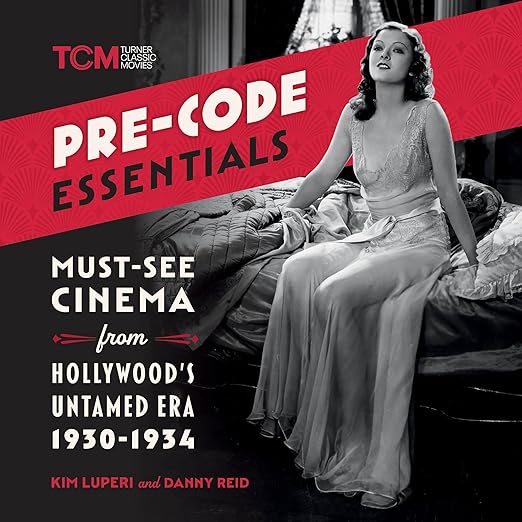
- Voice: Candace Fitzgerald is credited as reader; no listener comment on this listing evaluates the audio, and the format asks mainly for clean handling of dense proper nouns.
- Big ideas: pre-Code Hollywood, film censorship, Depression-era studio economics, rediscovered stars
- Atmosphere: Brisk, gossipy and quietly scholarly
- Worth it?: An excellent watchlist builder and censorship primer, weakened only by the photographs that cannot follow it into audio.
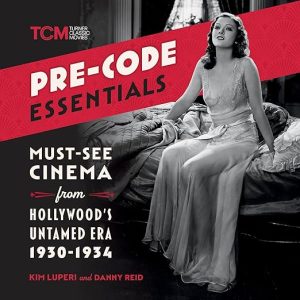
Fifty films in eight hours and seven minutes works out to roughly ten minutes apiece, which tells you a great deal about how this audiobook moves. Kim Luperi and Danny Reid are not building arguments across chapters here. They are running a guided tour through the four years when Hollywood said whatever it wanted, and the tour keeps a brisk pace.
Sidebars for Ann Dvorak, Paul Robeson, Dorothy Arzner
The window in question runs from 1930 to 1934, before the censorship code that governed American moviemaking for decades was strictly enforced. The publisher calls it "a wild and wonderful time in Hollywood history", and the subject list explains why: "sexual freedom, the glorification of outlaws, racial taboos, and class consciousness", all handled with a directness that would be impossible a year later. These films arrived at the depth of the Great Depression, when studios "were desperate to attract audiences", and desperation turned out to be an excellent creative condition.
The selection balances titles you already know against ones you almost certainly do not. Grand Hotel and King Kong sit alongside Safe in Hell, The Sin of Nora Moran, Downstairs and Merrily We Go to Hell. The copy promises that "Famous names like Barbara Stanwyck, Jean Harlow, Clark Gable, and Ernst Lubitsch get their due", which is the expected part. More interesting are the sidebars, which the publisher says "spotlight treasures of the period like Ann Dvorak, Joan Blondell, Paul Robeson, Nina Mae McKinney, Dorothy Arzner, Warren William, and Dolores De Rio." That second roster is the tell. This is a book with opinions about who the era actually belonged to rather than a reprint of the standard canon.
Two credentials sit behind it. The book comes from Turner Classic Movies and from the people behind the pre-Code site the publisher identifies as @precodedotcom, which is to say from programmers and archivists rather than from academics writing at a distance. That shows in the choices. I Am a Fugitive from a Chain Gang and Ann Vickers are singled out as lesser-known gems, and the wider list runs from Frankenstein and Freaks to Trouble in Paradise and Murder at the Vanities, which is a range no single critical thesis could hold together. The organizing principle is simply that these films were made under a particular set of conditions and stopped being makeable in 1934.
Listening to Censors Negotiate With the Studios
Censorship history is the spine of this book, not a footnote to it. Each entry carries what the publisher describes as "detailed production and censorship histories, recommendations, and trivia", and the closing material goes further: "the text of the 1930 Production Code" is included in full, along with Production Code Administration records covering "correspondence between studios and censors". Hearing the actual language studios used to negotiate with their own censors, then hearing what made it to screen anyway, is the part of this that stays with you. It reframes the era from a permissive accident into something closer to a four-year argument that one side eventually lost.
Newcomers seem to leave with homework. One reader's first line is "I now have an extensive list of movies to watch!" and another reports that the era's films "knew how to read a room." A third gives the practical verdict: the book is "Likely to help your understanding of the pre-code era by calling your attention to important movies of the era and some of the controversies related to enforcement of the production code", with the added note that it is "Very well written." Read across those responses and the function of the book becomes clear. It is a watchlist generator with historical scaffolding attached, and the final section on where to actually find these films is the part that turns intent into viewing.
The Omission of One Way Passage Called 'Criminal'
A book this dependent on photographs loses something real in audio, and it would be dishonest to skate past it. The print edition is described as a gorgeous guide, one reader specifically praises a discussion "packed with excellent photos" that "really lures you to watch films", and the listing itself files this under photography. None of that survives a spoken-word edition. What you get instead is the text, which is substantial, but the visual argument about how these films looked and what the studios were selling has to be reconstructed in your head from description alone.
Then comes the expertise problem. A three-star reader who clearly knows the period calls this "A thrilling list of films for newbies, pretty standard/played out for serious pre code heads", adds that "The omission of One Way Passage in 2025 is borderline criminal", and concludes it "could have used a deeper dive." That is a fair reading of the format. Ten minutes per film buys you context, a production anecdote and a recommendation, not a close analysis. Two smaller notes: the fifty entries are self-contained, so the audio has no cumulative build and works better sampled than binged, and the sheer volume of proper nouns means a title you want to note down will go past before you can pause.
One more structural quirk deserves a mention. Because the fifty entries are ordered to trace the era's evolution, the sequence carries an argument the individual entries do not. The window opens with a Production Code that exists on paper without strict enforcement and closes at the point where that enforcement arrives, so what changes across the fifty films is not the filmmaking but the pressure around it. Listening straight through is the only way to feel that arc, which sits slightly against my own advice to sample. Pick whichever you prefer, but know that the chronology is carrying an argument.
Works Well as Commuting or Chore Listening
Film obsessives who keep a running watchlist are the obvious audience, and they will finish this with twenty additions to it. So will anyone who has watched a handful of these films on late-night television without understanding why they felt so much stranger than everything else from the 1930s. The censorship material makes this a genuinely good primer for people interested in how American media has policed itself, and it works as commuting or chore listening precisely because each entry stands alone.
Approach with caution if you already own three books about this period, because the deeper-dive complaint above is coming from exactly your position. Approach with caution too if the appeal of the original was visual, since the images are the one thing that cannot make the transfer. And if you want a single sustained argument about why the Production Code happened and what it did to American film, this is not structured to give you one. It is fifty short essays that add up to an atmosphere, which is a different and perfectly respectable thing to want.
Questions Listeners Ask
Does the audiobook lose much without the photographs?
Yes, and it is the main trade-off. The print edition is built as an illustrated guide, and one reader singles out the photos as what makes each discussion work. The audio keeps every word of the text and the full censorship documentation, but the visual case for these films has to be rebuilt from description alone.
How much time does each of the fifty films actually get?
Divide eight hours and seven minutes by fifty and you land near ten minutes per film. That buys production background, a censorship anecdote and a recommendation. It does not buy scene-by-scene analysis, which is the complaint a three-star reader raises from a specialist position.
Can I follow this audiobook without having seen the films?
Comfortably. Every entry sets up its film before discussing it, and the running assumption is that you are deciding what to watch next rather than revisiting old favorites. The closing section on where these titles can currently be found is aimed squarely at listeners starting from zero.