Quick Take
- Voice: Chip Colwell self-narrates with an insider's authority and genuine emotional engagement, never slipping into either academic distance or performative guilt.
- Big ideas: Museum ethics and repatriation, Native American sovereignty, the meaning of cultural ownership
- Atmosphere: Morally serious and compellingly personal
- Worth it?: An essential audiobook on one of contemporary museum culture's most contested questions, told by someone who lived it from the inside.
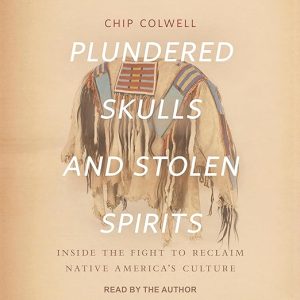
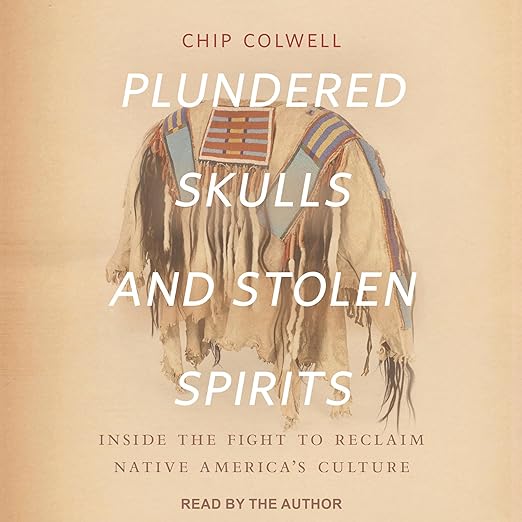
A Denver museum storage room holds the scalp of a massacre victim. The scene is real, documented, and morally unresolvable by institutional logic alone. Chip Colwell's audiobook Plundered Skulls and Stolen Spirits opens this territory not as abstraction but as lived professional experience: as senior curator of anthropology at the Denver Museum of Nature and Science, Colwell spent years navigating the Native American Graves Protection and Repatriation Act, better known as NAGPRA, and what he found was a process that was simultaneously legally mandated, ethically complex, emotionally charged, and inadequate to the depth of what it was trying to address.
The book follows four objects through their creation, collection, and return. The first is a sculpture that is, to its community, not an artifact but a living god. The second is the scalp of a massacre victim, held in a collection case. The third is a ceremonial blanket. The fourth is a skeleton from a tribe that Western anthropology had classified, with characteristic confidence, as extinct. Each of these objects carries its own legal, ethical, and spiritual dimensions, and Colwell uses each one to explore a different facet of the repatriation debate without pretending that any single case resolves the broader question.
What makes this book unusual in the museum ethics literature is Colwell's position. He is not writing as an advocate for either side of the NAGPRA debate; he is writing as the person who had to make the decisions, case by case, object by object, tribal consultation by tribal consultation. One reviewer who identifies as an archaeologist notes that the book offers a "glimpse into the archaeological history of the Native Americans and an insight into how they view science and the study of their people," while also documenting "the pitfalls and th..." of the process, the quotation cut off but the meaning clear. Another calls it "helpful perspective from an archeologist on a complex subject." These are precisely the right descriptions. Colwell is in the tradition of academic writing that earns its authority through proximity rather than distance.
The specific tension the book navigates throughout is between the academic freedom of scientists who argue that skeletal remains are sources of knowledge about human prehistory, and the religious freedom of Native communities who argue that their ancestors' remains are not data. Colwell does not pretend this tension is resolvable by a formula. He argues instead that it requires ongoing negotiation, moral imagination, and a willingness to hold the competing claims seriously rather than collapsing one into the other. That is a less satisfying conclusion than a clear answer, but it is an honest one.
Colwell Avoids Both Institutional Defense and Performative Guilt
Colwell self-narrating is the right choice for this material. His voice carries the quality of someone who has given many talks about these cases to both museum professionals and Native community members, which means he knows where the language can slip into either defensive institutional justification or performative guilt, and he avoids both. The nine hours and twenty-seven minutes of the audiobook cover enough ground to genuinely develop each of the four object narratives, and the structure moves fluidly between the legal history of NAGPRA, the specific case studies, and the broader philosophical questions about ownership, identity, and what museums are for.
The audiobook is particularly effective in the passages that put Colwell in direct dialogue with tribal representatives. These conversations, where he is trying to understand what return actually means to a community, what the blanket or the skeleton represents spiritually and politically, are the book's emotional center. Colwell renders these exchanges with enough specificity to feel real rather than illustrative, which is a difficult balance to strike when writing about communities that are not your own.
A Tribe the Law Once Declared Extinct
The book is structured around the four objects, which means the legal and philosophical argument is developed through narrative rather than systematic exposition. Listeners who want a comprehensive overview of NAGPRA's legal history will find this less structured than an academic legal analysis. Listeners who want to understand what the law actually means in practice, for specific people making specific decisions about specific objects, will find Colwell's approach far more illuminating than a legal overview would be.
The skeleton from the allegedly extinct tribe raises the most philosophically complex questions in the book, including the legal and moral status of objects belonging to communities that have been declared not to exist, and Colwell handles this section with particular care. The answer to whether a tribe classified as extinct can claim repatriation rights depends on questions of identity, continuity, and legal recognition that the law has not fully resolved, and Colwell is honest about the limits of what NAGPRA can accomplish in these edge cases.
One of the Most Important Books in This Space
This audiobook is essential for anyone working in museums, anthropology, archaeology, or any field that involves the custodianship of objects from other cultures. It is also genuinely accessible and important for general readers interested in Indigenous rights, cultural heritage law, and the ethics of collection and preservation. The four case-study structure gives the abstract questions specific human stakes, which prevents the book from becoming the kind of policy analysis that only specialists read.
Listeners who want a polemic or a clear advocacy position will find Colwell's measured, case-by-case approach less satisfying than they hoped. He is making a more demanding argument: that these questions require sustained moral attention rather than settled principles. For listeners who can hold that kind of complexity, Plundered Skulls and Stolen Spirits is one of the more important books in this space to have appeared in recent decades.
Does Chip Colwell narrate his own audiobook?
Yes. Colwell self-narrates, and his authority on the material, as the senior curator of anthropology who lived through the repatriation cases he describes, gives the narration a credibility that a professional voice actor could not replicate. His tone is measured and engaged without either institutional defensiveness or performative guilt.
Is this audiobook appropriate for listeners with no background in museum law or anthropology?
Yes. Colwell structures the book around four human narratives, each following a specific object from its creation through collection to repatriation, which makes the legal and philosophical complexity accessible to general readers. Prior knowledge of NAGPRA or museum studies enhances the experience but is not required to follow or be moved by the arguments.