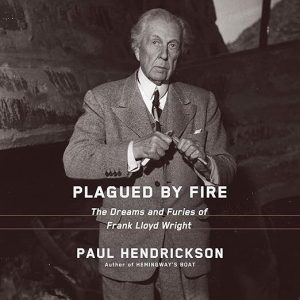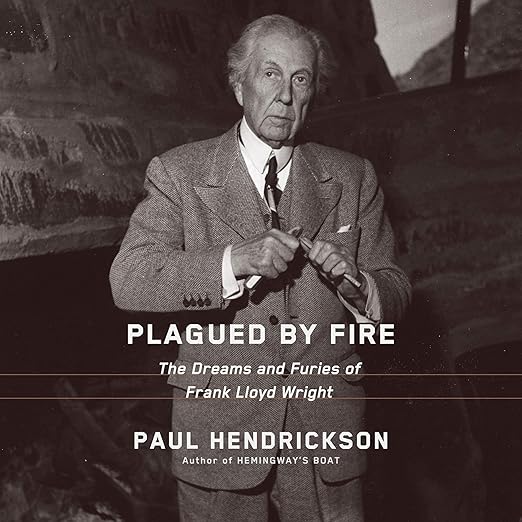
Frank Lloyd Wright ranks among the most written-about figures in American architectural history, and Paul Hendrickson's Plagued by Fire, narrated by Arthur Morey in this nearly twenty-five-hour audiobook, argues that most of what has been written about Wright has been written around his most important stories rather than through them. Hendrickson is the author of Hemingway's Boat, a biography that distinguished itself by attending to the peripheral and the overlooked, and he brings the same method to Wright: the relationship with Cecil Corwin that may have been romantic, the lie Wright told about his father across his entire public life, the fires that recur in Wright's biography with an eerie regularity that Hendrickson refuses to treat as coincidence.
The Taliesin Fire Reveals Wright Completely
Hendrickson's central contribution to the Wright literature is the fire at Taliesin in 1914, in which Wright's mistress Mamah Borthwick Cheney, her two children, and four other people were murdered by a servant who then set the house ablaze. Most Wright biographies treat this as an episode, a traumatic interruption in a long career. Hendrickson treats it as the event that reveals Wright most completely, and the biography's structure reflects that conviction. Everything is organized around what this catastrophe shows about Wright and about the consequences of his choices. The connection Hendrickson draws between the 1921 Black Wall Street massacre in Tulsa and the events at Taliesin is one of the biography's most unexpected threads, and he handles it with the precision that a claim of that weight requires.
Morey's narration across nearly twenty-five hours is the kind of sustained professional effort that biography of this density demands. Hendrickson writes in long, accumulative paragraphs that build associations rather than simply reporting facts, and Morey's delivery keeps the associative logic audible rather than letting it collapse into undifferentiated prose. The sections covering Wright's early years in Wisconsin and his relationship with his father, about whom Hendrickson demonstrates that Wright constructed a largely fictional public account, are the biography's most emotionally demanding, and Morey handles them without overclaiming on the emotional register.
Morey Makes the Returns Feel Deliberate
The biography's method, which multiple reviewers have compared to a kind of prodigious research-based impressionism, is better suited to audio than to print reading in short sessions. Hendrickson's arguments accumulate through return and variation, revisiting the same figures and incidents from different angles as new information arrives. Morey's consistent narration across the full run makes those returns feel like deliberate structural choices rather than repetition, which is essential to the audiobook's success. A listener who has absorbed the first six hours of Wright's early biography will find the later sections of Hendrickson's argument about fires and fathers and facades connecting with an authority that shorter engagement cannot produce.
Two reviewers described the book as the defining Wright biography, a significant claim given the existing literature. Hendrickson's specific contribution is the willingness to hold the human failures alongside the architectural achievements without resolving the tension between them. Wright's genius was real. The consequences of his choices were also real, to people who had not chosen to be in their path. The audiobook gives both sufficient room to exist without one canceling the other.
Hendrickson Circles His Subject, Doesn't Advance
At nearly twenty-five hours, Plagued by Fire is a substantial commitment, and Hendrickson's associative, literary style is not universally rewarding. Listeners who want a linear biography organized by dates and projects, the conventional architectural biography structure, will find this approach demanding. Hendrickson circles his subject rather than advancing directly toward it, and the pleasure of that method depends on a listener's tolerance for digression in service of depth. The architectural analysis in the book is present but subordinate to the biographical argument; engineers and architects looking for detailed treatment of Wright's structural innovations will find this biography addresses that material only occasionally.
The book also requires attention to the difference between what the historical record establishes and what Hendrickson infers. He is careful about signaling which is which, using language like may have been and the record suggests with discipline, but the associative method can sometimes make inferential claims feel more established than they are. Listeners accustomed to strictly documentary biography will want to hold that distinction in mind through the more speculative sections.
Two Wrights in the Listener's Mind at Once
Readers who want to understand Frank Lloyd Wright as a human being rather than as an architectural icon will find this the most searching portrait available in audio. Listeners who responded to Hendrickson's Hemingway's Boat will find the method familiar and the biographical subject equally compelling. Those interested in the specific catastrophes of Wright's personal life, the fires, the father, the Taliesin murders, will find Hendrickson's treatment the most detailed available. Skip it if you want a linear architectural biography or a comprehensive technical account of Wright's buildings; Plagued by Fire is a study of a psyche, not a catalog of a practice. For listeners willing to spend twenty-five hours with Hendrickson's patient accumulation of evidence, the audiobook offers a portrait of Wright that no shorter treatment can match.
Morey's narration handles something that is technically difficult in literary biography: the distinction between the author's voice and the voices of the historical figures Hendrickson is reconstructing. Wright himself was a prodigious self-inventor, the public statements he made about his father, his early life, and his relationships were not always in correspondence with the documentary record, and Hendrickson's method involves holding the self-created version alongside the archival version simultaneously. Morey keeps that dual awareness audible across the long run of the audiobook, which is the narration's most important contribution to the listening experience. By the final chapters, the listener has two Wrights in mind at once: the one he built and the one Hendrickson excavated.
At a Glance
- Read by: Arthur Morey brings Paul Hendrickson's discursive, poetically structured biography of Frank Lloyd Wright the sustained attention its nearly twenty-five hours demand.
- At its heart: Wright's lifelong flight from his father's legacy, fire as biographical metaphor and literal catastrophe, the relationship between artistic genius and personal destruction.
- Vibe: Dense, poetic, and persistently unsettling.
- Short version: Hendrickson's biography reframes Wright as a man haunted rather than triumphant, and the audiobook gives that argument space to accumulate its full force.