In Brief
- Read by: Pimsleur's cast of native Swahili speakers provides authentic phonetic modeling the method requires, and the call-and-response structure makes passive listening impossible in the best sense.
- At its heart: conversational Swahili production, spaced repetition, oral language acquisition
- Vibe: Focused and energizing, requiring active participation but rewarding it immediately
- Short version: This Swahili audiobook block covers lessons 6 through 10 with the methodological consistency that makes Pimsleur reliable for learners who want to speak rather than just recognize.
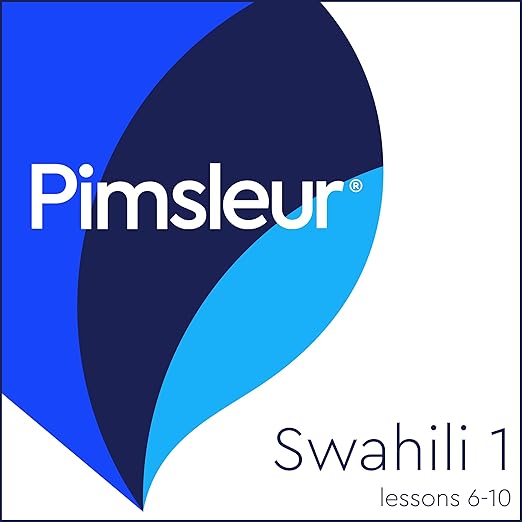
Pimsleur Swahili Level 1 Lessons 6-10 picks up where the first installment left off, and by lesson six a learner who has been using this method has already internalized the basic call-and-response rhythm that defines the Pimsleur approach. Two and a half hours of audio instruction covering five thirty-minute lessons sounds modest until you understand that every minute of that runtime demands active participation rather than passive absorption. This audiobook cannot be consumed the way a podcast can. It requires your voice, your memory, and your willingness to be wrong out loud before hearing the correction. That is a deliberate design feature, not a limitation, and it is what separates Pimsleur from vocabulary apps that build recognition without ever training production.
Swahili is a Bantu language spoken by more than 200 million people across East and Central Africa, functioning as a major regional lingua franca across Tanzania, Kenya, Uganda, and beyond. For English-speaking learners, it also happens to have a fairly regular phonological system and a verb conjugation logic that responds well to the kind of pattern repetition Pimsleur builds in systematically. These lessons expand on the foundational vocabulary and structures established in lessons 1 through 5, adding new material while continuously recycling earlier content through the spaced repetition scaffolding that the Pimsleur method relies on for long-term retention.
The method Pimsleur uses is neither new nor secret: brief conversational exchanges with native-speaking voices, prompts requiring the learner to produce the target language rather than recognize it, and systematic recall of previously learned material at intervals calculated to hit just before memory would otherwise fade. What makes the Swahili program specifically valuable is the quality of the native speaker cast. Swahili phonology is not trivially easy for English speakers; the vowel sounds and some consonant clusters require careful modeling, and hearing native speakers produce them naturally at conversational speed trains the ear in ways that a textbook pronunciation guide simply cannot replicate.
These particular lessons cover the range of material that transitions learners from survival-level phrases toward basic conversational competence. By the end of lesson 10, a consistent and disciplined user will have internalized enough structures to navigate introductions, simple requests, time and place references, and basic conversational exchange. That is not fluency, and Pimsleur makes no pretense of delivering fluency from a single level of five lessons. What it promises is genuine spoken competence within a carefully defined scope, and it delivers on that promise when learners engage actively and consistently with each session.
Output Beats Input for Real Conversation Skills
The argument for Pimsleur over app-based language learning comes down to output versus input. Most language learning applications train you to recognize correct answers when you see or hear them: they are building receptive vocabulary and reading comprehension. Pimsleur trains you to produce language spontaneously under mild time pressure, which is what actual conversation with another person requires. For learners who want to travel to East Africa, work with Swahili-speaking colleagues, reconnect with family heritage, or simply communicate rather than only decode, that production focus is the central value the method offers.
The thirty-minute lesson format is intentional and research-supported. Evidence on cognitive load and language retention consistently suggests that distributed shorter sessions outperform massed longer ones, which is why the method specifies one lesson per day as the recommended pace rather than marathon sessions. The portability of the audiobook format means those thirty minutes can happen during a commute, a walk, or any hands-free period in the day. The requirement that you speak aloud does make it unsuitable for genuinely public spaces, but that constraint is simply the price of a method that actually teaches speaking.
Patterns Come First, Grammar Rules Come Later
Learners who arrive expecting a comprehensive grammar reference or explicit rule explanations will be disappointed. Pimsleur does not explain grammatical rules explicitly; it demonstrates patterns through repetition and lets inductive learning do the structural work. For many learners that approach is exactly right, and the feeling of producing correct Swahili before fully understanding why it is correct is one of the method's signature experiences. For learners who need to understand the logic before they can use it comfortably, a supplementary grammar resource alongside the Pimsleur program fills that gap effectively. The two approaches are genuinely complementary.
The sequential dependency of these lessons is also important to understand. This is not a standalone block that can be dropped into a Swahili study program at any point. Learners who attempt to start with lessons 6 through 10 without having completed lessons 1 through 5 will find themselves unable to respond to the prompts, because the method builds each lesson's vocabulary directly on what was established in prior sessions. The listening order matters fundamentally, and the publisher structures the catalog accordingly.
Non-Negotiable Speaking Fills All Two and a Half Hours
This audiobook block is the right next step for anyone who has completed Pimsleur Swahili Level 1 Lessons 1-5 and found the method compatible with how they learn. It is also well suited to travelers preparing for East Africa, humanitarian workers, journalists, researchers, or anyone whose practical need for spoken Swahili is genuine and near-term. It is not suitable for learners starting from zero, those who have not completed the prior lessons, or anyone seeking a grammar-explanation-first approach to language study. The commitment to speaking aloud during every session is a non-negotiable requirement: learners who skip that step and listen passively will see dramatically reduced retention and should not expect the method's promised results.
Before You Listen
Can I start this audiobook without having completed Pimsleur Swahili Lessons 1-5?
No. Lessons 6-10 build directly on vocabulary and structures established in the prior block. Starting here without that foundation means you will be unable to respond correctly to the prompts from the first session, which undermines the entire method. Begin with Lessons 1-5 and work through them in sequence.
How is this Pimsleur audiobook different from a Swahili language learning app?
The core difference is production versus recognition. Apps typically train you to select correct answers, building receptive vocabulary. Pimsleur's call-and-response format requires you to produce Swahili spontaneously under mild time pressure, which trains the speaking and retrieval circuits actual conversation uses. They address fundamentally different skills.
What specific Swahili topics and structures does the Lessons 6-10 audiobook cover?
The lessons build on the foundational phrases from lessons 1-5, adding vocabulary for basic requests, time and location references, and conversational exchanges. By the end of lesson 10, a consistent learner should be able to handle simple introductions, make requests, discuss basic plans, and navigate straightforward interactions with Swahili speakers.