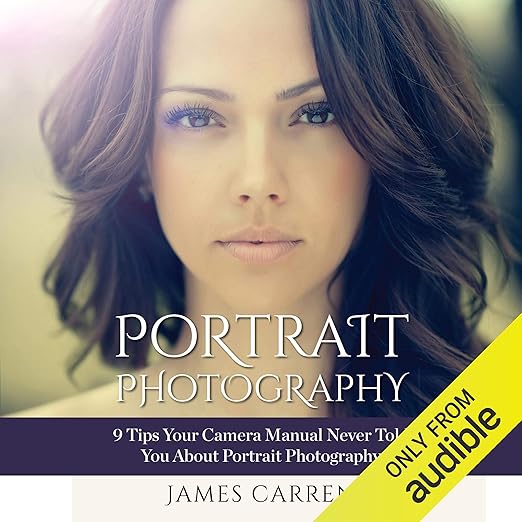
Fifty-seven minutes is the entire runtime here, and the description promises thirteen separate lessons inside it, running from types of portraiture through lighting, posing and retouching to making a good print of your final image. Under five minutes a topic, then. That arithmetic is the honest place to start with this audiobook, because it decides what the thing can possibly be, and it lines up with the one detailed critical response on the page, which reports that most subjects get two or three paragraphs before James Carren moves along to the next one.
Chapter Two Confuses Repertoire With Rapport
BC filed the only one-star grade on this listing and did buyers a genuine service by being specific about why. The book runs to thirty-five pages rather than the forty-four advertised. It contains, in that reviewer's words, not even "one photograph, chart or diagram", only text. And chapter two carries the title Establishing a Repertoire with Your Subject, where rapport was plainly the word wanted, a slip that notice catches and no editor did. None of those observations is an opinion. All three are checkable, and all three describe what you are actually buying.
Everything else on the page runs the other way and runs shorter. Carl says that anyone who has not done much portrait work ought to read this one. Two further five-star notices consist, in full, of the words Good and Perfect. Sixteen ratings have settled at an average of 3.8. So the evidence base is two substantial responses, one brief endorsement and two single words, which is thin, and it is also unusually split: the same short book is a useful primer or a padded pamphlet depending entirely on who filed the notice.
My own reading lands between the two camps. What James Carren has written is a structured briefing rather than a course. It names the decisions a beginner has to make, roughly in the order a beginner meets them, and it never quite pretends that naming them is teaching them. Judged as a first orientation to a craft, it does its job in the time it takes to make coffee and drink it. Judged against the description's promise to "walk you through each of these procedures step by step", it does not.
Edmondson Marks Transitions a Page Would Show
Instructional audio normally arrives with an apology attached, since the diagrams, the sample frames and the worked examples all stay behind on the page. That objection collapses here, and the one-star notice is what collapses it. A photography manual containing nothing whatsoever to look at is a strange object in print and an unexpectedly sensible one in audio: the recording is not a reduced version of some richer edition, because no richer edition exists. What you hear is the complete book, sentence for sentence.
What the recording actually buys you is a map of the decisions, laid out in sequence. Trust with the model comes before camera settings. Light comes before mood. The pose comes before the retouch, and the print comes last. That ordering is the most useful thing on offer, and it happens to be the part a beginner cannot pick up from a settings chart or a lens forum. Amy, who admits to owning no exceptional camera and to not taking portraits, still came away with a sense of how to use one "to the best of its ability".
John Edmondson carries the reading, and the material hands him an odd assignment. A chapter of two or three paragraphs is obvious on a page, where the white space announces it, and invisible in audio unless somebody marks it by voice. Across a briefing this short, roughly a dozen of those transitions arrive in sequence, and a listener has no headings to glance at. If you sample before buying, play a stretch where one topic ends and another begins, because that seam is where a compressed book either keeps its shape or turns into one undifferentiated run of advice.
Thirty-Five Pages Delivered, Forty-Four Promised
Start with the page count, because somebody already checked it. Thirty-five pages against forty-four advertised means roughly a fifth of the promised book is missing, and at this scale a fifth is a lot. That one-star notice also quotes the level of the advice: a line about making sure everybody is ready before you photograph a group of two to four people. Guidance pitched at that height is not wrong. It simply carries no information, and a listener who came for camera technique will notice the altitude quickly.
That repertoire slip deserves one more sentence, because a recording cannot quietly repair it. A misspelling vanishes the instant a sentence is spoken aloud. A wrong word survives intact: repertoire read out is still repertoire, and a newcomer who has never met the term rapport will simply learn the wrong one and carry it into a studio. Small in isolation, less small in a book explicitly aimed at people with no prior vocabulary, which is exactly who cannot catch the error themselves.
Dates and counts deserve a glance too. The earliest of these notices was filed a little over two weeks before the listed release date of July 2015, so at least one verdict here belongs to the text rather than to this recording. Sixteen ratings is small enough that a single low grade moves the average visibly, though whether that one-star notice sits among the sixteen, nothing on the listing tells you. Read 3.8 as an unfinished conversation, not as a settled position.
A Briefing for Near-Beginners, Per Carl's Review
Buy it if you own a camera you have not yet learned and you want the shape of portraiture before committing to a real course, or if somebody has asked you to photograph a family group next month and you have never done it. Amy's position is the fair one for that listener: no substitute for practice, but a way to walk in already knowing which decisions are yours to make and roughly what order they arrive in.
Look elsewhere if you already photograph people for money, if you want technique that has to be demonstrated rather than described, or if you expected the fresh lesson for every skill level that the description advertises. Carl's framing is the accurate scope for this one, a briefing for the near-beginner, honestly short and with nothing visual to lose along the way. Set expectations at that height and the fifty-seven minutes pay for themselves.
Questions Listeners Ask
How long is the Photography: Portrait Photography audiobook and how much does it cover?
It runs fifty-seven minutes, published by Sender Publishing in July 2015, and the description lists thirteen topics inside that span, closing on the business of getting a finished image onto paper. Divide one by the other and you get a few minutes per subject, which sets a realistic expectation before you start.
Does the audiobook lose the images a photography book normally depends on?
Nothing visual is lost, because by the only detailed account on the listing the print edition contains no photograph, chart or diagram at all. What you give up instead is retrieval: a setting or a posing tip heard once cannot be flipped back to, so keep a notes app within reach if you want to hold on to anything.