Before You Press Play
- Voice: John Edmondson is credited as reader on a visual subject, with no companion images, slides or reference sheet named anywhere on the listing.
- Big ideas: camera jargon decoded, beginner DSLR workflow, sharing and displaying pictures, photography treated as an art
- Atmosphere: Brisk, tidy and introductory
- Worth it?: An hour of vocabulary for a first-time camera owner, not the expert course the title advertises.
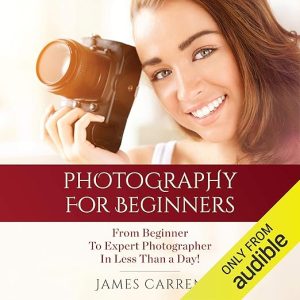
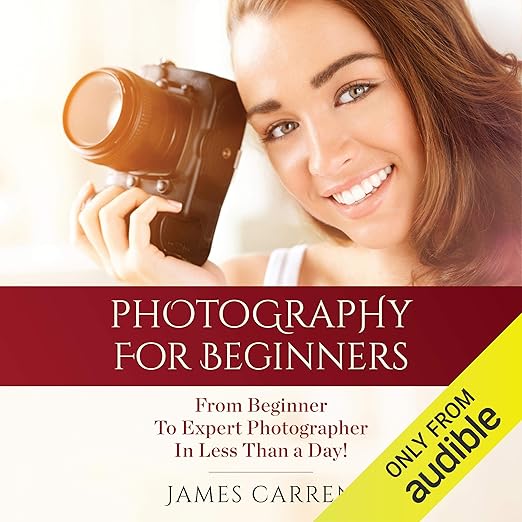
A camera manual outperformed this book, according to the harshest of the five written responses on its page, and that comparison lands differently on an audiobook than it would on a paperback. James Carren promises to carry a beginner all the way to expert inside a single day, and the recording John Edmondson reads runs one hour and three minutes. Both claims can hold at once, in the narrow sense that an hour is less than a day. The question worth asking before you spend the hour is what a beginner actually walks away holding.
Two Sentences, Two Different Beginners
Sixty-three minutes buys an orientation rather than a course, and the description is fairly honest about the shape of it: a sequence of steps toward taking a good photo, then ideas about how to share and display the results. The framing is generous toward the person who has opened a camera manual once and closed it again. Jargon and acronyms turn up everywhere in photography books, the copy argues, and definitions turn up nowhere. Fixing that is a genuinely useful job, and it is a job that needs no pictures.
What the copy never resolves is who it is addressing. One sentence says the book is written for a beginner, as the title suggests. The very next says it assumes the listener has some knowledge, maybe even just basic knowledge. Those two sentences sit side by side in the same paragraph, and the distance between them is the distance between somebody who unboxed a camera yesterday and somebody who already knows which dial changes what. No recording of this size can serve both ends of that range.
Both one-star responses land squarely in that gap. The first says the book did not really cover the basics or supply enough information to go out and shoot something new. The second, filed from the United Kingdom, argues the same material sits free online and that a camera's own manual taught more. Whatever level was intended, two paying readers arrived expecting groundwork and left without it. Against that, a four-star notice reduces the experience to a phrase that sounds like relief: well organized, informative and easy to comprehend. Both reactions are consistent with a short, tidy, shallow book.
A Film Veteran Just Needs New Vocabulary
Set the expert claim aside and a real use case survives underneath it. Somebody who has just been handed a digital camera needs vocabulary before technique, and vocabulary is what short audio delivers well. Carren's stated grievance is that camera books scatter their information and leave their acronyms undefined, so time spent defining terms in sequence is a service rather than a shortcut. You cannot practice while listening, but you can arrive at the manual already knowing what half of it means.
Sharing and displaying photographs occupies the second half of the description, and that is the part I would pay for. Carren gives real space to the idea that elements in any scene can be altered for aesthetic purposes, which is a different argument from the technical one most beginner guides make. Photography is an art, the copy insists, and art has few boundaries. That is a posture rather than a lesson, but it is the posture a nervous beginner needs before rules start piling up.
One response points to a listener the book fits exactly. Its writer is moving across from years of 35mm work and expects the material to sharpen the quality of their pictures. An experienced film photographer needs the digital vocabulary rather than the compositional groundwork, which is precisely the half this recording is equipped to give. For that person the length matches the problem rather than insulting it.
A Notice Twelve Days Older Than the Recording
That second one-star notice makes a request the format cannot meet. It asks for useful examples of standard everyday compositions and scenarios to try yourself, and on that point the audio edition is the wrong container entirely. Nothing in the listing names a companion document, a slide deck or a set of reference images. What you get is a description of a good photograph instead of a good photograph, and on a visual craft that is not a small deduction.
The numbers deserve a look before you commit. Thirteen ratings produce the 3.7 shown on the page, while the five notices you can actually read average 3.2 between them, two of them at a single star. That is a small and badly split base rather than the settled consensus the headline implies. The earliest of the five is dated twelve days before the recording's own release date, which means the warmest notice on the page is describing a text and not this file.
Then the title. It says Photography twice, once as a heading and once at the start of the subtitle, and closes on a promise of expert status inside a day. Stacking of that kind tells you how the product was packaged rather than how it was written, and packaging is not a crime. It does, however, set an expectation the running time was never going to meet, and Carren's own copy is noticeably more modest than the words above it.
Nobody Becomes an Expert by Tomorrow Here
Listen if you have just acquired a digital camera, want the language demystified before you open the manual, and can treat an introduction as an introduction. The section on sharing and displaying pictures is the part least damaged by the absence of images, since deciding where a photograph ends up is a decision you can talk through rather than see. The pitch about photography as an art, rather than as a set of settings, is the other thing worth having early.
Skip it if you want exercises. The material is offered as a sequence of steps and a set of ideas, not a set of assignments, and nothing in the listing suggests otherwise. Skip it, equally, if you already shoot regularly, because the pitch is aimed at somebody who has not yet taken a picture they are proud of. Skip it, finally, if the title is what drew you, because that promise is the least reliable sentence attached to this product.
If what you want is a short, calm session that turns a camera's vocabulary into something you can carry in your head, this does that job, and the running time is honest about its scope even when the cover is not. If you want to be an expert by tomorrow, the file cannot help you, and neither can any other.