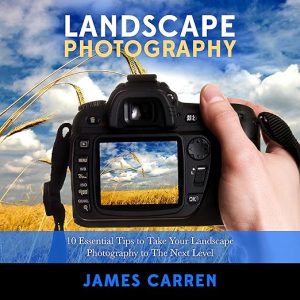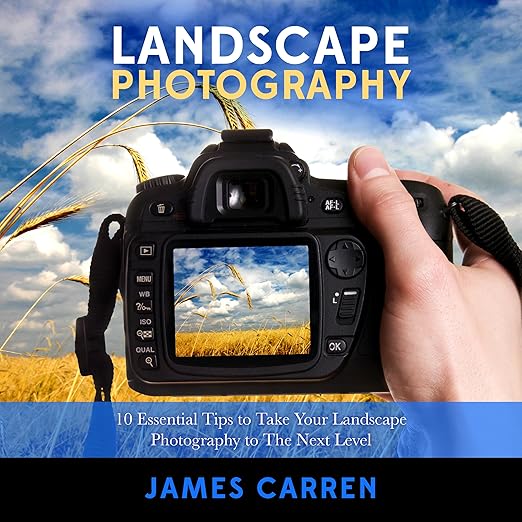
Sixty minutes of instruction about how to see. That is the shape of this audiobook, and the tension inside it is obvious before you press play: the subject is entirely visual and the format contains no pictures at all. The publisher's own description says the book concentrates on the art of seeing, and on how landscapes get built out of "the elements and principles of design." Every word of that has to reach you through a voice, with nothing to point at.
A Five-Star Review From Someone Without a Camera
The listing title is broader than the book. The description supplies the real one, "Landscape Photography - 10 Essential Tips to Take Your Landscape Photography to The Next Level," and ten tips is an honest account of the scope. Ground covered includes a brief history of the form and its movements, the best time of day to shoot, aperture, shutter speed and ISO, panoramas, composition and color theory, the role of light, the kit you need, and a run of Photoshop tricks at the end.
Reception splits hard along experience level, and two of the reviewers say so themselves. A three-star notice calls the information primarily suitable for beginners and complains of "Little meat and information for anyone with any experience." A two-star response reaches the same verdict in a single line, allowing that it is very basic and "maybe ok for total beginners." Neither is angry about it. Both are simply people who already knew this material and said so plainly.
Most revealing of all is a five-star response, and it is revealing because of who wrote it. That reader opens by saying they have always wanted to take up photography, adding that "my checkbook hasn't allowed for it" and that in the meantime they enjoy reading about the different types of photography. They do not own the camera. They loved the book regardless. That is genuinely useful information about what this recording delivers, because it works as an armchair introduction at least as well as it works as instruction for somebody standing in a field at dawn.
Edmondson Narrates a Problem No Reading Solves
John Edmondson is named as narrator, and the material hands him a problem no reading can solve. Composition, color theory, the principles of design, the difference between a flat sky and a live one: all of these are normally taught by putting two images side by side and pointing at them. A recording has to manage it in language alone, describing a frame the listener assembles out of nothing. Some of the book survives that translation intact. The passages about light, timing and habit do. The passages about looking at a photograph do not.
Half the book was always verbal, and that half comes through undamaged. Which hour of the day to shoot in, why landscape is harder than it looks, the single mistake the description says every beginner makes, a daily routine for building the habit: none of that needs an image. It needs an argument, and an argument reads perfectly well aloud. The length is also right for the content, long enough to lay out ten ideas properly and short enough that nobody has to pad them.
A genuine audience exists for photographic theory without a camera in hand, and the most enthusiastic reviewer on this page is proof of it. Heard on a walk, somebody explaining why a landscape photograph holds together changes how you look at the actual landscape in front of you, which is arguably the entire point of a book about the art of seeing. Whether that counts as instruction or as pleasure depends on what you came for, and the reviews suggest people came for both.
Written Reviews Score Lower Than the Average
Twenty-one people scored this at 3.6, while the five who wrote something landed noticeably lower, closer to 3.2 between them: two fives, a three, a two and a one. That inversion is worth pausing over. If those five sit inside the larger group, the readers who never wrote a word must average around 3.7, above the headline rather than below it. The written page you can actually read is therefore the harsher of the two verdicts on offer, which is the reverse of the usual arrangement.
Illustrations are the sharpest complaint here, and it arrives in a one-star notice reading, in full, "Poorly written, basic lack illustrations" and nothing more. Hold that against a subject made entirely of images. If a printed guide to landscape photography has too few pictures for one reader, an audio edition has none for everybody, and the description's promise of Photoshop tricks widens the gap further, since editing instructions describe a screen the listener cannot see.
Scope is the other thing to be straight about. This is a ten-tip beginner guide sold under a title broad enough to suggest a course. Two reviewers landed on that gap independently, and one of them mentions finishing the entire text in under two hours of reading, which tells you the recording is not a condensed version of something larger. What you hear is what exists. Anybody with a season of shooting behind them will find nothing new in it, and three of the five say so without malice.
A Phone Camera Is Audience Enough for This
Newcomers to a camera are the audience, and four of the five reviewers point that way, including the ones who disliked it. The three-star, two-star and one-star responses all describe the material as basic; the two five-star responses come from people at the very beginning. If you have never thought about why one landscape photograph holds and another does not, these are the right ten ideas to start with and the format asks very little of you.
Armchair enthusiasts make a second and slightly unexpected audience, on the evidence of the most detailed positive review on the page. Somebody who enjoys thinking about pictures without owning equipment gets real value from a spoken pass through composition, light and the history of the form. The same goes for anyone with a phone camera and no intention of buying anything else, since most of what the book teaches about seeing applies regardless of what you are shooting with.
Real technical instruction is not what this delivers, so anyone past the beginner stage should look for a course with images instead, and three separate reviewers effectively say as much. The editing material in particular needs a screen, and describing a Photoshop adjustment aloud is close to useless. Taken as time spent thinking about landscapes rather than time spent learning to photograph them, it is to my mind a considerably stronger book.
Common Questions
Does this audiobook work without any pictures?
Partly. The conceptual half survives intact: light, timing, why landscapes are difficult, the single beginner mistake, a daily habit routine. The visual half does not, and one reviewer complained about a shortage of illustrations even in the version they read. The Photoshop material in particular describes a screen you cannot see.
Does it cover aperture, shutter speed and ISO properly?
It covers them, but only at introductory depth. The description lists settings alongside composition, color theory and panoramas inside a ten-tip structure, and three separate reviewers describe it as elementary. Anyone already shooting in manual will find nothing new here. Anyone who is not will get a workable first explanation.
Why is this audiobook rated 3.6 when most written reviews score it lower?
The five visible responses average closer to 3.2 between them, below the 3.6 headline drawn from twenty-one ratings. If those five sit inside the larger group, the readers who never wrote anything must have scored it around 3.7. The people who bothered to explain themselves were, on balance, the less satisfied ones.
Is this a full course or a short guide?
A short guide. The description gives the real subtitle, ten essential tips, and one three-star reviewer reports finishing the entire text in under two hours of reading. The listing title is considerably broader than the contents, so calibrate toward a compact beginner primer rather than a comprehensive treatment of landscape work.