Quick Take
- Narrator: Joe Barrett is the credited reader, asked to mark the boundaries between unconnected essays and to carry a famously blunt first-person persona rather than neutral prose.
- Subjects: Art criticism as personal writing, high and low culture on equal terms, disappointment in a mentor, the pleasure of contrarian judgment
- Tone: Companionable, pugnacious and digressive
- Bottom line: Uneven by design and worth it for the sensibility, provided you enjoy the critic more than any single verdict.
Dave Hickey's publisher does something unusual in the copy for this audiobook: it concedes the book is imperfect. The closing line of the description says outright that Perfect Wave is not a perfect book, then argues it is a damn good one anyway. Publishers do not normally hand a buyer that sentence, and it turns out to be the single most accurate piece of information on the page.
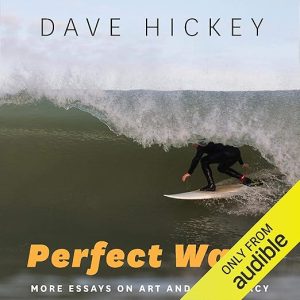
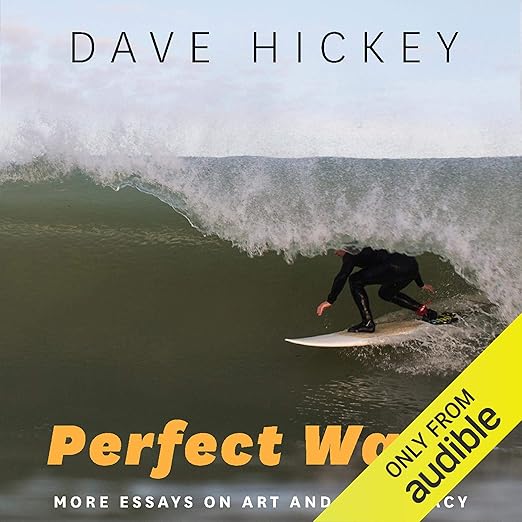
The collection gathers essays written across a long career by a critic the copy calls one of America's foremost critical iconoclasts, a no-nonsense voice on the frequently nonsensical business of art and culture. It is bookended by two previously unpublished personal pieces, one of which supplies the title: at twelve Hickey rode the wave every surfer wants, overshot the pier, and hit the rocks at Sunset Cliffs in Ocean Beach hard enough to come close to dying.
Between those bookends the range is deliberately wild. Disneyland and Las Vegas, London and Venice. The case for Karen Carpenter and Waylon Jennings. An argument that Robert Mitchum matters more than Jimmy Stewart. Antonioni and the uses of stillness. A wincing account of disappointment in the later career of Susan Sontag, an early hero. A rehabilitation of Norman Rockwell on the grounds of what he understood about common feeling. No unifying thesis holds these together and none is claimed; the connective tissue is a sensibility.
A Three-Star Review Calls It Self-Indulgence
Honesty extends to the description itself, in a line worth quoting because it doubles as advice on how to listen: "the doing is as important as what's done", and the pleasure "lies nearly as much in spending time in his company as in being surprised to find yourself agreeing with his conclusions". Take that seriously. If the prospect of seven and three-quarter hours in the company of an opinionated critic sounds like a chore rather than a pleasure, no individual essay is going to rescue it.
The sharpest thing in the small review pool is a direct collision with the marketing. The publisher advertises the genius of Karen Carpenter as a selling point. The only detailed reviewer here, a three-star response, singles out that same chapter as "total self-indulgence" and dismisses it in two words as a matter of nobody caring. The same reviewer finds other chapters engrossing enough to want further reading on the subject, and ends by asking for a Hickey biography. That is the collection in miniature: what delights one listener is precisely what exasperates the next, essay by essay.
Barrett's Voice Does the Page Break's Job
Essay collections suit this format better than almost anything else, because the unit of attention is already the right size. Each piece runs its argument and stops, which means you can take one on a lunch break and lose nothing by putting the rest aside for a week. Nobody has to hold a plot. Nothing accumulates that you can fail to remember. For a book with no through-line, that is a structural advantage rather than a compromise.
Boundary work is what this collection asks of whoever reads it. With no narrative to signal a transition, the only marker between an essay about a Nevada casino and an essay about an Italian filmmaker is what happens in the gap, so the pacing and the shape of the endings have to do the work a page break does in print. Joe Barrett is credited with the whole recording. Hickey's page voice is also a constructed one, cherished for its bluntness, which means a hired reader is being asked to carry a persona rather than simply deliver prose.
Personal material at either end is the other reason to hear this rather than read it. Criticism written in the first person by someone who nearly died at twelve doing the thing he loved carries a different charge when spoken aloud, and the surfing essay is the piece the whole collection is named for. A five-star reviewer who got there before the audio edition even appeared reported loving the book from its very first sentence.
A 4.8 Average Resting on Three Reviews
Three written reviews is not much to go on, and the composition of those three matters more than the 4.8 average across twenty-eight ratings suggests. One consists of the single word Good. One was posted six days before the audio edition existed and recommends the book in print. Only the three-star response engages with the contents in any detail, and it is the least enthusiastic of the set. Anyone treating that score as a consensus is treating one considered opinion as a crowd.
Expectations are the second hazard, and the same reviewer names it: this is "No where near the joy of" Air Guitar, the earlier Hickey book many readers arrive from. The verdict is still affectionate, granting that "Dave is always insightful and a fun and informing read", but a listener coming in from that book should calibrate. A career-spanning gathering assembled late will always be more uneven than a collection written to a single purpose, which is exactly what the publisher admits in its own last sentence.
Visual art poses one problem this format cannot solve. Hickey writes about paintings, films and buildings, and you will be listening to descriptions of things you cannot see. The Rockwell and Antonioni essays in particular assume images you either know or do not. No supporting images are offered anywhere in the copy, so keep a search engine within reach if you want to follow the specific works under discussion.
Assumes You Have Already Turned Up
People who read criticism as a genre in its own right are the constituency here, the ones who want a first-person voice with strong opinions and no interest in balance. It suits listeners with catholic tastes, since a single sitting can move from a country singer to an Italian director, and it suits anyone who enjoys being argued out of a settled position. Readers who already know Hickey and want the personal writing will find the two unpublished essays are the reason this exists.
Skip it if you want a coherent argument about art rather than a gathering of occasions, or an introduction to art history, because the essays assume you have already turned up. Skip it too if you would rather not spend the better part of eight hours with a single sensibility, however good the company. And read the publisher's own warning literally. Some of these essays will not be for you, and the collection was assembled knowing that.