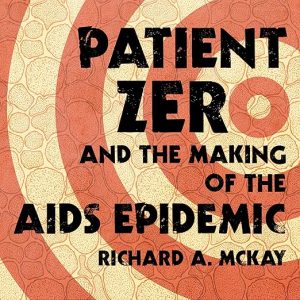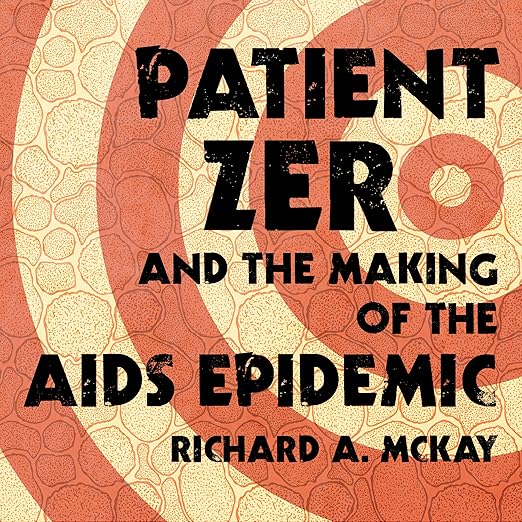
Quick Take
- Narration: Paul Woodson delivers McKay’s scholarly prose with clarity and restraint, the measured academic register suits a book that deliberately resists sensationalism, though the pace can feel slow in the densely footnoted sections.
- Themes: historical myth-making, blame allocation during disease crises, media responsibility and the social construction of epidemic narratives
- Mood: Measured, revisionist, and quietly urgent, the kind of history that quietly dismantles what you thought you knew
- Verdict: A meticulously researched corrective to one of epidemic history’s most damaging myths, best suited to readers willing to engage with its deliberately academic pace.
I started listening to this one on a Tuesday morning, during a week when I had been rereading coverage of the early COVID years. The parallels were impossible to ignore: the rush to identify a villain, the way a single figure could absorb collective fear, the institutional pressures that shaped what counted as knowledge. By the time Paul Woodson’s voice settled into Richard A. McKay’s careful first chapter, I realized I was listening to a book that wasn’t really about Gaetan Dugas at all. It was about us.
McKay is a historian at Cambridge, and this shows. Patient Zero is not a biography of Dugas and not a conventional chronicle of the AIDS epidemic. It is an intellectual history of a myth, specifically, how the concept of a “patient zero” was inadvertently coined by CDC epidemiologists during cluster studies, then dramatically amplified by journalist Randy Shilts in And the Band Played On, and how that amplification reshaped public understanding of the epidemic for decades. The book’s scope is genuinely unusual: it draws on archival research, interviews, and an astonishing range of primary sources to trace how a labeling error metastasized into a cultural certainty.
The Machinery of Blame
The central argument McKay makes is not simply that Dugas was wrongly accused. It’s more unsettling than that. He shows how the patient zero narrative served specific social and political functions in the early 1980s, offering a seemingly coherent explanation for a crisis that was terrifying precisely because it had no clear origin story. The CDC investigators who coined the term “Patient O” (for “outside California”) never intended it to mean what it came to mean. The transformation from administrative code to cultural scapegoat is what McKay documents with forensic care.
One reviewer describes the book as “a painstaking analysis of all that went into the construction of the notion of a patient zero in the early years of the AIDS crisis, historically, culturally and in the life of its major author.” That phrase “major author” is doing real work here, because McKay is not only analyzing Gaetan Dugas and the CDC researchers, he is also analyzing Randy Shilts, whose And the Band Played On became the defining popular narrative of the epidemic’s early years. McKay treats Shilts with a complexity that avoids both hagiography and condemnation, tracing the pressures, journalistic, political, personal, that led to the amplification of a story that was, at minimum, far more ambiguous than the book presented it.
What Woodson’s Voice Brings to Dense Material
Paul Woodson is a narrator who excels at making academic prose feel navigable without softening its intellectual demands. This is exactly the right instinct for Patient Zero, which is genuinely scholarly, its footnotes are dense, its citations thorough, and McKay writes with the precision of someone who knows his claims will be scrutinized. Woodson doesn’t try to inject drama where McKay hasn’t placed it. He reads the measured sentences with appropriate gravity, letting the argument accumulate its own momentum. Some listeners will find this slow. One reviewer notes that it is “primarily about the social history of patient zero and not about the biology or medicine of the epidemic” and calls it “probably not the first book about the epidemic you should read.” That caveat is worth taking seriously. If you come to this book expecting a narrative arc or a medical account, you may feel stranded in the third chapter. But if you come to it as a study in how historical narratives are constructed and what damage they can do, Woodson’s steady pace becomes appropriate, even necessary.
Why This Book Matters Now
The subtitle promises “insights for our interconnected age,” and McKay earns that claim. The mechanisms he describes, an administrative abbreviation repurposed into a moral category, a journalist shaping public debate through a dramatically compelling narrative frame, individuals and institutions adopting the patient zero concept to advance their own agendas, these are not historical artifacts. They describe something that happens with every new health crisis, including the ones we have lived through in recent years. Reading Patient Zero after COVID is a different experience than reading it in 2017 when it was published. The patterns McKay documents feel less like history and more like a recurring structure.
One reviewer calls it “myth-smashing revisionist history at its best.” I would slightly qualify that: it is myth-dissection rather than myth-smashing. McKay is more interested in understanding how the myth operated than in the satisfaction of tearing it down. The book’s ending is not triumphant. It is cautious, careful, and honest about the limits of what revisionist history can repair once a narrative has taken hold. That restraint is part of what makes it so credible.
Who This Is For and Who It Is Not
Listen to this if you are drawn to the history of medicine as intellectual and social history, if you have read And the Band Played On and want a rigorous reckoning with its legacy, or if you are interested in how epidemics generate narratives and what those narratives cost. Listen also if you have personal or professional investment in LGBTQ history and want to understand how Gaetan Dugas was used, misused, and finally partially rehabilitated in the historical record.
Skip it if you want a medical history of the AIDS epidemic, a biographical portrait of Dugas, or a narrative-driven account of the crisis years. This is a book for people who want to think carefully about how history is made and unmade, not for those looking for a story that builds toward resolution. The academic tone is genuine and sustained; Woodson navigates it well, but he cannot transform it into something it is not designed to be.
Frequently Asked Questions
Does this book rehabilitate Gaetan Dugas completely, or is McKay’s argument more nuanced than that?
McKay’s argument is considerably more nuanced. He does not claim Dugas was blameless in every respect, the historical record is too complicated for that. What he demonstrates is that the specific ‘patient zero’ designation was the product of misinterpreted data, amplified by journalism, and that the moral weight it carried was disproportionate to any evidence. His interest is in the myth-making process as much as in Dugas himself.
How does this book relate to Randy Shilts’ And the Band Played On? Do I need to have read that first?
You don’t need to have read it first, but the book makes considerably more sense if you have some familiarity with Shilts’ work. McKay devotes substantial attention to how And the Band Played On constructed its patient zero narrative, so knowing the source material enriches McKay’s analysis. If you haven’t read Shilts, the synopsis McKay provides is sufficient to follow the argument.
Is this primarily a medical history of the AIDS epidemic or a social and cultural history?
Firmly social and cultural. One reviewer notes this explicitly: the book is about the history of an idea and a label, not the biology or medicine of HIV transmission. Readers looking for clinical detail or a comprehensive epidemiological account should look elsewhere, Randy Shilts’ book, or Jonathan Engel’s The Epidemic, would serve that need better.
At just under 13 hours, does the length feel appropriate for the material, or does the book overextend its argument?
Most readers find the length proportionate to McKay’s scholarly ambitions. The book draws on extensive archival research and traces the patient zero concept across multiple contexts and time periods, which requires space. The academic pace means some sections feel denser than others, particularly in the middle chapters. Listeners who engage with the argument actively rather than passively will find the duration earned.