Key Details
- Read by: Tim H. Dixon has no prior track record on file, but his measured, unhurried pace handles a genuinely crowded cast of nineteenth-century names without ever rushing the material.
- At its heart: Urban transformation and authoritarian power, Impressionism and artistic rebellion, wealth and poverty in a boomtown city
- Vibe: Dense, absorbing, quietly indignant beneath the elegance
- Short version: A rewarding but demanding listen for anyone who wants Haussmann's Paris explained with real political teeth, not just postcard nostalgia.
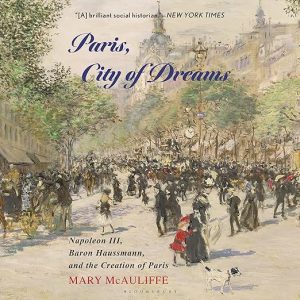
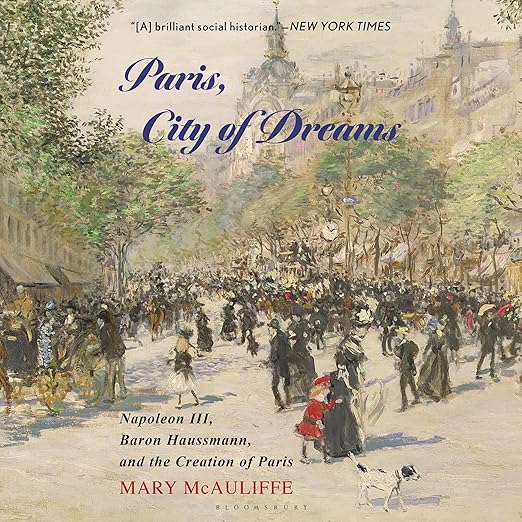
Would Victor Hugo recognize today's Paris, the city built by the emperor he spent nearly two decades attacking from exile? That question sits at the center of Mary McAuliffe's audiobook Paris, City of Dreams, narrated by Tim H. Dixon across twelve and a half hours. McAuliffe traces how Napoleon III and his prefect Georges Haussmann rebuilt the city into the grid of wide boulevards and uniform limestone facades most visitors now assume has always existed, financed by an economic boom and enforced by a regime that tolerated remarkably little dissent. What makes the material land as more than urban planning history is McAuliffe's decision to run the political story alongside the artistic one, Manet, Monet, and Berthe Morisot painting a city that kept shifting under their easels, while Zola and Flaubert wrote against the grain of official taste.
More than one reviewer mentions wanting to track down the rest of McAuliffe's Paris books after finishing this one, which tracks with what the audiobook actually delivers: a historian who trusts listeners to hold multiple timelines of change at once without flattening any of them into footnotes. A Booklist starred review credited her with a “readable yet detailed” history, and that balance carries the entire twelve-and-a-half-hour runtime, since dense nineteenth-century political and cultural material could easily become a slog in less capable hands.
Financial Engineering Shares the Chapter With Art
The book's real achievement is refusing to treat the physical rebuilding of Paris as separate from the intellectual ferment happening inside it. McAuliffe spends real time on the financial engineering, the new forms of banking and money lending, that made Haussmann's demolition crews possible in the first place, and she is honest about the cost: enormous new wealth sitting next to extreme poverty, a boomtown economy built partly on authoritarian control of dissent. Against that backdrop, she follows Manet, Morisot, and Monet as their work strained against institutional taste, and gives real space to Baudelaire and to Hugo's long-distance broadsides from exile against an emperor he never stopped detesting.
Wide Boulevards Doubled as Crowd Control
Dixon's narration serves this dual structure well. I have no prior track record on file for him, but on this title specifically his pacing stays measured and unhurried through what is genuinely a crowded cast of historical names, never rushing past a Zola or a Flaubert to get back to the Haussmann plotline. That patience matters because McAuliffe's real argument arrives late: that the ease of new transportation, the popularization of photography, and the emergence of Impressionism and Naturalism were all downstream of the same physical and economic transformation, artistic yearnings that would fully flower only in the Belle Epoque after Napoleon III's own reign had already collapsed in a war against Germany.
The architectural signature Haussmann left behind, uniform building heights running the length of each new boulevard, wide straight avenues cut through what had been a tangle of medieval streets, and a modernized sewer system running beneath it all, gets real attention here because McAuliffe treats it as a political choice rather than a neutral civic improvement. Wide, straight boulevards were also easier to defend against the kind of barricade uprisings that had repeatedly threatened earlier French governments, and McAuliffe does not let listeners forget that beauty and crowd control were designed into the same streets at the same time. That double reading, gorgeous city and surveillance instrument, is what keeps the book from ever feeling like a real estate brochure for nineteenth-century Paris, even at its most visually admiring.
Dixon Keeps French Names Consistent for Hours
For a book this thick with French proper nouns, hearing a narrator handle the names is a real advantage over silently sounding out Haussmann, Manet, and Baudelaire on the page. Dixon keeps consistent pronunciation across artists, writers, and streets alike, which matters over a twelve-hour runtime where the same handful of names recur across decades of narrative. The audio format also suits the book's real strength, which is momentum: McAuliffe moves confidently between a construction budget, a Salon rejection, and a Hugo pamphlet within the same chapter, and hearing that woven together in one continuous voice sells the connections better than flipping between sections in print.
One reviewer admitted he had never actually been to Paris and still found that the book “did fill a lacuna in at least my understanding of history,” which is really the target audience the Booklist blurb is naming when it points to armchair historians specifically. You do not need firsthand familiarity with the city's geography to follow McAuliffe's argument, though listeners who have walked the boulevards Haussmann carved will likely recognize the streets she describes being built in real time, tenement by demolished tenement.
Not a Nostalgic Love Letter to Paris
This is not a light survey. Twelve and a half hours is a real time commitment, and McAuliffe writes for a listener already curious about the mechanics of nineteenth-century urban and political history rather than one who wants only gossip about famous painters. The book's chronological center of gravity is the Second Empire itself, and while it gestures forward toward the Belle Epoque in its closing pages, that later era is a coda here, not the main event, so anyone expecting extensive coverage of the 1890s and early 1900s should adjust expectations accordingly.
Worth flagging too: despite the wistful title, this is not a nostalgic love letter to Belle Epoque Paris. McAuliffe keeps the authoritarian machinery of the Second Empire in view throughout, the censorship, the crushed opposition, the poverty sitting alongside the new wealth, so listeners expecting a purely romantic portrait of Impressionist Paris will instead get a clear-eyed accounting of what the boulevards cost the people who did not get to enjoy them.
This Rewards Patience More Than Curiosity
Francophiles and readers of narrative political history are the obvious audience, but so is anyone who has ever wondered why Paris looks the way it does, wide, uniform, deliberately sightlined for both beauty and crowd control. Fans of Impressionist painting will get real value from hearing the movement's origins narrated as a direct response to the city convulsing around Manet and Monet rather than as an isolated art-history footnote, and listeners who enjoyed McAuliffe's evident affection for her subject, cited by two separate reviewers as a reason to seek out her other Paris books, will find that same voice sustained here across the full runtime.
Casual history browsers should know this is a marathon, not a highlight reel: at over twelve hours, with a genuinely large cast of statesmen, painters, and writers to track, it rewards patience more than curiosity alone. Listeners hoping for a tight single-subject biography, of just Haussmann, say, or just Napoleon III, will find the canvas here is deliberately wider than that, encompassing banking reform and Impressionism and a running exile campaign from Victor Hugo all at once. If that breadth sounds like a feature rather than a bug, the audiobook delivers it with real narrative confidence.
Does the Paris, City of Dreams audiobook cover the Belle Epoque in detail?
Not really. The narrative centers on Napoleon III's Second Empire and Haussmann's rebuilding of Paris, with the Belle Epoque appearing mainly as a closing gesture toward where the story is heading rather than a fully developed section of its own.
Do I need to have visited Paris to follow this audiobook?
No. One reviewer specifically noted he had never been to Paris and still found the book filled real gaps in his understanding of the city's history, though listeners who know the boulevards Haussmann built will likely recognize specific streets as they come up.
How does the audiobook handle all the French names and places?
Tim H. Dixon keeps pronunciation consistent across the dozens of artists, writers, and streets McAuliffe cites, which matters over a twelve-and-a-half-hour runtime where names like Manet, Morisot, and Baudelaire recur across different decades of the narrative.