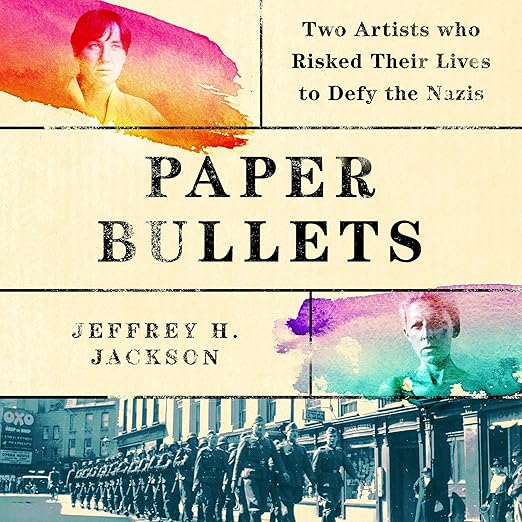
Jeffrey H. Jackson's Paper Bullets opens with a premise so specific and so strange that the audiobook earns your attention before the first chapter is done. Two avant-garde Parisian artists, a lesbian couple known for gender-bending work that would later be classified by the Nazis as degenerate art, retreating to the British Channel Island of Jersey and deciding to wage a one-person psychological war against the occupying German forces through handwritten slips of paper. They tucked their notes into soldiers' pockets, slid them inside newsstand magazines, and constructed what amounted to a private PSYOPS campaign with no training, no organization, and no safety net. Susan Bennett narrates with a precision that the material demands.
Jackson has done extraordinary archival work, and the result is dense with specific names, dates, and recovered documents. Bennett moves through it without letting the density tip into recitation, which is a real narration challenge with heavily researched history. The craft achievement here is making scholarship feel like pursuit rather than inventory.
The subjects of this history, Claude Cahun and Marcel Moore, were known primarily as Surrealist artists before Jackson's research began recovering their wartime resistance work. Their story is unusual in almost every dimension: lesbian partners on a British-occupied island under German military occupation, running a psychological operations campaign by writing notes designed to demoralize soldiers. They had communist affiliations, Jewish ancestry on Cahun's side, and a public artistic practice involving cross-dressing and gender identity challenges that made their survival under the Nazis genuinely improbable. Nine of their classmates died in service; Cahun and Moore were sentenced to death in a court martial in 1944 and survived by an accident of timing when liberation came before the sentence could be carried out.
The reviewer Carol B notes she had read volumes on WWII and the Holocaust before this book and encountered nothing like it. That assessment holds. The Channel Islands' occupation is already underrepresented in English-language WWII history, and the specific story of Cahun and Moore within that context is essentially unknown outside specialist art history circles. Jackson does the work of making it accessible without sacrificing the complexity of what these two women were actually doing.
Bennett Carries the Propulsive Quality of the Writing
The audiobook format suits this material because Jackson is fundamentally a narrative historian. He is not producing a biographical encyclopedia; he is reconstructing a story with clear stakes and a driving question about what happens when two people with no military training and limited resources decide to take on an occupying army using only wit, artistic skill, and extraordinary nerve. Bennett's narration carries the propulsive quality of Jackson's writing, and the pacing through the research-heavy sections is careful enough that the background on Surrealism, on the Channel Islands' political situation, and on the broader occupation context lands as essential rather than digressive.
The Stonewall Honor in Nonfiction and the Carnegie Medal longlist reflect something real about how the book operates. The queerness of Cahun and Moore is not incidental to their story. Their identity as lesbian partners, their history of gender-bending artistic work, and the specific way the Nazi system would have classified them made their choice to resist both more dangerous and more pointed. Jackson integrates all of this without reducing the book to a single framework, which is the central craft achievement. Karen S notes that the book is a story of love and deep devotion alongside a study in resistance strategy, and that duality is what makes it memorable rather than merely informative.
Mind-Boggling Research That Demands Active Listening
The audiobook is dense with historical context, and listeners without much background in the Channel Islands occupation or in early twentieth-century European avant-garde art will want to pay close attention to the first few chapters. Jackson does the necessary introduction work, but it covers a lot of ground relatively quickly. The detail that Hampton Sides calls mind-boggling in terms of new research is both this book's greatest strength and the thing that requires the most active listening in audio form.
At just under eleven hours, this is a substantial commitment, but Bennett never makes the running time feel like a burden. The reviewer Burns situates the book within a broader tradition of occupied-territory resistance histories and notes its uniqueness even against that backdrop. Listeners who have read extensively in this space may find some of the surrounding historical context familiar, but the Cahun and Moore material remains singular regardless of how many resistance histories you have consumed. The final chapters, documenting the trial and survival, are where the accumulated research pays off most completely.
Two Different Readerships, the Same History, Different Doors
This audiobook is essential for anyone with an interest in WWII history who wants to move beyond the most-documented theaters and figure types. Readers of LGBTQ+ history will find a story that connects artistic identity, political resistance, and survival in ways that are rarely so concretely documented. Art history listeners interested in Surrealism and the pre-war Parisian avant-garde will find the biographical sections on Cahun and Moore's earlier work genuinely illuminating, independent of the wartime material.
Listeners who want a fast-paced narrative above all else may find the contextual depth a slight friction in the early hours, but the payoff in the final sections justifies the investment entirely. Bennett's performance does not make this feel longer than it is, and the book's dual distinctions, a Stonewall Honor and a Carnegie Medal longlist placement - represent genuinely different readerships finding their way to the same history through different doors.
In Brief
- Performance: Susan Bennett delivers a careful, measured performance that gives the historical material the gravity it requires without over-dramatizing a story that needs no embellishment.
- What it covers: Artistic resistance, LGBTQ+ identity under fascism, the political power of creative work
- Feel: Taut and quietly urgent, with the weight of real stakes throughout
- Our call: One of the more remarkable WWII histories in recent years, made more accessible in audio by Bennett's steady narration and Jackson's propulsive, deeply original research.
Frequently Asked Questions
How does Susan Bennett's audiobook narration handle the balance between biographical detail and historical analysis?
Effectively. Bennett maintains enough momentum through the research-heavy sections that the historical context does not feel like a detour from the main story. She gives the archival material a deliberate quality that signals its documentary importance without becoming dry. The narration matches the seriousness of Jackson's research throughout the nearly eleven hours.
Is Paper Bullets suitable as an audiobook, or does the level of historical detail make the print version better?
Suitable as an audiobook for engaged listening. The narrative structure Jackson uses means the history unfolds as story rather than reference material, and Bennett's pacing is calibrated to that. Listeners who want to look up specific figures or dates while reading may find print more convenient, but the audiobook experience is complete and coherent on its own terms.