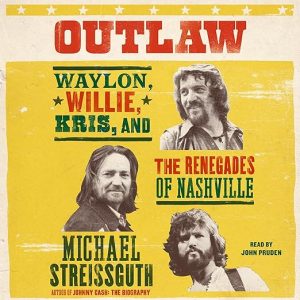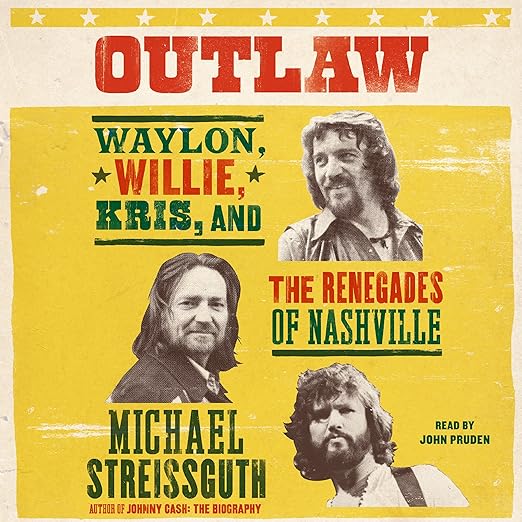
Waylon Jennings didn't fit Nashville's assembly line, and neither did Willie Nelson or Kris Kristofferson, which is precisely the tension this audiobook spends seven hours unpacking. Michael Streissguth has built a career studying this exact corner of American music history, and Outlaw reads like the culmination of that work rather than a quick cash-in on three famous names. The book's real subject isn't fame, it's friction: three musicians colliding with a hit-making machine built on the polished, string-laden Nashville Sound, and refusing to sand down their own rough edges to fit it.
Nashville's West End as a Political Choice
Streissguth grounds the outlaw movement in a specific place and moment: Nashville's West End in the late 1960s, where young transplants collided with the city's own homegrown civil rights and antiwar organizers, an angle most country music histories skip in favor of pure industry gossip. That civic backdrop matters, because it explains why Waylon, Willie, and Kris sounded closer to the Allman Brothers or Bob Dylan than to anything coming out of RCA's Nashville studios at the time. The book treats their raw, unpolished sound as a genuinely political choice, not just a stylistic one, and that framing gives a familiar story a sharper argument than the usual greatest-hits retelling.
The book's own title borrows a label the three men wore uneasily. 'Outlaw country' was as much a marketing tag Nashville's rivals slapped on the trio's refusal to conform as it was a self-chosen identity, and Streissguth is careful enough to show that ambivalence rather than flatten it into a simple rebel narrative. That nuance separates Outlaw from hagiography; the three men come across as genuinely conflicted about their own outsider status, not cartoon rebels posing for an album cover.
The secondary cast does real work too. Johnny Cash, Rodney Crowell, Kinky Friedman, and Billy Joe Shaver all move through these pages as more than cameo appearances, and reviewer W. Graburn credits the book with introducing readers to lesser-known figures who shaped the movement alongside its three headliners. That breadth comes from real legwork, probing interviews with people who were actually in the room, not recycled quotes from earlier biographies.
Pruden's Steady Hand From a Military Memoir
John Pruden narrates, and the assignment asks a lot of him: sustaining a clear narrative thread across three overlapping careers, a shifting cast of dozens of named musicians, and roughly a decade of Nashville's music-industry history without letting any one thread flatten the others. His prior work on a sprawling, multi-decade military memoir suggests he's built for exactly this kind of steady, controlled pacing, the sort that keeps a listener oriented across a book with this many names and this much overlapping timeline.
A simple format argument favors choosing audio here too, though not the one you might expect. A book about musicians, built around the sound of a specific era, benefits from a voice carrying you through recording sessions and live shows the way liner notes never quite manage on the page. Pruden doesn't try to imitate anyone's singing voice or affect a honky-tonk drawl, which is the right call; the material needs someone who can keep three decades of Nashville's power structure straight while never losing the human tension of three men risking their careers to sound like themselves.
Streissguth's own track record in this space is part of the case for trusting his angle. He has spent much of his writing career on Cash and Jennings specifically, and Outlaw reads like a book written by someone who already knows where the institutional bodies are buried in Nashville's history, not a journalist parachuting in for one project. That familiarity shows up in small details, the specific names of West End clubs, the specific civil rights figures who crossed paths with these musicians, the kind of texture a less-invested writer would have smoothed over.
The 4.2 rating across 479 responses places Outlaw solidly in solid-but-not-universal territory for music biography, an honest reflection of a book that clearly satisfies readers drawn to movement history while sometimes frustrating those who came purely for individual artist gossip. That's a fair trade for the kind of book Streissguth set out to write, one closer to a cultural history than a fan-service tour through three famous lives.
Closer to a Magazine Article Than a Biography
Not every reviewer walked away fully satisfied. Rick Spell's review captures a common reaction: strong on Kristofferson, entertaining on Nelson ('Willie Nelson is Willie,' as he puts it), but the Jennings sections, covering the movement's biggest commercial presence, occasionally slow the momentum rather than build it. A second reviewer, going by Mu_Shin, pushed further, describing the book as closer to 'an extended magazine article' than a fully realized biography, with plenty of peripheral detail but less depth on Streissguth's actual sourcing than expected from a project this thoroughly researched.
That tension is worth taking seriously rather than waving away. A book trying to serve three separate fan bases, Jennings loyalists, Nelson loyalists, and Kristofferson loyalists, while also mapping the wider cultural moment around them, was always going to spread its attention unevenly. What the mixed reviews suggest is less a failure of research than a structural choice: Streissguth is telling the story of a movement first and three individual careers second, and listeners expecting the reverse emphasis may come away wanting more on whichever of the three they came for specifically.
It's also worth sizing up the source material Streissguth had available. Interviews with figures this famous, especially ones as guarded as Willie Nelson has historically been about his own myth-making, are hard to get in full candor, and the 'peripheral information' Mu_Shin flags may partly reflect real limits on how much any of the three men were willing to reveal, rather than a research shortfall on Streissguth's part.
Skip It for a Single-Artist Deep Dive
Outlaw rewards listeners who care about country music's actual social history, not just its hit singles: the West End scene, the antiwar undercurrent, the specific mechanics of how three men broke a formula Nashville's labels had every financial incentive to protect. Fans of Johnny Cash's own outlaw-adjacent legend, or anyone who has read about Bob Dylan's influence bleeding into unexpected genres, will find plenty to recognize here. At just over seven and a half hours, it's a manageable commitment for a music history this dense with names and context.
Skip it if you're hoping for a tightly focused single-artist biography of just Waylon Jennings or just Willie Nelson; both men have dedicated books that go deeper on their individual stories, and Outlaw's three-way structure means none of them gets a truly exhaustive solo treatment. Listeners who found the mixed reviews' concerns about pacing and sourcing depth persuasive should sample a chapter before committing to the full runtime.
In Brief
- Voice: John Pruden brings steady, controlled authority to a story juggling three overlapping careers and dozens of named musicians without losing the thread.
- Big ideas: The outlaw country movement, Nashville's music-industry machine, civil rights and antiwar undercurrents in 1960s West End Nashville.
- Atmosphere: Engaged and detail-rich, with real affection for its subjects.
- Worth it?: A genuinely well-researched group biography that favors movement history over any single artist's deep dive, best for listeners who want that wider lens.
A Few Questions About Outlaw
Does the Outlaw audiobook cover Johnny Cash and the other secondary figures in depth, or mainly Waylon, Willie, and Kris?
It covers the wider circle in real detail, Johnny Cash, Rodney Crowell, Kinky Friedman, and Billy Joe Shaver all get meaningful attention, which is part of what reviewer W. Graburn singles out as a strength. The three headliners still anchor the narrative, but the movement's supporting cast isn't treated as filler.
Is John Pruden's narration on the Outlaw audiobook well suited to a book with this many named musicians and decades of history?
Yes. Pruden previously handled a sprawling, multi-decade military memoir with a similarly large cast of named figures, and that same steady, controlled pacing transfers well to keeping three overlapping music careers and a decade of Nashville history straight for the listener.
Some reviewers say the Outlaw audiobook gets bogged down on Waylon Jennings. Is that a fair criticism?
It's a reasonable one. Reviewer Rick Spell specifically flags the Jennings sections as slower going than the Kristofferson and Nelson material, even though Jennings was arguably the movement's biggest commercial presence. It reads as an uneven-pacing issue rather than a research gap.
Do I need to already know country music history to follow this audiobook?
No prior expertise is required. Streissguth explains the Nashville Sound formula and the West End cultural backdrop clearly enough for a newcomer, though listeners who already know Cash, Crowell, and Shaver by reputation will catch more of the connective tissue in the secondary cast.