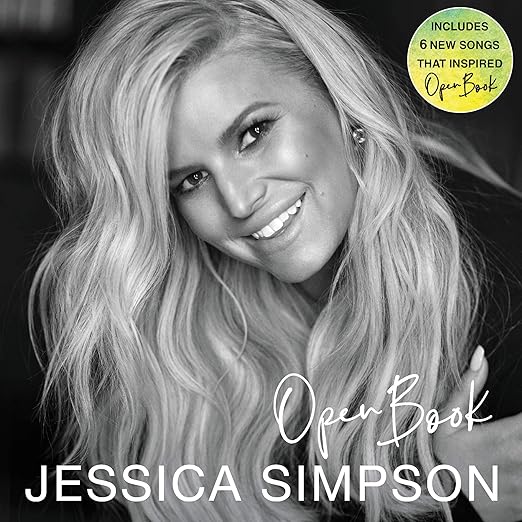
Six songs sit inside this recording that you cannot get any other way, and that single fact settles the format question before we start. Heartbeat, Practice What You Preach, Sweet Temptation, Your Fool with Willie Nelson, Party of One and Free Will were written for this project and released exclusively in the Open Book audiobook. Jessica Simpson reads the memoir herself across eleven hours and twenty-two minutes, and the description states plainly that her music runs throughout rather than sitting in a block at the end. For once the audio edition is not a convenience. It is the complete one.
Eleven Hours Is a Long Assignment for a Singer
Everything about the tone follows from how the book came to exist. Simpson was approached five years before publication to write a motivational guide to living your best life, and she walked away from it, which nobody around her understood at the time. The reason given in the description is the most interesting sentence on the page: she did not want to lie. What replaced that book is this one, assembled from journals she has kept since she was fifteen, which is why the chronology has the texture of contemporaneous record rather than of recollection tidied up afterward.
She is also working against a pile of received language, and the copy lists it without flinching: chicken or fish, Daisy Duke, the football jinx, mom jeans. Each of those was a national joke at somebody's expense, and the book's project is to reclaim the events underneath them from the shorthand. Whether you find that compelling depends largely on whether you were around for the jokes, because the book assumes you were.
Reading her own work is the obvious decision here and it is still worth examining. Eleven hours is a long assignment for someone whose profession is singing rather than sustained speech, and the trade is intimacy against technique. What the choice buys is coherence: the journals were hers, the voice describing the crippling need to please is the same instrument that gets used on the songs, and a hired reader would have to imitate a person the audience can already hear in her head. Sample a passage of plain narrative rather than one of the musical sections, since the songs will sell themselves and the long stretches of reading are what you actually have to live with.
Willie Nelson Closes a Loop Text Can't
Candor is what readers keep testifying to, and they frame it as a surprise. "Whenever a celebrity comes out with a book about their life you wonder how much are they really going to share", one five-star response begins, before working through the calculation such a book normally involves and concluding that this one refuses it. Another reader, writing from Brazil, calls her "hella funny and despite being rich, relatable" and says the title earns itself because "she tells you everything". Those are two very different readers arriving at the same verdict.
Music changes what kind of object this is. A memoir that pauses to sing is doing something a printed page structurally cannot, and for a subject whose entire public identity began with a voice, hearing that voice do both jobs closes a loop the text alone leaves open. Willie Nelson appearing on one of the six is not a small booking either. I would treat the song list as part of the contents rather than as a bonus, since a memoir that stops to perform is telling you where it thinks its emotional weight actually falls.
Her Side of the Story, and Only Hers
Useful caution arrives from the one four-star response, and it is not about quality. That reader notes the book is "written in first person, speaking to the reader", which produces the pleasant sense of an inside line, and then names the cost: "this is her side of the story", and other people in those stories have versions that never appear. A memoir is always a brief for the defense. This one is a particularly well-argued brief, and a listener should keep the genre in mind through the sections about other named individuals.
Expect a redemption shape as well. The description promises inspiration, best and most authentic lives, and a woman finally living hers, which is the register the book resolves into. A reader who wants the disintegration without the recovery arc will find the last stretch tidier than the middle, and the motivational guide she declined to write has not vanished entirely; it has been folded into the ending.
One Review Is Actually About a Parcel
Correct the review pool before you weigh it. Five responses are displayed, but one of them, filed in France, is about a parcel: it arrived early, in very good condition. That is a note on a delivery rather than an account of the book, which means the honest count of readable opinions here is four, and one of those four comes from Brazil and another arrived three years after publication. It is a thin and geographically scattered sample for a title the description calls a number one bestseller.
That thinness is compounded by the rating base. Eighteen grades producing a 4.6 is a very small foundation for a book with this profile, and a single strong opinion moves the number. Treat the score as close to meaningless and read the responses instead, which is generally the right instinct when a famous title shows a rating count you could fit in an elevator.
Receipts a Ghostwritten Memoir Couldn't Produce
Anyone who followed the culture that produced her should hear this in audio specifically. The reality television era, the tabloid decade, the fashion business that followed: this is a first-hand account from the middle of all three, delivered by the person it happened to, with original music attached. That combination does not come along often.
Readers of celebrity memoir tired of the ghostwritten register will find this a relief, as will anyone curious about what a public appetite for a young woman's humiliation actually costs the woman. The journals give it receipts that most books in this category cannot produce, and a reader who suspects celebrity memoir of being reverse-engineered from a publicist's timeline will find that harder to argue here.
Hoping for a settling of scores? Look somewhere else, because the tone throughout is confessional rather than combative. A listener with no prior relationship to the pop culture involved should also think twice: reclaiming a punchline only works on people who remember the punchline, and this is a long time to spend on jokes you never heard.