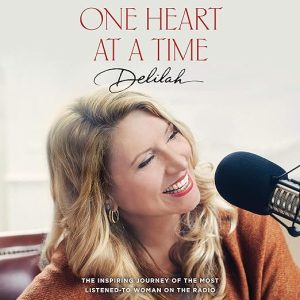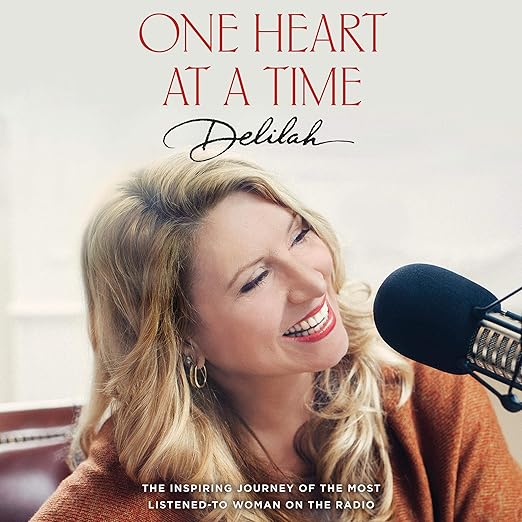
Delilah, whose full name most of her 9 million radio listeners have never needed to know, has spent decades being the voice that answers late at night. One Heart at a Time, narrated by Delilah herself across 7 hours and 1 minute, is the audiobook that explains who answers. Carrying a 4.7 rating from 496 listeners, this memoir moves between the public career that made her an American radio icon and the private life she has rarely discussed in any detail: the 13 children, 10 of them adopted, the father who disowned her, the series of firings that preceded her eventual success, and the humanitarian work through Point Hope that took her to refugee camps in Ghana.
How One Heart at a Time Holds Up
The craft of memoir depends on the gap between the public self and the private one, and Delilah's version of that gap is unusually wide. The radio persona, warm, romantic, reliably sentimental, always available, is one of the most consistent in American broadcasting. The person behind it has experienced divorce, addiction in her family, devastating loss, and the specific challenges of raising 10 children with special needs through a foster care system she has become an explicit critic of. That contrast is not used for shock value. Delilah writes and narrates her own story as the series of miracles she calls it in her subtitle, which means the difficult material is framed through survival rather than trauma, and the faith that has sustained her is neither triumphalist nor defensive about its limits.
Her New York City producer David Savino described the audiobook as the mission statement of the radio program made explicit, a claim that points to something the format achieves that printed memoirs of radio personalities rarely do. Delilah's voice has always been the delivery mechanism for other people's love stories. Here, it is the delivery mechanism for her own, and the continuity between the two uses is what makes this feel like more than a celebrity memoir. The intimacy of the format is not performed; it is the natural extension of a career built entirely on voice as connection.
Why One Heart at a Time Works as an Audiobook
Delilah's self-narration is not merely appropriate. It is the audiobook's primary value. Radio hosts narrating their own memoirs carry a specific authenticity advantage: the audience already knows exactly what they sound like when they are being sincere versus when they are performing sincerity, and Delilah has three decades of that currency with her listenership. The directness of her voice throughout the more difficult passages, the father's rejection, the losses, the red tape of international adoption and the broken foster care infrastructure, reads as the earned confidence of someone who has arrived at a settled relationship with her own history.
The memoir's structure moves between the narrative of her career and the parallel narrative of her family, and the audiobook's 7-hour runtime holds both without either feeling compressed. The Point Hope NGO work in Ghana is given genuine space. It is not treated as a philanthropic footnote to the celebrity story but as the logical extension of the same impulse that built the radio career. That integration of the humanitarian work with the personal story gives the memoir a coherence beyond the standard radio-personality format, and it makes the audiobook's title feel earned rather than aspirational.
Weak Spots in One Heart at a Time
The sections covering Delilah's children, particularly those dealing with the long-term effects of the foster care system on children who came to her with established trauma, are the audiobook's most honest and most challenging passages. She does not sentimentalize the challenges of special needs parenting or the gaps in available support systems. The love is evident throughout, but so is the exhaustion, the systemic failure, and the specific difficulty of parenting children whose early experiences have made trust and stability genuinely hard to build. These passages carry more weight than the career narrative because they are talking about something she could not leave at the studio door when the show ended.
The accounts of her firings, more than a dozen jobs over the years, each terminated before she found the combination of market and format that produced her eventual longevity, are also worth tracking for listeners interested in how broadcasting careers actually develop. The pattern of failure and persistence is not glamorized, and Delilah's characteristic ease in recounting it makes the eventual success feel earned rather than predestined. Both the career narrative and the family narrative are structured around the same principle: that persistence in the direction of your actual purpose eventually produces something real.
Should You Listen to One Heart at a Time?
Delilah's existing radio audience will find this audiobook the most direct access to the person behind the show they have been listening to, and her narration gives the intimacy that print alone cannot provide. Listeners who have no prior familiarity with her work will still find the memoir a compelling account of resilience, faith, and unconventional family-building. Those interested in radio history, American broadcasting culture, or the humanitarian dimensions of celebrity platform will find additional layers beyond the personal narrative. Readers who want emotional complexity alongside the warmth should know this memoir delivers both. The faith framework is consistent throughout but never a substitute for honest reckoning with difficulty. Anyone who has ever stayed up late listening to her show will find this audiobook the most honest version of that conversation they have had with her.
- Read by: Delilah reading her own memoir is the only version of this audiobook that could possibly work; the radio host voice, instantly recognizable to her 9-million-listener audience, gives the life story a continuity no third-party narrator could replicate.
- At its heart: Resilience and faith through extraordinary loss, adoption and family beyond biology, the gap between public persona and private life
- Vibe: Moving and direct, with the warmth of the radio voice and the honesty of someone who has stopped performing
- Short version: Delilah's memoir delivers real access to the woman behind the microphone, and her self-narration makes the distance between radio persona and personal truth feel genuinely small.
Questions Listeners Ask
Does this audiobook give a complete account of Delilah's radio career, or does it focus primarily on her personal life?
Both are woven together throughout. The career narrative, including the dozen firings before her eventual success, runs alongside the personal story of her family, faith, and humanitarian work. The two threads are treated as parts of a single story rather than separate subjects.
How does hearing Delilah narrate her own audiobook change the experience compared to the print version?
Substantially. Her radio audience already knows exactly what her sincere voice sounds like versus her performance voice, and hearing her narrate the difficult passages carries an authenticity that a third-party narrator cannot replicate.
Does this audiobook discuss Delilah's adopted children and the foster care system in depth?
Yes, and it is among the memoir's most honest material. She covers the specific challenges of raising 10 adopted children, many with special needs, and she is direct about the systemic failures in foster care infrastructure rather than sentimentalizing the experience.