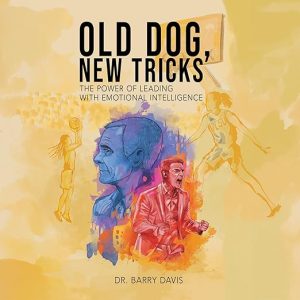
Coaching books usually arrive as bullet points and acronyms, so an audiobook that buries its leadership curriculum inside a novel is doing something less common. Old Dog, New Tricks spends four hours and fifty-nine minutes on Darren Blood, a coach twice fired, still shaking off a scandal, and handed one last job by a friend who happens to run a university. Barry Davis wrote it. Dr. Barry Davis reads it. Same person, two forms of the name on the same listing, and that small split turns out to say something about how the book wants to be taken.
The setup is efficient to the point of bluntness. Blood is described in the publisher copy as unrelenting, authoritative and devoid of people skills, which is an unusual thing to advertise about your own protagonist. He lands at Virginia Central State University to coach the Lady Foxhounds, a women's program carrying what the copy calls a legacy of defeat, hired by Dr. James Harding, a university president who happens to be an expert in emotional intelligence. The mentorship that follows is the engine of the whole book.
Mark, in the most detailed of the written responses, lays out the machinery plainly: President Harding mentoring Coach Blood, with vulnerability and effective communication treated as skills to be learned rather than personality traits you either have or lack. That response calls the president Jimmy rather than James, which is a small inconsistency between the page and the listing copy, and a sign of how quickly the characters become first-name familiar to people reading them. It also confirms what the structure is doing, since the mentor exists so that someone on the page can say out loud what the author wants said.
What I appreciate about the construction is that Davis does not make his coach sympathetic first and competent later. Blood is difficult from the opening, and the scandal in his past is neither excused nor dwelt on. A fictional frame lets a coaching author show behavior under pressure, which is where emotional intelligence either exists or does not, instead of asserting it in the abstract. That is the argument for writing this as a novel, and it mostly holds.
What Barry Davis Gets Right
The best evidence that the material travels beyond basketball comes from Kate Dean, a high school teacher who reports using techniques from the book in a classroom, specifically as ways for students to self-evaluate and set short-term goals. That is a long way from a college gym, and it suggests the emotional intelligence content is portable in the way the author clearly intends it to be. A leadership novel lives or dies on that question, because the whole form asks you to accept an invented team as a stand-in for your own department, classroom or shift.
Runtime is part of the appeal. Under five hours is short for a business-adjacent title, and the fictional shape means you are following a story rather than grinding through a framework. If you have ever stalled halfway through a management book because chapter four repeated chapter three with different examples, the narrative structure here solves a problem you have felt. Blood has to change or lose the job, so the pacing comes from the plot instead of from a promise that the good part is coming in chapter nine.
Sports fiction and leadership writing rarely share a shelf, and the crossover works better in audio than I expected. Practice sessions, locker room confrontations and the president's office all land as scenes, and scenes hold attention while you are doing something else with your hands. A checklist does not. Davis understood the trade he was making when he chose to dramatize the curriculum rather than list it, and the choice pays off most in the stretches where Blood is being told something he does not want to hear.
Where Barry Davis Loses Some Ground
One response singles out the summary at the end of each section as the feature that makes the ideas easy to implement day to day. That is a genuine strength on paper and a genuine friction in audio. Summaries reward flipping back, and flipping back is exactly what a listener cannot do quickly. If you plan to use this as a working reference, expect to note timestamps or keep a text copy alongside the recording.
The publisher copy also does something odd worth naming. It describes the novel, then pivots mid-paragraph to say that Coach Barry Davis, PhD, demonstrates how coaches can win using emotional intelligence, sliding from the fictional coach to the real author without marking the seam. The top written response compounds the confusion by pluralizing the title to Old Dogs, New Tricks. Neither error affects the book, but if you are searching for it, use the singular.
Consider who is actually in the ratings pool. Greg Himes, a working coach early in a career, writes about picking the book up out of respect for Davis and his reputation on and off the field. The other responses read much the same way, from readers who came to the book already respecting its author. A perfect average from that kind of readership tells you less than the same average from strangers would.
Who Should Pick Up Old Dog, New Tricks
Rob Sheppard frames the target listener about as precisely as anyone could: people serious about improving their leadership, particularly those who already accept that influencing others requires self-awareness, empathy and deliberate growth. If that describes you, and you would rather absorb the lesson through a character than a chapter heading, the five hours will land. Coaches, department heads, teachers and anyone inheriting a demoralized team are the natural fit.
Skip it if you want a basketball novel. The Lady Foxhounds exist to give the ideas somewhere to happen, and readers who came for the sport will find the games serve the curriculum rather than the reverse. Skip it too if you want research: this is a practitioner's fiction, not a survey of the literature on emotional intelligence, and it does not pretend otherwise. Anyone allergic to the moment when a story pauses to explain itself should also look elsewhere, because this book pauses to explain itself on purpose, at regular intervals, and considers that a feature.
For the right listener, though, the compression is the selling point. Most leadership titles would have stretched this into nine hours of case studies. Davis tells one story, closes each stretch with what it was meant to teach, and lets you out before dinner.
In Brief
- Narration: Self-read by the author, which keeps the end-of-section takeaways in the same voice as the story they follow.
- Themes: Emotional intelligence as a coaching skill, second chances after a public fall, rebuilding a program with a losing history
- Mood: Brisk and instructional, wrapped in a sports novel
- Verdict: Worth the five hours if you manage or coach people, less so if you came for the basketball.
Good to Know
Do you need to follow basketball to get anything from the Old Dog, New Tricks audiobook?
Not really. The setting is a women's college program at Virginia Central State University, and the games matter to the plot, but the situations Blood faces are staff problems: a roster that has stopped believing, a boss with expectations, and a reputation to rebuild. Anyone who has run a team will recognize them.
Who reads the Old Dog, New Tricks audiobook?
The author does. The byline on the listing reads Barry Davis and the narration credit reads Dr. Barry Davis, the same person under two forms of his name. That makes this a self-read title, with the coaching material delivered by the coach who wrote it rather than by a hired reader.
Do the written responses on the listing describe the audiobook or the printed edition?
The printed edition, in every visible case. All five are dated before the audio release date shown on the listing, and they talk about reading, classrooms and passages returned to. Treat the star average as a verdict on the writing and the coaching content, then decide separately whether a self-read production suits you.