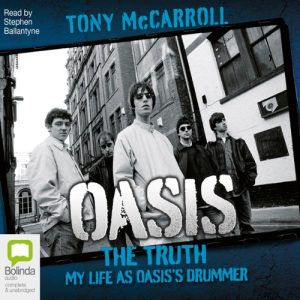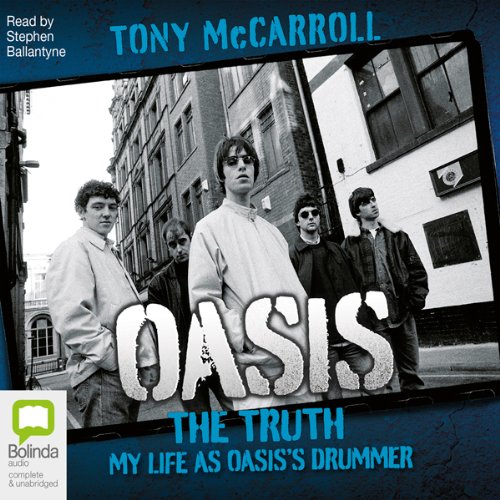
- Read by: Stephen Ballantyne delivers McCarroll's Manchester voice with a dry, economical quality that suits the book's refusal to turn grievance into performance. The accent work is consistent and the timing on the comic passages is well-calibrated.
- At its heart: The gap between founding myth and commercial reality in rock music, loyalty and exclusion in creative partnerships, the price of success you didn't get to keep
- Vibe: Candid and often genuinely funny, with an underlying current of loss that never becomes self-pity
- Short version: Tony McCarroll tells the Oasis origin story from the drummer's chair rather than the Gallagher brothers' orbit, and the perspective shift produces an account that is sharper, more honest, and considerably funnier than the standard rock memoir format allows.
Tony McCarroll was in the room when Oasis became Oasis. He was the drummer for the band's first three years, the years that produced Definitely Maybe, the fastest-selling debut album in UK chart history at the time. Then he was not in the room anymore. Oasis the Truth, narrated by Stephen Ballantyne in this audiobook running 8 hours, is McCarroll's account of that trajectory: how five Mancunian musicians assembled something extraordinary, and what it cost the one who got pushed out before the mythology fully solidified.
The book could have been bitter. By every metric that measures bitterness in rock memoir, McCarroll has earned the right to it. The dismissal, the financial disputes, the public characterization by Noel Gallagher. But reviewer Firelock specifically noted that McCarroll does not come off as bitter, despite having good reason to be. That quality is the book's central achievement and the thing that makes it readable as something more than an act of score-settling. Ballantyne's narration understands this, delivering the Gallagher passages with a wry detachment that keeps the inevitable resentment in the subtext rather than the foreground. Reviewer Exit 10 identified McCarroll's gift for storytelling and specifically mentioned laughing out loud in multiple passages, and that laughter is earned rather than forced.
Why Liam Comes Off Warmer Than Noel Does
The origin-story section is the book's richest material. McCarroll traces the band's formation from the years before they had a name through the early Manchester gig circuit to the moment when Alan McGee signed them to Creation Records, the sequence that produced one of the most compressed rises from obscurity to phenomenon in British music history. That speed is part of the story: Definitely Maybe came out in August 1994, and by the time McCarroll was pushed out in 1995, the band he had helped build was already becoming something he no longer recognized.
The Noel Gallagher portrait that emerges across 8 hours is the book's most contentious element and also its most interesting. McCarroll does not present Gallagher as a villain, but he does present him as someone whose creative genius was inseparable from a controlling temperament that made ordinary professional loyalty impossible to navigate. The Liam characterization is warmer than expected. Reviewer Firelock noted that Liam came off in a much better light than anticipated, and that asymmetry between the brothers feels like observation rather than strategy. McCarroll clearly found Liam's chaotic honesty easier to respect than Noel's strategic intelligence.
How Ballantyne Handles Thick Manchester Vocabulary
Ballantyne's narration is one of the audiobook's structural assets. The Manchester vocabulary and idiom that reviewer Exit 10 flagged as occasionally requiring editorial clarification in print is handled differently in audio. Ballantyne delivers the Mancunian texture with enough consistency that it becomes part of the book's authenticity rather than a comprehension barrier. Non-British listeners may need to let some phrases settle into context, but the general meaning is always clear from delivery even when specific vocabulary is culturally specific.
The celebrity cameo sections covering David Beckham, Prince, Eric Cantona, and John McEnroe are delivered with the same matter-of-fact quality as the rest of the narrative, which is exactly right. McCarroll is not using these encounters as proof of arrival. He is including them as evidence of how strange the band's trajectory was, how quickly ordinary Mancunian life was replaced by a world none of them had prepared for. Ballantyne reads these passages with a slight bemusement that matches McCarroll's own retrospective tone.
A Financial Dispute the Gallagher Brothers Never Detail
The sections leading up to and immediately following McCarroll's departure are the emotional core of the book, and they are written with more care than the surrounding chapters. McCarroll is reconstructing a period where the information he had was incomplete. He knew something was wrong before he knew exactly what. The retrospective clarity he brings to that confusion is the kind of self-knowledge that takes years to develop. Ballantyne slows slightly in these passages, which is the right instinct. The comedy recedes and what remains is the actual cost of the story.
The financial dispute discussion is handled with unusual frankness for a music memoir. McCarroll does not reduce it to good-guys-bad-guys, but he is clear about what he believes he was owed and what he received. For listeners interested in the business mechanics of how early Oasis revenues were structured and distributed, this section provides a ground-level account that the Gallagher brothers' own published statements have never addressed in this kind of detail.
A Rare Genre Combination of Candor and Generosity
The obvious audience is Oasis fans who want an account of the band's formation and early years from a perspective that is not Noel or Liam Gallagher. McCarroll's position, central to the early years and absent from the peak, gives him an angle on the story that neither brother can provide. Listeners who have read or heard the Gallagher brothers' own interviews and memoirs will find McCarroll's version illuminating specifically because of the gaps and tensions it reveals in those accounts. General rock memoir readers who are not Oasis fans will find the origin-story and music-business sections engaging, but the emotional weight of the dismissal will carry more force for listeners who already understand what the band eventually became. At 8 hours, the pacing is comfortable. This is a storyteller's account, and Ballantyne's delivery keeps it moving. The book covers one specific chapter of the Oasis story with unusual depth and without the defensiveness that characterizes most rock memoir written under legal pressure. That combination of candor and generosity is rare enough in the genre to make it worth 8 hours regardless of where your Oasis fandom sits.
A Few Questions About Oasis the Truth
Is this audiobook an authorized account with input from the Gallagher brothers, or is it McCarroll's independent perspective?
This is entirely McCarroll's independent account. It has no input from Noel or Liam Gallagher and is explicitly positioned as his version of events, including events and characterizations that Noel Gallagher has disputed in other contexts. It is one-sided in the way all first-person memoir is one-sided, but McCarroll's tone is notably less combative than the premise might suggest.
Does the Oasis the Truth audiobook cover the full Oasis story, or only the early years when McCarroll was present?
The book focuses on the period McCarroll directly experienced, from the band's formation through his departure in 1995 following the release of Definitely Maybe. The peak years of Be Here Now and the Knebworth concerts fall outside the scope. It is specifically the origin story told from inside the room where it happened.
Stephen Ballantyne narrates the audiobook. How does he handle the Manchester dialect and music-industry vocabulary?
Ballantyne delivers the Mancunian idiom consistently and with enough authenticity that it becomes an asset rather than a barrier. Non-British listeners may encounter occasional unfamiliar vocabulary but the delivery makes the general meaning clear from context in almost all cases.