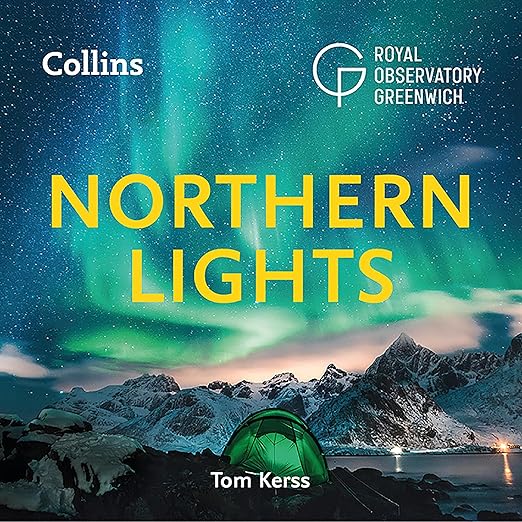
Tom Kerss, an astronomer specializing in solar phenomena, has spent a career helping people find and understand what they are looking at in the night sky. His audiobook Northern Lights distills that expertise into a three-hour-and-41-minute guide that covers the aurora from every angle that matters to someone who wants to actually see one: the science of how it forms, the cultural and mythological history of how humans have interpreted it, and the practical information about forecasting and photography needed to catch it on your own terms. The narrator credit for this edition is unlisted, which is worth flagging upfront; the audio is present and serviceable, though there is no individual performance to assess separately.
Kerss is not writing purely as a scientist. The book opens with cultural and mythological context before moving into aurora science, which is the right sequence for a general audience. By the time Kerss explains what actually causes the aurora, the plasma discharge from solar activity interacting with Earth's magnetic field, the listener already has a sense of why humans across dozens of cultures have found this phenomenon worth explaining in terms of gods, spirits, and omens. The scientific account lands differently, with more resonance and less abstraction, after that grounding in human response.
The Historical Chapter Outshines the Science
The aurora is a subject where enthusiasm and accuracy can pull against each other in popular science writing. The phenomenon is genuinely extraordinary, and the temptation is either to strip it down to physics or to drown it in adjectives. Kerss navigates between these by staying specific. He covers the formation and types of auroras with precision without becoming a textbook, and his historical chapter, from classical antiquity through the scientific developments that eventually explained the mechanism, is the strongest section of the audiobook, carrying real narrative momentum that the earlier format-as-nature-guide sections build toward.
Reviewer Claire S, who described meeting Kerss on a Norwegian cruise organized specifically to view the Northern Lights, noted the book is filled with interesting history and easy-to-understand scientific information. That combination is exactly what Kerss is going for, and the reviewer's endorsement from someone who had experienced both the phenomenon and the author firsthand carries more weight than a generic positive rating. Reviewer Miyagi confirmed that Kerss's background as an astronomer specializing in solar phenomena gives the scientific sections an authority that popular aurora books, written more from the observation side than the science side, often lack.
Where Norse Mythology Meets the Aurora Science
At 3 hours and 41 minutes, this is one of the most time-efficient ways to build genuine competence around a subject that most people approach with enthusiasm and very little practical knowledge. Kerss covers what you need to know to forecast aurora activity, choose the right location and season, and make basic photography decisions, all within a runtime that can be completed in a single evening. The compact structure means very little of the content is padding; Kerss is working from a defined scope and stays within it, covering science, history, and practice without allowing any of the three to crowd out the others.
The historical and cultural sections translate to audio particularly well. Kerss's account of how different civilizations interpreted the aurora, Norse mythology, indigenous North American oral traditions, the early modern European natural philosophers who documented it before understanding it, has the quality of good science history. It respects both the scientific and pre-scientific accounts without treating the latter as merely quaint or primitive. This section of the audiobook works as self-sufficient listening even for someone who will never attempt to photograph an aurora and is simply interested in how one of the sky's most striking phenomena moved through human culture.
The Audiobook Needs a Print Companion for Photography
The photography instruction is the section most dependent on visual supplements. Kerss describes equipment, settings, and technique in plain language, and the audio conveys the logic clearly, but the practical application of that instruction requires actually seeing example images. The book version includes visual support that the audio cannot replicate. If your primary interest is aurora photography, plan to use both the audio and the print versions together rather than relying on the audiobook alone for that section.
The aurora forecasting section involves some engagement with solar cycle data and geomagnetic indices that require a baseline orientation to understand. Kerss explains the vocabulary as he introduces it, but listeners who want to use this information actively rather than passively will benefit from pausing and noting down the resources he references for live aurora forecasting, since the audio format does not allow for the kind of quick reference that printed tables and charts provide.
Built for Fjord and Iceland Trip Planning
Anyone planning a trip to aurora country, whether Norwegian fjords, Iceland, northern Canada, or Alaska, will find this audiobook a useful preparation that covers more ground more efficiently than most travel guides manage. Astronomy enthusiasts who want to understand the solar physics behind the phenomenon will find Kerss's scientific sections accurate and accessible. For the photography chapters specifically, use the audiobook as an orientation and the print edition as a reference. Skip it if you want a purely technical treatment of space weather or solar physics; this is a guide for observers and travelers, written by an astronomer who understands that most of his audience cares about the experience as much as the mechanism. The compact runtime makes it easy to return to specific sections as a trip approaches, and the combination of science, history, and practical guidance in a single short volume is genuinely unusual in the aurora literature.
Questions Listeners Ask
Who is Tom Kerss, and does his astronomy background add credibility to the audiobook?
Kerss is an astronomer who has specialized in solar phenomena and aurora observation, and the book reflects that expertise. He balances scientific accuracy with accessibility rather than simplifying to the point of inaccuracy.
At under four hours, does this audiobook cover the subject in enough depth to be genuinely useful?
For a first-time aurora observer or someone planning a viewing trip, yes. Kerss has defined a specific scope, science, history, observation, and photography, and covers each with enough depth to be actionable. It is not a comprehensive scientific treatment, but it delivers complete practical grounding within its stated purpose.