Quick Take
- Narration: David Gans brings insider fluency to the material, reading with the ease of someone who already knows this world.
- Themes: Grateful Dead history, countercultural community, the band's business model
- Mood: Analytical and immersive rather than nostalgic
- Verdict: A rewarding listen for serious Dead fans and counterculture historians, less suited to casual gossip-seekers.
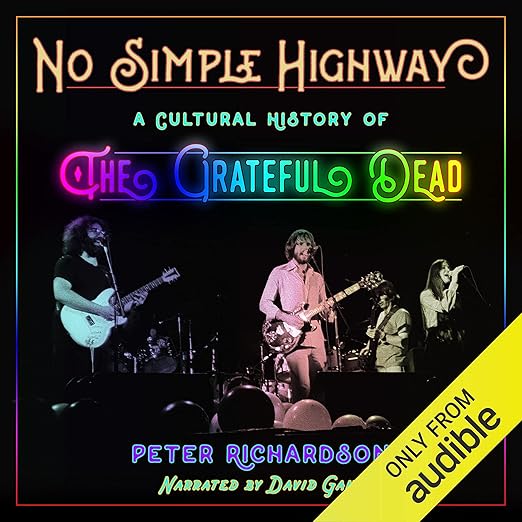
Three decades as America's most popular touring band is a strange, specific kind of success for a group mainstream media routinely caricatured as grizzled hippie throwbacks, and No Simple Highway sets out to explain exactly how the Grateful Dead pulled it off. Author Peter Richardson argues the band tapped into three durable utopian ideals, ecstasy, mobility, and community, and built an entire business and cultural model around them that outlasted nearly every one of their contemporaries. This audiobook, read by narrator David Gans across just under twelve hours of new archival research and fresh interviews, brings a specific kind of insider credibility to material that a generalist narrator would likely handle competently but without the same underlying fluency.
Gans's Narration Treats the Thesis Seriously
Gans reads with the unhurried authority of someone who already knows this world intimately rather than someone encountering the Dead's history for the first time through a manuscript; the pacing through band-formation details, the founding of their own record label, and the Acid Test era never rushes past material a less familiar narrator might treat as simply another chapter to get through. That familiarity shows most clearly in how naturally the countercultural terminology and the band's internal jargon land, delivered without the slight hesitation or over-explanation a narrator less steeped in the subject might unconsciously add.
Richardson's central argument, that the three utopian ideals of ecstasy, mobility, and community explain the band's durable appeal better than the usual caricature of stoned hippie nostalgia, gives the book real analytical spine beyond a simple chronological band biography. Gans's narration treats that thesis seriously throughout rather than merely reciting tour dates and album releases, returning to the underlying argument at key structural points so a listener always understands why a given anecdote, the record label's founding, the late-career commercial explosion, is being included rather than experiencing the book as a loose grab-bag of trivia.
Gans's own background as a longtime Grateful Dead chronicler and radio host, well known within Deadhead circles specifically, means he is not simply performing enthusiasm for the material the way an outside narrator might; he brings a working familiarity with the band's internal history that shapes small interpretive choices throughout: which musician's account to lean into during a disputed timeline, how much weight to give a particular archival interview. That insider judgment is difficult to quantify precisely, but it is audible in the small confidence of his pacing through material a less immersed narrator would likely read more cautiously.
Kirk McElhearn Calls This Field Deadology
At 4.6 across 160 ratings, this has clearly resonated with an audience that includes serious, invested fans rather than casual listeners skimming for surface trivia. One reviewer, Kirk McElhearn, frames the book within a genuinely growing field he calls Deadology, the study of the Grateful Dead, noting the fiftieth anniversary of the band's founding brought a wave of new books, and specifically credits Richardson's volume with using fresh archival research rather than simply rehashing already-well-documented ground other Dead biographies have already covered.
Another reviewer, J. M. Benchoff, frames the book's core value proposition well: any artist with genuinely lasting cultural impact raises real questions about the context their work emerged from, and Richardson's book directly answers those questions about the Dead rather than settling for hagiography or nostalgia alone. A third reviewer describes a direct personal connection to the band's early history through family, adding an unusually vivid, if unverifiable, personal dimension to how deeply this specific slice of countercultural history still resonates with listeners who lived adjacent to it themselves.
The book's release amid what reviewer Kirk McElhearn calls a broader wave of new Grateful Dead scholarship tied to the band's fiftieth anniversary places it in direct competition with several comparable titles, and Richardson's specific analytical framework, built around three named utopian ideals rather than a straightforward chronological retelling, is what distinguishes this entry from more conventional band biographies covering similar ground. For listeners who have already read a more standard biographical account and want a more argument-driven, thesis-forward take on the same underlying history, that structural difference is the book's clearest specific selling point.
More Business Model Than Backstage Gossip
This is cultural and business history built on an argument, not a music-focused biography heavy on song-by-song analysis or a collection of on-the-road anecdotes and backstage gossip, and listeners hoping primarily for the latter should recalibrate expectations before starting. Richardson is more interested in explaining the Dead's business model, their record label, and their sociological appeal than in relitigating specific concerts or personal dramas among band members, and the twelve-hour runtime reflects that analytical emphasis throughout rather than a looser, more anecdotal approach.
Listeners with only passing Grateful Dead familiarity, who mostly know a handful of songs and the band's general reputation, may find some sections assume a working knowledge of band history, member names, and album chronology that a true newcomer will need to look up separately to fully follow. This rewards existing engagement with the subject more than it functions as a true beginner's introduction to who the Grateful Dead actually were.
The twelve-hour runtime is substantial for a single-band cultural history, and Richardson's academic background, this reads closer to a work of cultural history than music journalism in tone, means the prose occasionally favors sociological framing over the more anecdote-driven storytelling style common in commercial rock biographies. Listeners who generally prefer a breezier, more narrative-driven music biography style should know this leans more toward argument and evidence than toward a purely story-driven account of the band's decades on the road.
An Academic Argument for the Committed Fan
Serious Grateful Dead fans, students of American countercultural history, and anyone interested in the music business side of a band that built genuinely unconventional, durable structures around touring and community will find real substance here well beyond a standard rock biography. Gans's insider-level narration specifically rewards listeners who already care about getting the cultural context right rather than just the surface chronology of hit songs and famous shows.
Readers of broader countercultural history, the 1960s Bay Area scene, the intersection of music and utopian community-building more generally, will also find real value here even without deep prior investment in the Grateful Dead's specific catalog, since Richardson's actual argument extends outward into a wider American cultural moment the band happened to embody particularly durably.
Casual fans hoping mainly for concert stories, celebrity gossip, or a breezy nostalgia trip through greatest-hits moments will find an academic argument instead, one more interested in explaining why the ecstasy-mobility-community formula worked than in relitigating specific legendary shows in vivid detail. That is not a flaw so much as a mismatch of expectations, and knowing the difference upfront will save the wrong listener a fair amount of frustration partway through.