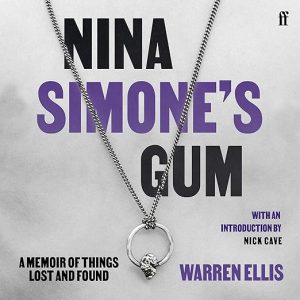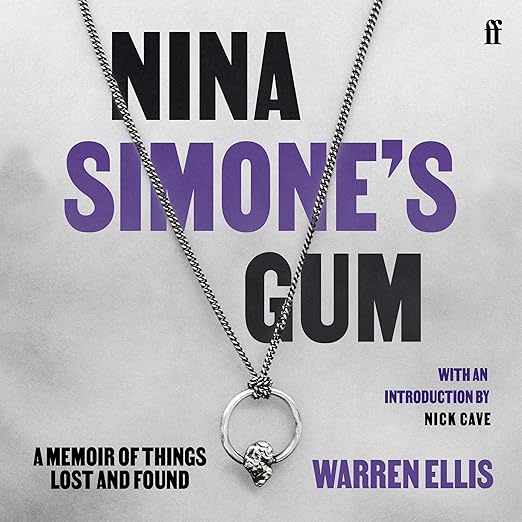
Can a piece of chewing gum actually hold twenty years of someone's spirit inside it? Warren Ellis apparently believed so, and this audiobook is the record of that belief: a compact memoir built entirely around a single piece of gum that Nina Simone left on a piano in July 1999, after a rare performance at Nick Cave's Meltdown Festival.
Ellis, the acclaimed musician and composer best known for his long-running work alongside Cave, crept onto the stage that night, wrapped the gum in Simone's own stage towel, and kept it inside a Tower Records bag for the next two decades before finally opening it again.
Ellis has spent decades as a genre-crossing musician and film composer, known for his violin and multi-instrumentalist work with the Dirty Three and for the long string of film scores he has written alongside Cave. None of that career breadth prepares a listener for how small and specific this book chooses to be: not a retrospective, but an extended meditation on a single artifact.
Ellis Half-Believes His Own Superstition
The gum itself becomes something close to a character, the way the first reviewer I read put it, a small object around which an entire theory of artistic meaning-making gets built. Ellis isn't really writing a Nina Simone biography here; he's writing about why an object touched by someone extraordinary can carry weight far beyond its physical size, and how protecting that object for twenty years shaped his own creative life in the meantime.
David Noonan reads the material with an unhurried, hushed register that suits a book this quietly reverent toward its subject. The pacing lets small, strange observations land without rushing past them, which matters for a memoir built more on meaning than on plot.
The spiritual framing Ellis brings to the gum, worrying that opening the towel might let some of Simone's presence vanish, could read as precious in less careful hands. What keeps it grounded is how honestly Ellis interrogates his own superstition even while indulging it, treating the object's power as something he half-believes and half-knows is simply a story he has chosen to tell himself.
A Tower Records Bag as a Reliquary
Ellis never fully resolves the tension between wanting to protect the gum forever and needing to finally write about it, and that unresolved quality is part of what makes the book feel honest rather than tidy. Most memoirists arrive at their subject with hindsight already smoothing the edges; here the uncertainty about whether opening the towel was even the right choice persists right through the final pages.
The specific choice to keep the gum in a Tower Records bag for two decades carries its own quiet irony worth noting: a chain-store bag, mass-produced and disposable by design, pressed into service as a reliquary for something the opposite of disposable. Ellis doesn't dwell on that irony explicitly, but it sits there for any listener paying attention to the material details he chooses to include.
The book's short chapters suit audio listening in a way a denser, longer memoir might not; each one functions almost as its own standalone meditation on a specific fragment of memory, giving the whole audiobook a rhythm that holds up whether you take it in one sitting or spread it across several shorter ones.
Ellis's Own Music Woven Into the Listening
This particular audiobook includes original music composed by Ellis himself, along with Nick Cave's introduction, genuine audio-specific additions that a print copy simply can't offer in quite the same way. For a book this attentive to sound and small sensory detail, having Ellis's own music woven into the listening experience adds a dimension the text alone wouldn't carry.
The critical reception backs up the strangeness working: a Times top-ten bestseller and a Book of the Year pick across the Guardian, Telegraph, Irish Times, Rolling Stone, Mojo, and Uncut. At four hours and under 300 pages in print, per one reviewer, it's also short enough to finish in a single sitting, which several listeners reported doing without meaning to.
One reviewer's description of the book as covering 'champagne, cocaine, and sausages' captures its unpredictable texture better than any plot summary could. This moves fluidly between reverence and absurdity, between genuine grief and genuine comedy, in a way that mirrors how memory itself actually works rather than how a conventional memoir usually organizes it.
Ellis Follows the Gum Back to Childhood
One reviewer poses the real audience question directly: do you need to love Nick Cave and the Bad Seeds to get something out of this? The honest answer is no, but familiarity with that musical world does add resonance to certain passages, and listeners with zero context for who Ellis and Cave are to each other will miss some of the emotional shorthand.
Structurally, this is associative rather than chronological. Ellis follows the gum backward into his own childhood and forward into questions about friendship and creative process, rather than building a linear account of Simone's career or his own. Listeners expecting a conventional music-history narrative should adjust their expectations before pressing play.
Because the book is so short and so specific, it doesn't attempt the kind of comprehensive cultural context a longer Nina Simone biography would provide. Listeners hoping for a deep account of her career, activism, or discography should look elsewhere; her presence here is almost entirely filtered through this one object and this one night.
Reviewers Across Outlets Keep Calling It Unique
Nick Cave and Bad Seeds devotees are an obvious audience, but so is anyone curious about the psychology of relics and memorabilia, or readers who enjoy memoirs that work more like extended meditations than career retrospectives. One reviewer mentioned this as a book club pick that sparked real conversation, which tracks with how much the book packs into so few hours.
It also rewards listeners who enjoy books about collecting and obsession more broadly, in the tradition of object-focused essay collections, or any memoir built around the strange emotional weight small, specific things can carry. The four-hour runtime makes it easy to gift to a friend without asking for a major time commitment, yet dense enough that a second listen turns up details missed the first time through.
Reviewers across multiple outlets reached for the word 'unique' independently, and having sat with the book myself, that consensus feels earned rather than lazy; genuinely no other memoir treats a single small object quite this way, worthy of extended, serious attention rather than a passing anecdote.
Skip this if you want a conventional music biography with career chronology and discography detail; Nina Simone's Gum is something stranger and more intimate than that, closer to an essay collection wearing a memoir's clothes.