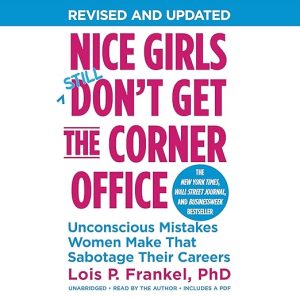
- Narration: Lois P. Frankel reads her own coaching, so the tone is that of somebody who has said these things across a desk to a paying client, blunt where a hired reader would soften.
- Themes: self-sabotaging workplace habits, negotiation and self-advocacy, office politics, coaching rather than critique
- Mood: Brisk and unsparing
- Verdict: Still the most usable tactical handbook of its kind, provided you accept that it coaches the individual and never once the institution.
Two fields on this audiobook record carry the same string, doctorate and all: the author is entered as Lois P. Frankel PhD PhD, and so is the narrator, credential duplicated in both slots. That is how a self-narration credit gets built by copy and paste, and it is the first sign the page was assembled in a hurry. The second sign is the date. This is the 10th Anniversary Edition, published in February 2014 at eight hours and fifty-one minutes, still on sale more than a decade later while the shelf around it has moved on without it.
A Quiz Decides Which Patterns Are Actually Yours
Frankel's premise has aged better than the title suggests. The book catalogs over one hundred and thirty behaviors that women are taught in girlhood and that quietly work against them at work, and it numbers every one of them: avoiding office politics at thirteen, multitasking at twenty-one, failing to negotiate at fifty-four, inappropriate use of social media at seventy, asking permission at eighty-two. The framing is coaching rather than critique. Frankel is an executive coach and the book reads like a coaching engagement transcribed, which means it tells you what to stop doing well before it tells you why the world is arranged to reward you for doing it.
Some of that will grate, and it should be said plainly. A book that locates the problem in the woman rather than in the room will always be open to the charge that it teaches people to survive a rigged game instead of naming the rig. The response that mentions the quiz gets at the appeal anyway: the book opens with a self-assessment, so you find out which of the hundred and thirty patterns are actually yours before committing to change anything. That triage is what makes a list this size usable rather than crushing, and it is the single smartest thing about the design.
Nearly Nine Hours With No Index at All
An August 2024 entry supplies the best practical instruction on the page: take it one section at a time, and treat it as advice for any woman in a workplace regardless of her role. That is how the structure wants to be used. The mistakes are short, self-contained and independently numbered, so nothing at all is lost by dipping in, and a great deal is lost by grinding through nearly nine hours in sequence hunting for a narrative the book never set out to build.
Hearing an executive coach deliver her own material changes what the book is. Frankel wrote these as diagnoses and reads them as instructions, and the shift is audible in the best sense, closer to a session than to a recitation. What audio takes away is navigation. One hundred and thirty numbered items across nearly nine hours is a reference structure, and a reference structure without an index is an awkward object to own. Play a run of consecutive mistakes rather than the introduction, and listen for how clearly each number gets announced, because that announcement is the only bookmark you are going to get.
Numbering the mistakes is the design decision that made this book last. Each item is a behavior you can catch yourself doing in an afternoon rather than a value you have to renounce, and the granularity is what makes it actionable. Mistake twenty-one, on multitasking, makes the point in a line: being able to do something is not a reason to do it. Mistake fifty-four, on refusing to equate negotiation with confrontation, has paid for the book several times over for anyone who acted on it before a salary conversation. Mistake eighty-two, on asking permission, is the one most likely to sting.
A Detailed Review for a Different, Later Book
Reception here needs unpicking. The counter above the reviews reads two ratings while five people have written underneath it, which is two different populations wearing one badge. The average is not the broken part, since 4.5 is a value two whole-star votes can genuinely produce. The count is. And the most detailed of those five responses, filed in February 2026, opens by naming a different book: Nice Girls Still Don't Get the Corner Office, which is a later title and not the 10th Anniversary Edition on sale here. It is a careful, specific account of a career changed by a book, attached to the wrong page.
One more entry is worth flagging for a different reason. A four-star from June 2014 spends its opening on a separate title about building a website for passive income, complete with a description of how detailed and easy to read that other book is, before turning to Frankel and singling out the advice on finding a mentor and on not waiting to be given what you want. The Frankel half is genuine and useful. The first half is an advertisement, and on a page carrying five written verdicts it occupies a meaningful share of the available evidence.
Before Lean In, a Tactical Guide for Meetings
Women early in a career, and women who have just moved into a role where they supervise people who test them, are the two groups this serves most directly. The copy pitches it at the era before Lean In, and that placement is honest: it is a tactical book, concerned with what happens in a meeting, in a negotiation and in the corridor afterward, rather than a book about structures and systems. Anyone who has been told they are too nice at work, and who suspects the compliment is quietly doing them damage, will find the diagnosis unnervingly precise and the remedies specific enough to try this week.
Look elsewhere if you want the structural argument, because this book deliberately declines to make it, and anyone who wants workplace inequity analyzed rather than navigated will find the individual focus frustrating. Look elsewhere too if you meant to buy the current edition, since the later title is a different book and one response on this very page is describing it. Should a numbered list of one hundred and thirty items sound like the wrong shape for headphones, trust the instinct and buy the text.