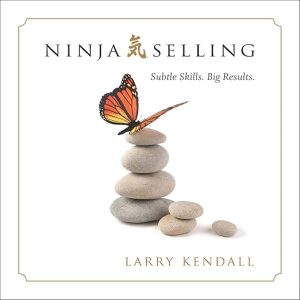
Realtors keep handing this one to each other, and the record shows why the ordinary publishing machinery never got involved. The publisher field reads Larry Kendall, Ninja LLC, which is the author and his own company. The narrator field reads Larry Kendall as well. So the book, the business behind the book and the voice on the audiobook all belong to the same person, and eight hours and six minutes of it went out into a sales category that mostly sells to people who were told to buy it by someone above them. None of that is a criticism yet. It is the frame everything else has to be read inside.
Income Per Hour, Not Gross Volume
Stop selling, start solving is the slogan, and underneath it sits a genuinely different proposition from the usual sales manual. The pitch is a system built on asking better questions and listening to the answers, aimed at attracting clients rather than chasing them, and explicitly designed to work regardless of personality type. That last claim is the interesting one, since most sales training quietly assumes you are an extrovert with stamina. One detailed response, from a working realtor, frames the appeal as a rejection of the old sell-sell-sell model that treats a transaction as a contest over who extracts more, and describes this instead as a primer on building something. The measure the book keeps returning to is income per hour, not gross volume, which tells you what it actually values.
Three of the five people who wrote about it identify themselves as licensed agents or as being trained by a broker, so the audience that has actually adopted this material is narrower than the sales shelf suggests. The description leads with credentials, opening on a 2018 Axiom Business Book Award gold medal and a bestseller ranking before it says a word about content. Both of those belong to the print edition, which existed well before this 2020 recording, and neither tells you anything about how the system performs in your market.
Kendall's Cadence Instead of a Hired Voice
Sales systems tend to travel with a voice attached, and this one has been unusually literal about it. Larry Kendall reads his own material, which for a methodology with training and licensing built around it is close to the point: what you are hearing is the founder's cadence, the emphasis he puts on particular questions, the pauses he leaves for an answer. A hired professional would deliver the words more evenly. The author delivers the intent, and on a book whose whole method is about how you speak to another person, that distinction is not trivial. Eight hours is short enough to run through twice, which is how training material is usually consumed anyway.
Adoption is the strongest evidence on the page, and it arrives from an unexpected angle. One response comes from someone in their first year with a license, who was pointed at this book by a broker who teaches from it directly, and who credits it with providing structure through a demanding first twelve months. That is a different signal from someone enjoying a book. It means the material has become curriculum inside at least one brokerage, which is the highest form of endorsement a sales text can get and the reason this one keeps circulating without a major publisher pushing it.
Two Votes Can Only Produce 4.5 or 5.0
To sit at 4.8, at least one of the two people who rated this would have had to deduct a fraction of a star, and fractions are not on offer. Two votes can only produce 4.5 or 5.0 at that end of the scale, so the number displayed here is unreachable. The star line reports two ratings and the reviews below it number five, which compounds the problem: the badge is quoting a value that cannot exist for a population smaller than the one you can read. The written responses are the only usable evidence on this listing, and they are unanimous, which is its own kind of warning about who bothers to write.
Subtitles matter more than they look, and this listing has lost one. A written response gives the book's full name as Ninja Selling: Subtle Skills. Big Results, while the page carries only the first two words. That missing half is the part that tells a browsing buyer what the promise actually is. Weigh the commercial structure too: a system with a company, a training program and a certification behind it is being introduced by a book that the same company published. The material can be sound and the book can still function as the top of a funnel. Both are true here.
Handed a Script and Told to Make It Work
New agents are the clearest fit, especially anyone in a first or second year who has been handed a phone script and told to make it work. The relationship-first approach suits people who find cold prospecting unbearable, and the income-per-hour framing suits anyone trying to build a career rather than survive a quarter. It also works for established agents in a slow stretch who want a structured way to rebuild a pipeline rather than a motivational lecture, and for brokers looking for something their whole office can work through together.
Not for you if you sell outside relationship-driven markets, since the examples and the cadence are shaped by property work even where the principles generalize. Not for you either if you want independent evidence for the science-based claim, because the book supplies the framework and the results while the verification sits with the same organization. Systems with training programs attached are not to everyone's taste, and this is the entrance to one rather than a standalone volume that leaves you alone afterward.
Before You Press Play
- Read by: The author reads it himself, so the emphasis and the pauses come from the person who designed the method.
- At its heart: Relationship selling, question-led discovery, income per hour, real estate careers.
- Vibe: Practical, evangelistic, quietly systematic.
- Short version: A real methodology rather than a pep talk, sold by the company that also sells the training.