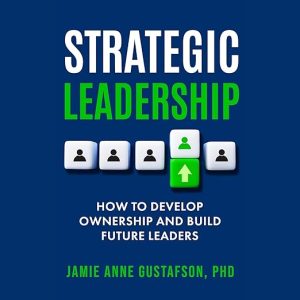
Leadership books tend to cluster around one of two orientations: they either focus on mindset and character, or they focus on specific tactical skills. Strategic Leadership: How to Develop Ownership and Build Future Leaders by Jamie Gustafson, narrated by Terran Rae Smith, positions itself in a third lane, organizational process design, and this audiobook is more interesting for it. Gustafson's central argument is that leadership failures at the organizational level are almost never a people problem. They are a process problem, and the process is broken in a specific and diagnosable way that most organizations are not even trying to name.
The problem Gustafson names is the practice of promoting employees to leadership roles without preparation, what he calls accidental leadership development. The promoted individual did not ask to lead; they simply performed well as an individual contributor, stayed around long enough, or happened to be available when a gap opened up. The organization then discovers, often slowly and expensively, that the skills which made someone effective as a contributor do not automatically transfer to leading others. The structural failure is not in the individual. It is in the absence of a deliberate pipeline that gives people the chance to practice ownership before stepping into authority, and Gustafson makes a convincing case that this is a systemic and solvable problem.
Gustafson's solution is the 5-Stage Ownership Journey, a framework designed to move contributors through increasingly complex levels of decision-making responsibility before they are placed in formal leadership roles. The stages are organized around strategic awareness, ownership development, and leadership formation, and the book spends considerable time on each as a practical matter: what it looks like, how to recognize it in candidates, and how to design organizational conditions that support it. The author's credentials here are relevant. A C-Suite executive, consultant, professor, and PhD in Strategic Management brings multiple vantage points to the material, and the text reflects that range rather than the narrower perspective of a purely academic or purely practitioner background.
Smith Delivers Clarity Without the Stiffness
Terran Rae Smith's narration is clean and professional, calibrated to the material's register. This is not a book that asks for dramatic performance or emotional range. It asks for clarity and authority, and Smith delivers both without the kind of stiffness that sometimes characterizes business audiobooks narrated by performers unfamiliar with corporate language. The three-hour-thirty-nine-minute runtime keeps the content focused without feeling rushed, and Gustafson's writing does not pad or repeat itself unnecessarily.
One reviewer noted that they had experienced poor leadership in most organizations they had worked for, and wished their previous employers had access to the frameworks in this book. That comment captures something real about the book's appeal: it is a diagnosis and prescription for a problem that many people have experienced as recipients rather than architects of organizational culture. The book is written primarily for HR professionals, managers, and senior leaders, but its diagnostic clarity is useful for anyone trying to understand why leadership quality in their organization is not improving despite good intentions and significant investment in training programs.
A useful structural note: Gustafson organizes the book so that the diagnostic portion, the what and why of the accidental leadership problem, comes before the prescriptive framework. That sequence matters in audio because it means listeners build genuine investment in the solution before it is introduced. By the time the 5-Stage Ownership Journey is laid out in detail, the problem it addresses feels specific and personal rather than theoretical. That is not an accident of structure but a deliberate pedagogical choice, and it reflects Gustafson's background as a professor who has spent years figuring out how to make leadership development feel necessary rather than optional.
Five Stars Across Just Two Reviews So Far
The rating here is five stars across two reviews, which is a very thin sample. Listeners should treat this as a promising but unverified title rather than one with a broad consensus behind it. The quality of the argument, the author's credentials, and the review sentiment are all strong indicators, but the audience at this point is small. This likely reflects a relatively recent publication date rather than any indication of limited appeal among the intended audience.
The book's focus on organizational systems means it is less immediately useful for individual contributors who lack the authority to redesign leadership pipelines in their organizations. The 5-Stage Ownership Journey is designed to be implemented by people with organizational authority, not navigated individually from below. That said, understanding the framework as an individual can help someone advocate for better development practices in their organization or recognize what a well-designed leadership pipeline looks like when evaluating employers or assessing their current company's development culture.
This Is About Structure and Process, Never Inspiration
Best suited for HR professionals, talent development practitioners, and senior leaders who have direct responsibility for how leaders are identified, developed, and promoted in their organizations. Also valuable for managers who want to take a more intentional approach to developing the people on their team rather than relying on informal learning-by-doing. Individual contributors hoping to advance into leadership will find the ownership framework useful for self-directed development even if they cannot redesign their organization's system. Those looking for a motivational leadership audiobook focused on character and mindset should look elsewhere. This title is about structure and process, not inspiration.
Good to Know
Does the audiobook address leadership development for small organizations, or is it focused on large enterprises?
The principles apply across organizational sizes, though the examples and framing reflect Gustafson's experience in larger organizational contexts. The core argument, that leadership must be intentionally cultivated rather than left to chance or seniority, is if anything more actionable in smaller organizations where individual leaders have more direct influence over development practices.
Who is the primary audience for this audiobook?
HR professionals, talent development leaders, managers, and senior executives who have authority over how people are developed and promoted. The book is explicitly addressed to those who can redesign the leadership pipeline. Individual contributors will find the framework informative but less immediately actionable without organizational authority.
How does Terran Rae Smith's narration handle the more technical or framework-heavy sections of the audiobook?
Smith's delivery is clear and methodical, well suited to the structured, framework-driven nature of the content. The narration does not flatten into monotony despite the relatively low emotional range of the material, and the pacing gives the 5-Stage Ownership Journey and its component concepts room to register without feeling rushed.