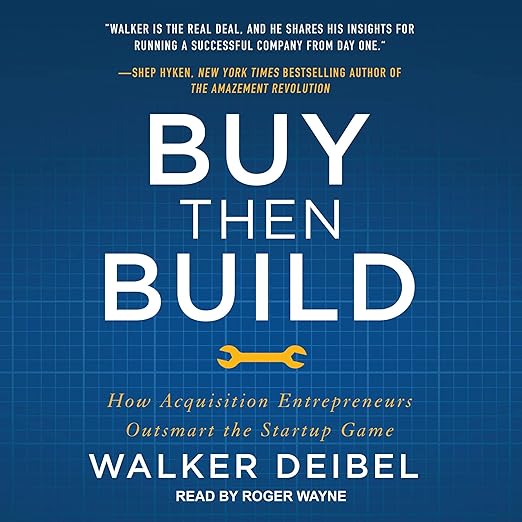
Walker Deibel's proposition is blunt enough to state in a line: stop trying to found a company and go buy one instead. Almost all startups fail or never reach a size worth having, the argument runs, and the entrepreneurial culture that celebrates founding has simply never engineered anything better. Buying a profitable business means revenue on day one, an existing customer base and a much shorter fundraising problem. That argument arrives here as an audiobook of seven hours and fifty-eight minutes, and the term it introduced to the field, acquisition entrepreneur, has since outgrown the book that coined it for this audience.
Acquisition Treated as a Craft With Steps
Startups take the beating in the opening chapters and the case is made economically rather than rhetorically. Deibel is not romantic about failure rates or about the years spent chasing capital, and the alternative laid out here is procedural: find companies, evaluate them, use ownership as a route to financial independence, and grow from a base that already works. What separates this from the general run of business advice is that it treats acquisition as a craft with steps, rather than as a status you achieve. The book is a sequence, and it expects to be followed in order.
Structure is what the strongest response on this listing praises, describing a format that is clean and easy to follow, with each section building logically on the one before, and taking the reader from identifying targets through closing a deal to creating long-term value. That same reading contrasts it with business books that get lost in theory, which is the right compliment. The chapters do the unglamorous work of explaining how to generate your own deal flow, how to find brokers worth knowing and how to see listings before everyone else does.
Wayne's Job Is Purely Navigational Here
Acquisition thinking has become a whole category since this book appeared, and much of the vocabulary in current podcasts and newsletters traces back through it. One reader arrived in exactly that way, catching up on investing reading before a meetup and reporting the book's central statistic, that something like ninety percent of startups fail while the survivors mostly become small or medium enterprises anyway. That framing is the hinge of the whole argument, and hearing it laid out once properly is worth the eight hours even for someone who never buys anything. The second payoff is quieter and more useful: the book keeps insisting that an existing company is a set of relationships and habits rather than a spreadsheet, which is the part first-time buyers reliably underestimate before they own one.
Listeners who intend to act on this will be pausing constantly, and that shapes what the reading has to do. Roger Wayne is the reader of record, and the work here is navigational rather than expressive: keeping numbered processes, evaluation criteria and risk lists legible when nobody can see a heading. Sample a chapter of deal mechanics rather than the opening argument, and check whether the chapter markers on your player are detailed enough to find your way back to a section later.
Two Votes Cannot Average to 4.7
Two votes are what the counter records, and 4.7 is not a value two votes can average to, since any pair of whole-star ratings lands on a whole or a half and nothing in between. The set of averages available to two people simply does not contain that number. Five responses have been written underneath it, which means every reason available to a buyer sits in the written column, and one of those five is not an assessment at all: it awards five stars while saying, in its entirety, that the book looks great and the reader cannot wait to start it.
Depth is the fair criticism of the book itself, and a four-star reading puts it politely, calling this a good overview of the process, the key steps and the pitfalls, and recommending it as something to read before deciding rather than as the thing you work from. That is accurate. Eight hours can establish why acquisition beats founding and what the stages are, but it cannot teach valuation, quality of earnings or deal structure in any operational detail. The financing environment and broker conventions it describes are also American, which listeners elsewhere will have to translate.
Dreamers Seeking Permission Will Find Plenty
Corporate professionals weighing an exit are the ideal audience, especially anyone who has been circling a startup idea without conviction and has never seriously considered the alternative. It also serves people already inside the search process who want the whole arc laid out in one sitting, and finance-trained readers who know how deals work but have never seen small-business acquisition described as a career rather than as an asset class. At under eight hours it is a single day of listening for a decision that usually takes months.
Dreamers looking for permission will find plenty of it and very little else, which is a poor use of the money. Anyone already running a search fund or working with an intermediary has moved past this book, and anyone who needs the numbers taught rather than named should treat it as the first item on a reading list. Listeners outside the United States should discount the mechanics accordingly, and anyone who wants a single volume covering both the case and the calculations should look for a longer, drier book than this one.
Before You Press Play
- Voice: Roger Wayne narrates a book that invites constant rewinding, so player navigation matters nearly as much as the voice.
- Big ideas: Acquisition entrepreneurship, why startups fail, deal flow and broker relationships, valuing a company somebody else built.
- Atmosphere: Confident and orderly, the register of a workshop handout rather than a manifesto.
- Worth it?: The clearest single introduction to buying a business, and a starting point rather than the last word on any part of it.
Good to Know
Is this audiobook practical enough to actually buy a company from?
It gets you through the decision and the search, not through the closing. Expect a clear account of sourcing, broker relationships, what to look for and what to avoid, plus the case for acquisition over founding. Valuation, due diligence and legal structure are introduced rather than taught in working detail.
What separates this from other acquisition books?
It is the case-making one. The argument moves from why startups mostly fail to how ownership of an existing company delivers the same independence sooner, and the process chapters follow that logic in order. Books built around valuation mechanics or diligence checklists sit downstream of it.
Should you take notes while listening to this audiobook?
Just under eight hours, and yes if you are serious. The chapters run through criteria, stages and pitfalls that reward being written down, so a first pass while commuting followed by a second with notes is a more realistic plan than trying to absorb it all once.
Do you need capital to make this approach work?
Less than founding requires, according to the argument. The premise is that an existing business generates revenue immediately and can support financing structures a startup cannot, which shortens the fundraising problem considerably. Personal wealth is not presented as the entry requirement; deal-finding discipline is.