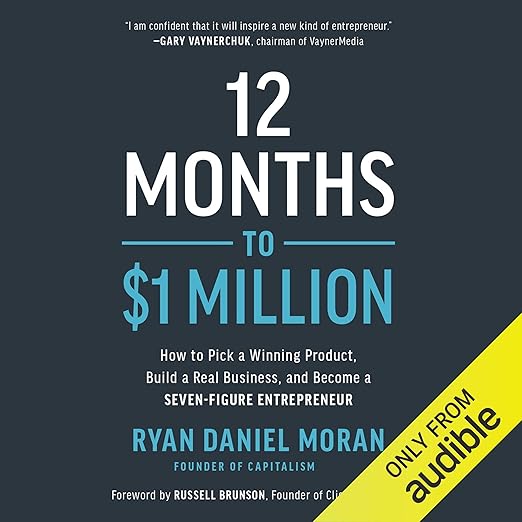
How honest is a business book that puts a dollar figure in its title? That question decides whether you should spend seven hours and thirty-eight minutes here, and the answer in this case is more encouraging than the cover suggests. This audiobook is narrated by Ryan Daniel Moran himself, and what it sells is not a mindset but a calendar. Twelve months, three named stages, and specific numeric checkpoints at each one. Whether the promise at the end holds is a separate matter, but the structure underneath it is real, and it is the reason this title keeps circulating among people starting product businesses.
Moran splits the year into three parts and refuses to blur them. The Grind covers months zero to four: find a winning product idea, identify customers who will reliably buy, secure funding, and make a first sale before month five. The Growth runs months five to eight and sets a hard target, using cheap advertising to reach at least twenty-five sales a day, which the book treats as proof of a functioning business rather than a hobby. The Gold, months nine to twelve, is about building a range of products until you average a hundred sales a day. Those numbers are the book's claims, and they are refreshingly falsifiable.
Tone is what separates this from the rest of the shelf. A five-star from February 2023 insisted that simple does not mean easy, crediting Moran with refusing to sugarcoat what building a multimillion-dollar brand costs. That response described entrepreneurship as lonely, scary and confusing as well as thrilling and fulfilling, called the book small but densely packed with examples of ordinary people getting results, and praised it as inspiring without the fluff and hype of overnight riches. The absence of hype is the distinguishing feature. Moran has run the model, and the writing carries the specificity of someone describing work rather than selling a dream.
The Capitalism.com Voice Arrives in Your Ears
Month-by-month framing is the whole product. A five-star from July 2025 reported having read many business books and finding this the first that produced actual movement, crediting the monthly breakdown for making it possible to focus on one step at a time instead of attempting everything simultaneously. That same response singled out the product selection advice as having prevented wasted time and money, and picked out the emphasis on building a brand rather than merely a business. For a first-time seller, sequencing is the scarce resource, and sequencing is precisely what this book supplies.
Narration here is worth weighing on its own terms. Moran reads the recording, which puts the voice behind the Capitalism.com training sessions directly into your ears for seven and a half hours. Author-read business books trade polish for conviction, and in a genre where the author's credibility is the product, hearing the plan from the person who claims to have run it more than once carries information that a hired reader cannot supply. The description credits him with watching more than a hundred entrepreneurs cross the seven-figure line, several of whom went on to sell their companies.
Five Written Responses Outnumber Two Votes
Repetition is the most consistent complaint, and it comes from an admirer. A five-star from April 2021 laid out pros and cons plainly: straightforward, practical advice arranged into a plan that can be followed in a linear fashion, written in a style that reader found enthusiastic and empathetic, set against noticeable repetition of the steps throughout the book. That reader welcomed the repetition and expected others to call it filler. The same response wished for more examples of people who had actually run the process, and the sentence breaks off before finishing the thought.
Calibration comes from the four-star, the most measured voice in this pool. Filed in April 2024 by someone already selling online with a different business plan, it credits the book with providing a real step-by-step roadmap for picking a product and selling it, and notes that the author has repeated the process several times successfully. Then it lands the necessary caveat: like everything else, easier said than done. That is the correct posture toward any book that puts a revenue figure on the cover.
Metadata deserves a glance too. Two ratings are logged against this title, and the five written responses underneath outnumber them more than twice over. Two whole-star votes have only three possible averages between them, and the 4.7 displayed here is not among the three. Every written response on the page describes reading rather than listening, weighing writing style, book length and page-level repetition, which are all judgments about a printed object.
A Calendar You Can Actually Argue With
Would-be product sellers with capital and a year to commit are the real audience. The May 2020 five-star spelled out the context most usefully, describing Moran as a former eight-figure online seller who dominated the early days of marketplace selling, and explaining that the reader had found him through a widely shared video sharing the book's title. That is who is speaking, and the plan reflects it. If your ambition is an online brand built on physical goods, this maps the first year with more precision than almost anything else on the shelf.
Service businesses, software founders and anyone hoping for a passive side income will find the fit poor, since the model assumes inventory, advertising spend and daily sales volume. Skeptics of the seven-figure promise should still consider the middle third, where the twenty-five-sales-a-day checkpoint gives you a way to test the business before betting a year on it. A calendar you can argue with is worth more than one more book about mindset.
A Few Questions About 12 Months to $1 Million
What kind of business does this audiobook actually teach you to build?
A physical product sold online under a brand you own. The plan assumes you will select an item, find a defined customer group, secure funding and scale through advertising toward daily sales volume. Service businesses, agencies and software startups fall outside the model, and the monthly checkpoints will not translate cleanly to them.
Are the sales targets in the book realistic milestones or marketing numbers?
They are stated as operating checkpoints: a daily sales figure to clear by the end of the second stage, and a much higher one by the end of the third. Treat them as tests rather than guarantees. The value is having a measurable point at which to continue or stop, which most business books decline to offer at all.
Does hearing the author read his own plan add anything to this audiobook?
Moran reads the whole recording himself, which in this genre matters more than usual. The book rests on the claim that he has run the process repeatedly and coached others through it, so the delivery carries the same credibility the argument depends on, for better or worse.
Do I need capital before starting the twelve-month plan?
The first stage explicitly includes securing funding alongside choosing a product and reaching a first sale, so the plan assumes money will be raised or committed early. Anyone expecting a zero-investment path should know that inventory and advertising spend are built into the structure from month one.