Before You Press Play
- Performance: Robyn Green delivers a clean, confident read that suits the no-nonsense business tone without any performative urgency.
- What it covers: entrepreneurship and ownership, wealth versus income, capital allocation
- Feel: Focused and purposeful, with a refreshingly calm insistence on playing a longer game.
- Our call: Worth the listen if you have built something and suspect you are working harder than your results justify.
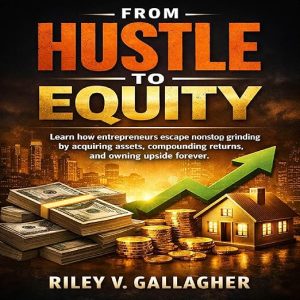
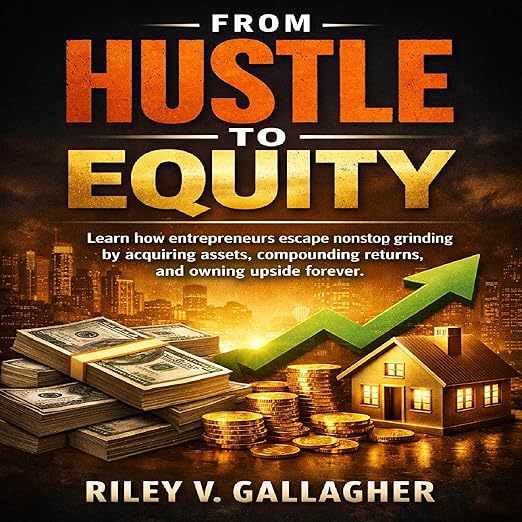
Equity is a word that gets thrown around a lot in business circles, usually by people who are still grinding. Riley V. Gallagher's audiobook From Hustle to Equity earns its title by actually interrogating what equity means in practice: not just ownership on paper, but the kind of compounding, leverage-based architecture that eventually makes the work optional. I came across this one while sorting through a backlog of short-form business listens, and at just over three hours, it landed squarely in the window I had on a long drive between cities. I expected another motivational gloss on the usual advice. I did not expect the clarity of framework I got.
Gallagher's central argument is both straightforward and underexplored in most entrepreneur literature: effort alone does not build wealth. Ownership, leverage, and disciplined capital allocation do. The book draws a firm distinction between income and assets, and it does not gloss over the cognitive shift required to move from thinking like an operator to thinking like an owner. That pivot is genuinely hard, and Gallagher credits it as such. The framing is not that hustle is bad but that hustle without an exit strategy is a trap most ambitious people willingly set for themselves without recognizing it for what it is.
The structure follows a progression from diagnosis to execution. Early chapters deal with the mindset problem: why the entrepreneurial identity is so often built around activity rather than results, and how perpetual busyness can masquerade as strategy. Later chapters get into mechanics: how to assess which assets produce recurring cash flow, how to allocate capital with intention rather than emotion, and how to build systems that do not require constant operator oversight. None of this is new territory for anyone who has read the classics in this space, but Gallagher's synthesis is efficient and his framing around protecting downside risk while maximizing upside potential is a more honest handling of risk than you get in most hustle-culture titles.
The chapter on breaking free from perpetual busyness is particularly sharp. Gallagher identifies the trap with clinical clarity: many entrepreneurs have built a very demanding job for themselves and called it a business. The distinction he draws between a business you own and a role you perform is conceptually simple and structurally important, and he gives it enough room to land without hammering it into the ground. This is writing that trusts its reader to follow an argument without being walked through it twice.
Green's Even Keel Refuses to Oversell It
Robyn Green's narration is clean and steady throughout. Her delivery suits the material well because she does not oversell it. Business audiobooks have a tendency toward performative urgency, with narrators who speed up on key points as if they are pitching to a room. Green keeps an even keel, which lets the frameworks land without feeling pressurized. At three hours, this is also a text you can absorb in a single session and return to specific chapters without needing to reorient yourself in a longer narrative. That compression is actually a feature of the content design: Gallagher writes in tight, enumerated frameworks rather than extended storytelling, so the listen-again value is higher than its runtime suggests.
Where the book delivers most clearly is in its treatment of capital intentionality. The contrast drawn between emotional allocation, which most early entrepreneurs practice by default, and disciplined allocation, which emerges from a clear model of what you are trying to build, is worth the runtime on its own. Gallagher does not pretend this shift is easy. He acknowledges the discomfort of watching capital sit in an asset rather than being reinvested into activity, which is a common behavioral hurdle that most books in this genre wave past. That psychological honesty is part of what gives the practical frameworks credibility.
The book's treatment of systems that scale without constant oversight is another section that carries genuine weight for anyone who has tried to build a second revenue stream while running a first business. Gallagher is specific about what makes a system genuinely autonomous versus what creates a dependency in disguise, and the distinction he makes between the two is one of the more practically useful ideas in the book.
More Positioning Than an Implementation Manual
At three hours, the book cannot go deep on everything it touches. Topics like acquiring cash-flow-producing assets and structuring business portfolios each get chapter-level treatment where a practitioner would want an entire course. This is a positioning book as much as it is a how-to, which means its primary function is to reframe your operating assumptions rather than to serve as an implementation manual. If you approach it that way, the depth is appropriate. If you want granular deal structures or legal frameworks for acquiring businesses, you will need other resources alongside it.
The audience assumption also leans toward people who already have at least one business generating revenue. Gallagher is not writing for the pre-revenue founder who still needs to find product-market fit. The advice around protecting downside while maximizing upside presupposes you have something worth protecting. Listeners who are earlier in their journey may find the frameworks intellectually valuable but practically premature for their current stage.
For Entrepreneurs Past the Survival Threshold
This audiobook is well-suited for entrepreneurs who have crossed the survival threshold and are starting to wonder why growth feels like running faster on the same treadmill. It will also resonate with anyone restructuring a financial life after a first exit and trying to deploy that capital wisely rather than reflexively. Skip it if you are in the early grind phase looking for tactical startup advice, or if you have already read deeply in the wealth-building canon and are looking for new ground rather than a well-organized synthesis of existing principles.
Does the From Hustle to Equity audiobook work as a standalone listen or does it require supplementary material?
It works well as a standalone introduction to the operator-to-owner mindset shift. For implementation, Gallagher points toward frameworks that you would want to explore further with more specialized resources on asset acquisition and capital allocation.
Is this audiobook geared toward people with an existing business or can early-stage entrepreneurs benefit?
The book is most useful for entrepreneurs who already have revenue coming in and are starting to feel the limits of effort-based growth. Pre-revenue founders will find the ideas useful for future planning but may not have the practical context to apply them immediately.
How does Robyn Green handle the narration of business frameworks and enumerated lists?
Green keeps a steady, unrushed pace that makes the structured content easy to follow without feeling like a lecture. She does not dramatize the material, which is the right call for this kind of prescriptive business writing.