
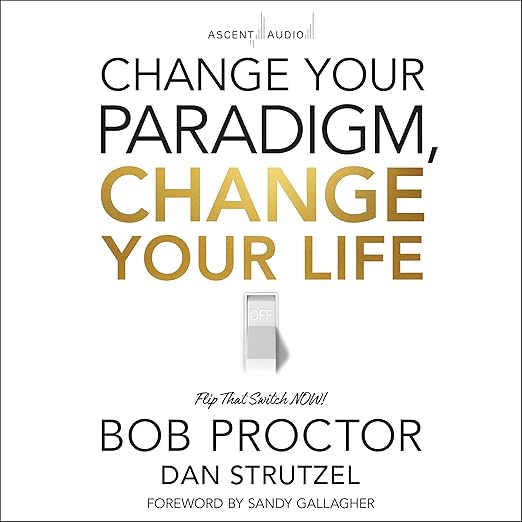
Take the star display off this page before deciding anything, because it is the least trustworthy element on it. Five hours and twenty minutes, Bob Proctor reading his own material, and a badge announcing 4.7 over exactly two ratings. Two people, each handing over a whole number of stars, can produce nine different averages between one and five, and 4.7 is not one of the nine. The tally says two have graded this audiobook while five have written about it at length underneath. What the recording actually is turns out to be considerably more interesting than what the page claims about it.
Diagnosis at Full Strength, Treatment in Outline
Proctor's central term carries a lot of weight and the copy defines it early. A paradigm, in his usage, is the mental programming running underneath every decision you make, and its function is to stop you the moment you attempt something outside your ordinary range. The description lists the disguises it wears: complacency, fear, worry, anxiety, insecurity, self-doubt, mental hurry, self-loathing. Locked in a box and starved of your own ambitions is the phrase used, which is melodramatic and, for a great many people, roughly accurate. From that definition the book makes its one genuinely useful argument, that hours and effort are not sufficient, and that a person can work extremely hard for years inside a paradigm which guarantees the work goes nowhere.
Five stars in October 2025 describe the book's shape better than the marketing does, calling it very short on words and dense with information. Fair, and it cuts both ways. Proctor does not pad. The distinction between knowing something and having it operate automatically gets made once, clearly, then applied across finances, health and lifestyle without much restatement. The consequence is that the practical half, how a person actually replaces one paradigm with another, arrives compressed. You get the diagnosis at full strength and the treatment in outline, which is a common trade in this category and worth knowing about in advance.
Strutzel Asks the Questions, Credited Nowhere
One credit is missing from this record and it is not a minor one. The description states plainly that the book is Bob Proctor in conversation with Dan Strutzel, so a second person sits in the room asking the questions that structure everything. Neither the author field nor the narrator field mentions Strutzel anywhere. In print an uncredited interlocutor is a footnote. On a recording assembled out of a conversation the questioner's timing shapes every answer, and a buyer scanning these credits has no way to learn from the page whether a second voice is on the file at all. Sample before you assume a solo reading.
Five stars in December 2024 describe what a receptive listener takes away: actionable steps, and examples relatable enough to send a reader back through their own thinking rather than nodding along. That response is the strongest evidence on the page for the book's real asset, which is not originality. Proctor's ideas belong to an old tradition of success philosophy and he makes no effort to disguise the lineage. What he brings instead is decades of explaining them to rooms full of people, and that practice shows in the architecture rather than in the content, which is why the argument stays clear across five hours.
A Five-Star Entry Addresses Proctor in Memoriam
Paper is what the written column is largely grading. Four stars in January 2026 assess this title as a manufactured object: the binding was well made, the lettering and the size were good, the ink did not smell, and the subject matter was not to that reader's taste. Every one of those observations concerns a physical article. It is an honest review of a printed purchase and completely useless to somebody deciding whether to spend five hours with a recording. Read the column for whether Proctor's framework lands on people, then stop, because it will tell you nothing about this file.
Five stars again in March 2026, and that entry does something none of the others do: it addresses Proctor directly, in memoriam, and thanks him. That shifts the character of the purchase a little. This is a recording of a man explaining, in his own voice, the framework he spent a working lifetime assembling. For listeners inside his tradition that gives the five hours a weight the printed text would not carry on its own. For listeners outside it, knowing the fact makes the reverence in the surrounding reception legible. Nothing on the record presents this as a final statement, and it is not sold as one.
The Science of Habit Formation Lives Elsewhere
Readers already persuaded by the self-directed success tradition are the natural buyers here, and more specifically anyone who has read widely inside it and kept failing to convert the reading into changed behavior. That exact gap is what Proctor names, and naming it is the most honest thing the book does. Five hours is short enough to take in two sittings and structured enough to return to in pieces, and the self-narration means the framework arrives from the person who assembled it rather than through an interpreter working from a script.
Mechanism is where the book runs thin. It explains what a paradigm is far more thoroughly than it explains how to swap one, so anyone hoping for the science of habit formation with studies attached is in the wrong section of the shop. The business and careers shelf misdirects slightly too: nothing here is about a career in particular, and a Career Success tag oversells the workplace application of what is really a general theory of stuck people. Come for the diagnosis and bring your own treatment plan.
Good to Know
Does the audiobook assume familiarity with Proctor's earlier teaching?
None is required. The description positions this as a synthesis of decades of study, application and teaching, and it defines the central term from scratch before doing anything with it. Newcomers can start here comfortably. Anyone who already knows the tradition will recognize the framework fast and may find the opening stretch familiar.
Does the audiobook reward a second pass through?
A partial one, yes. Just over five hours, arranged as a conversation rather than as lectures, and because the framework is established early and then applied to money, health and lifestyle in turn, returning to the later sections is far more productive than replaying the whole thing. Expect to revisit parts rather than repeat it.
Is this really a business book, given where it is shelved?
Only loosely. The listing files it under business and careers with a Career Success tag, while the description promises to transform finances, health and lifestyle, which is general self-direction rather than workplace strategy. Nothing in the copy addresses management, hiring, negotiation or any other specific professional skill.







