In Brief
- Performance: Read by a professional rather than the author, which keeps an internal framework sounding like information instead of a pitch.
- What it covers: Company operating systems, employee buy-in, management vocabulary, team discussion prompts.
- Feel: Brisk, plain, corporate in the useful sense.
- Our call: Close to essential if your employer runs EOS, close to pointless if it does not.
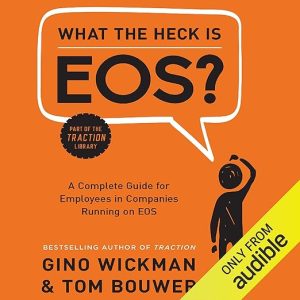
Two hours and sixteen minutes is a briefing, not a book, and this audiobook knows exactly what it is. The description states the target audience without any coyness at all: it is written for the millions of employees inside companies that have already adopted EOS, the Entrepreneurial Operating System. That is an unusual thing to find on a retail listing. Most business titles are sold to the person choosing what to read next, while this one is sold to the person whose employer has already chosen, and everything about its length and its tone follows from that.
EOS is an operating framework, and the first job this book takes on is explaining what an operating system for a company even means to someone who has never thought about the question. From there it works through the tools by name and asks the one question every staff member actually has, which the description prints in plain type: what is in it for me. The written column backs up that this is where the value sits. One detailed response walks through the framework's components, naming Rocks and Level 10 Meetings among the tools the book unpacks, and describes the result as well organized enough to serve new and experienced staff at the same time. That is a specific claim, and it matches the shape of the material.
Nobody should mistake this for the implementation manual. It is deliberately a layer above the how, closer to an orientation document than a playbook, and each tool comes with discussion questions attached so managers and their teams can talk about it rather than simply absorb it. Whether that reads as thoughtful design or as a very short book depends entirely on your position in the building. A leadership team that has already committed to the system gets a way to bring everyone else along. Someone browsing for a management framework to evaluate gets a two-hour argument for a decision that has already been made elsewhere.
A Neutral Professional Voice Reads the Framework
Corporate explainer audio has a specific hazard, which is that the voice can either flatten the material into a compliance video or oversell it into a sales pitch. The reading here is credited to Corey Snow rather than to the author, and for this particular assignment the distance is arguably the right call. A framework being introduced to employees by a neutral professional voice sounds like information. The same framework read by the person who invented it and sells the consulting around it sounds like something else. The credit is the one narration fact this listing supplies, so treat it as a fact rather than as a verdict, and sample a couple of minutes if pace matters to you on a file this short.
Both ratings behind the 4.5 badge are, unusually, fully accounted for. Two votes averaging 4.5 have exactly one solution: one four and one five, with no other combination landing on that display. It is a rare thing on these listings, a badge that breaks no arithmetic rule at all. The counter itself is the strange part. It claims two ratings. Five different people have left written verdicts underneath it, four at five stars and one at four. The star tally and the readable column are not describing the same population, and the column is by far the more informative of the two.
A Reader Who Wished This Came in Paperback
Everything here assumes context you may not have. If your company does not run EOS, this book will read as an extended advertisement for a system you have no way to act on, because the entire premise is that the decision is already made and you are being brought up to speed. One response makes the dependency concrete: six months into rolling out Traction, that reader used this book as the handout that gave managers a layperson's grasp of what was happening to them, and wished aloud that it came in paperback. Useful in that setting. Close to inert outside it.
Format is the second thing to weigh, and the design of the book keeps raising it. This is a volume people buy in order to give to somebody, and audio does not hand across a desk. Each tool arrives with questions meant to be discussed in a room, which is easier to do from a page you can put on a table. If your plan is to distribute this across a team, the listening format works for the individual and works against the group exercise.
The Whole Thing Before Your First Planning Session
Managers preparing to explain a rollout to their teams are the obvious audience, and so is anyone newly hired into a company that already talks in a vocabulary nobody has offered to translate. Two hours means you can do the whole thing before your first quarterly planning session. Business owners considering the system will also get a fast, honest overview of what their employees are about to be asked to absorb, which is a legitimate reason to listen even if it is not the stated one.
Buy something else if you want the framework itself argued from first principles, or if you are shopping for a management philosophy rather than adopting one under instruction. The same applies if you want depth on execution, since the tools are described here rather than taught. Where the purchase is meant to put copies in people's hands before a meeting, the shape of the exercise favors print, whatever the recording does well.
Frequently Asked Questions
Is this audiobook worth listening to if my company does not use EOS?
Probably not on its own terms. The description writes explicitly for employees at companies already running the system, so the material answers questions you would only have from inside one. As an outside overview it works, but you would be listening to an orientation for a decision nobody has asked you to make.
Does the audiobook work as something to give a whole team?
Individually yes, collectively less well. Every tool arrives with prompts designed for a group conversation, and a shared exercise is easier to run from something everyone can see. As a personal catch-up before a planning meeting, just over two hours is close to ideal.