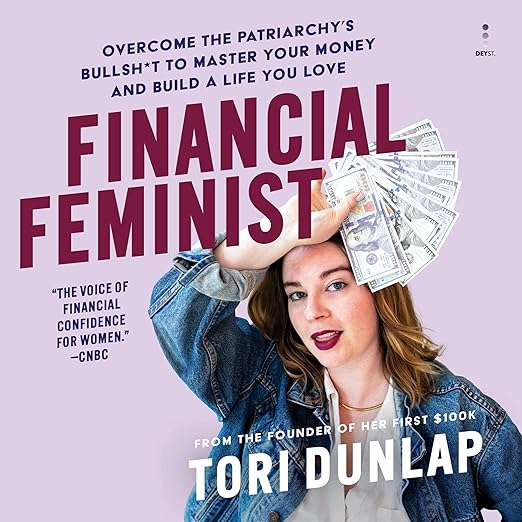
- Read by: Dunlap self-narrates with the fluency of an experienced content creator; personal specificity and conversational authority make this one of the better self-narrated personal finance audiobooks available.
- At its heart: Gender wealth gap and financial literacy asymmetry, shame-free money management, investing and financial independence as political acts
- Vibe: Warm and direct, with genuine urgency beneath the accessible delivery
- Short version: A finance audiobook that earns its breadth by keeping structural awareness and practical advice in productive tension throughout; the self-narration is an asset, not a compromise.
Personal finance books written by women for women have a recurring structural problem: they tend to acknowledge the systemic causes of the gender wealth gap and then pivot immediately into individual behavior change, as if awareness of the system and navigation within it are the same project. Tori Dunlap's Financial Feminist audiobook does something more interesting. It holds both ends of that tension and refuses to let the systemic analysis become an excuse for inaction, while also refusing to let the tactical advice obscure the structural inequity it's addressing.
This audiobook began as the content engine behind Dunlap's Her First $100K platform, a personal finance community that grew into something considerably larger than a brand and closer to a movement. The book emerged from years of teaching financial literacy to women who discovered, as Dunlap did, that the standard financial education directed at women is mostly about restricting spending while the standard financial education directed at men is about building wealth. The asymmetry is the argument. Everything that follows in the eight-hour audiobook flows from understanding that asymmetry as a design feature rather than an accident.
The Altoids Tin System Feels Genuinely Hers
Dunlap's self-narration is one of the audiobook's genuine assets. She has spent years developing content for audio and video formats, and that fluency shows in how the material is paced and delivered. The conversational register never collapses into casualness; she maintains authority without adopting the slightly stiff formality that professional narrators sometimes bring to personal finance content. When she describes her own childhood watching her parents balance their checkbook, or explains the Altoids tin savings system, the memory feels genuinely hers rather than borrowed for effect. The personal specificity is exactly what this kind of audiobook needs to distinguish itself from the shelf of broadly similar titles.
The book covers paying off debt, identifying 'value categories' (Dunlap's frame for aligning spending with actual priorities rather than guilt), saving without extreme deprivation, and investing. The investing section is particularly useful for listeners who have absorbed the message that investing is important but have never received a clear explanation of what index funds actually are or why fees matter. Dunlap does not condescend; she explains compounding and market mechanics with the confidence of someone who expects her audience to understand it once it's explained plainly and without the hedge-everything formality of standard financial disclaimers.
Journaling Prompts as Optional Pauses in the Flow
The journaling prompts embedded in the audiobook are an unusual structural feature for the format, and they work better than they might sound. Dunlap signals them clearly, framing them as optional but useful pauses in the linear flow. Listeners who actually stop and engage with the prompts will get more from the book than those who listen through continuously, because the prompts are designed to surface individual patterns and assumptions that the general framework can't address. The supplemental PDF mentioned in the production notes contains companion material that reinforces this interactive dimension.
Reviewers confirm what the structure promises: one described this as 'the first finance book I've read that provided a clear path forward' after many similar titles, and another noted that the value lies not just in the information, which experienced readers will often recognize, but in the 'confidence and clarity' that Dunlap's specific approach generates. The emotional relationship to money, the shame, the avoidance, the sense that financial competence is something other people have but not you, is addressed directly and repeatedly, which is what distinguishes this from purely tactical personal finance writing.
Strong as Introduction, Short of Portfolio Construction
The book's scope is broad enough that specialists in any single area will find the coverage lighter than they'd like. The chapters on investing are strong as introduction but don't go deep enough for listeners who want to progress beyond index funds to portfolio construction, tax optimization, or real estate. Similarly, the debt chapters cover the standard frameworks without adjudicating firmly between them. This breadth is appropriate for the intended audience, women early in their financial lives or those who have avoided the subject until now, but more advanced readers should calibrate expectations accordingly.
The political dimension of the book is present throughout: Dunlap frames financial independence explicitly as a form of power, and the chapters on voting with dollars and the racial wealth gap situate personal finance within broader equity arguments. Some listeners will find this dimension essential to the book's project; others may prefer their personal finance advice without political framing. That positioning is clear enough in the title and the platform that it shouldn't surprise anyone who picks up the audiobook intentionally.
Dunlap's Voice Makes This Worth Revisiting
Women who are early in their financial lives or who have avoided money management due to shame, confusion, or lack of access to relevant financial education will find this one of the most useful audiobooks available in the personal finance genre. Dunlap's approach is inclusive, shame-free, and grounded in genuine understanding of the specific obstacles that face women navigating financial systems designed with different users in mind. Those who have already read extensively in personal finance may find the tactical sections familiar, though the frame and the voice make the material worth revisiting. The self-narration is essential: this audiobook should not be substituted with a print edition if at all possible, because the personality in the delivery is doing real work that text alone cannot replicate.
Listeners who have been told that personal finance is complicated and not for them will find Dunlap's specific gift is dismantling that narrative in real time, not by simplifying the material but by demonstrating that the complexity was always artificial, a feature of financial education that kept certain people outside the conversation rather than a reflection of the subject's inherent difficulty. That reframing is the book's most durable contribution and the one that will stay with listeners longest after the specific tactical advice has been applied and forgotten.
How does this audiobook handle the intersection of personal finance and systemic gender inequality?
Dunlap holds both simultaneously rather than choosing between them. She explains why women face specific structural disadvantages in accumulating wealth, then provides practical tools for navigating those structures more effectively. Neither the systemic analysis nor the individual advice is used to dodge the other.
Is Tori Dunlap's self-narration of this audiobook worth the format, or would the print edition give the same value?
The self-narration adds genuine value. Dunlap's delivery carries personality and emphasis that a professional narrator reading the same text couldn't replicate, particularly in the personal anecdotes and sections where tone matters as much as content. Listeners able to choose format should pick audio.