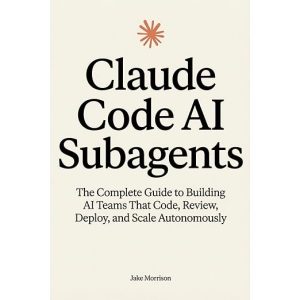
- Narration: Virtual Voice (AI-generated) handles the technical prose competently and avoids major mispronunciation issues, but lacks the enthusiasm and emphasis a human narrator would bring to practitioner-focused content.
- Themes: multi-agent AI orchestration, developer workflow architecture, cost optimization in AI-assisted engineering
- Mood: Technical and practical, with a startup-energy register that suits its target audience
- Verdict: A useful conceptual framework for developers ready to move beyond single-AI-assistant workflows, though the print version is necessary for actual implementation.
AI orchestration guides are proliferating faster than most developers can evaluate them, but Jake Morrison's Claude Code AI Subagents arrives as a Virtual Voice audiobook with specific technical credentials worth examining. At under four hours, this is a compressed treatment of a genuinely complex topic: how to move from single-AI-assistant workflows to coordinated multi-agent development teams. The audiobook format raises immediate questions about whether this material translates from print to audio, and the answer is qualified but positive for listeners who want the conceptual framework rather than the implementation specifics.
The premise of this audiobook is that developers who interact with a single AI assistant, asking it to handle frontend, backend, database, and DevOps concerns simultaneously, are encountering the same kind of cognitive overload that would slow down any human developer asked to context-switch constantly across unrelated domains. Morrison's argument is that the solution is not better prompting but better architecture: create specialized AI agents with focused domains and managed communication between them. That reframing is the audiobook's most valuable contribution.
Virtual Voice's Flatness in the Persuasive Passages
The Virtual Voice narration is an ironic choice for a book about AI orchestration, and not entirely a comfortable one. AI-generated narration works adequately for technical prose where the primary demand is clarity of information delivery rather than interpretive warmth. Morrison's writing is direct and structured, and Virtual Voice handles the technical terminology without the mispronunciation issues that can plague AI narration of domain-specific vocabulary. Whether the content is delivered with the enthusiasm and emphasis a skilled human narrator would bring is a different question, and the answer is that it is not. The flatness is noticeable in the more persuasive passages.
The book's content structure is solid. Morrison works through the problem of "context pollution" in single-agent workflows, then introduces the specialization framework, then builds toward a practical blueprint for a six-agent development team. The inclusion of a "30-day implementation plan" and references to "production-ready agent configurations" suggests the book was designed as a working guide rather than a conceptual overview, and the audiobook format is somewhat at odds with that practical orientation. Technical readers who want to follow configuration examples will struggle without a print or digital companion.
A Cost Section's Reliance on This Moment
The audiobook's conceptual argument is worth hearing even for listeners who will ultimately need the print version to implement it. Morrison's framing of AI orchestration as team architecture rather than tool optimization is a useful shift in thinking, particularly for developers who have hit the ceiling of what a single AI assistant can do well in a complex codebase. The distinction between sequential, parallel, hierarchical, and swarm coordination strategies is explained with enough clarity that it survives the audio format without requiring visual support to follow the logic.
The cost optimization section, which promises a 5x reduction in AI API costs through model selection and caching strategies, is one of the more concrete portions of the audiobook. This is also where the book's reliance on a specific technical moment matters: AI model pricing, capability levels, and optimal selection criteria change rapidly, and recommendations about specific model versions for specific tasks will need updating as the underlying model landscape evolves. Listeners should approach the specific model recommendations as illustrative examples of a selection framework rather than permanent advice for a stable ecosystem.
A Taxonomy of Coordination Failure Modes
The absence of listener reviews at the time of this assessment means evaluation relies entirely on the audiobook's own content and structure rather than accumulated listener experience. The book's 4.5 average from two ratings is too small a sample for meaningful inference. What is assessable from the audiobook itself is that Morrison writes with practitioner confidence rather than theoretical abstraction; the claimed eighteen chapters of "production-ready agent configurations" and "complete system prompts" have the specificity of someone who has built what they are describing and encountered the failure modes along the way.
The "Ship a Full-Stack SaaS in 5 Days" chapter heading is the kind of promise that tends to age poorly in technical writing. What Morrison delivers is a methodology and a blueprint, not a turnkey guarantee, which is appropriate and honest. But listeners approaching the audiobook hoping for a shortcut to that specific outcome rather than a framework for building toward it may feel the promise exceeds the delivery. The value here is in the orchestration architecture, not in any specific timeline claim.
The audiobook's most concrete contribution is probably its taxonomy of coordination failure modes: the ways multi-agent systems break down when agents receive conflicting instructions, when context boundaries are drawn incorrectly, or when the orchestration layer fails to manage dependency chains. Morrison has clearly encountered these failure modes in practice, and naming them clearly gives the audiobook practical value beyond its conceptual framework. Developers who have already tried and failed at naive multi-agent setups will recognize the failure patterns Morrison describes.
Not an Introduction to AI-Assisted Development
This audiobook is best suited for full-stack developers, technical founders, and engineering leads who are already using AI coding assistants regularly and have identified the single-agent ceiling in their workflows. It is not an introduction to AI-assisted development and assumes familiarity with the basic tools. Listeners who want to understand the conceptual shift from single-agent to multi-agent workflows will find the audio format sufficient. Those who need to implement the specific configurations and system prompts described will require the print or digital version alongside the audiobook. The four-hour runtime makes it accessible as a high-altitude technical overview for busy engineering teams.
Common Questions
Can I implement the agent configurations described in the audiobook using only the audio version?
No. The audiobook conveys the conceptual framework and architectural principles well, but the specific YAML configurations, system prompts, and implementation blueprints require a print or digital version to work from. Audio alone is insufficient for hands-on implementation.
How quickly will the specific model recommendations in this audiobook become outdated?
Relatively quickly. AI model capability and pricing change rapidly, and recommendations about specific model versions for cost-performance tradeoffs will need revisiting as the model landscape evolves. The underlying framework for model selection is more durable than the specific recommendations.
Does this audiobook cover agent orchestration beyond the Claude Code environment?
The audiobook is explicitly centered on Claude Code's YAML configurations and system prompt architecture. The conceptual principles of multi-agent coordination translate across platforms, but the specific implementation details are Claude Code-specific.