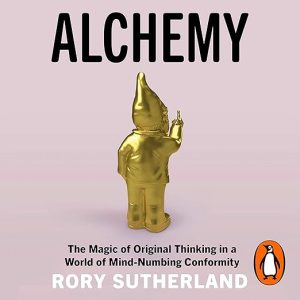
Rory Sutherland's central argument in the Alchemy audiobook is that we have fundamentally misunderstood what drives human decision-making, and that this misunderstanding costs businesses, governments, and individuals an enormous amount of value. Sutherland, who spent his career at Ogilvy before becoming the agency's vice chairman, is making a case against the tyranny of rational models, and he does so with the particular energy of someone who has been waiting a long time to say it at book length.
The full title, Alchemy: The Surprising Power of Ideas That Don't Make Sense, announces the epistemological provocation upfront. His argument is not simply that people are irrational in predictable ways, that's Kahneman's territory, but that irrationality is often the correct response to signals that rational models can't process. Why does Red Bull succeed despite most people finding the taste unpleasant? Because the unpleasantness is a feature that communicates something real about intensity and efficacy. Why do countdown boards reduce perceived wait time on train platforms? Because uncertainty is more painful than delay. Sutherland's examples are memorable, mischievous, and well-chosen.
Sutherland's Comic Timing After Decades of Conference Talks
The self-narration is essential here. Sutherland's voice is the voice of someone who has spent decades thinking about how to make boring things interesting, and that skill transfers directly to the audiobook performance. He reads his own prose with the comic timing of a man who has given many conference talks and knows exactly when a pause earns a laugh. The TED Talk sensibility, his two talks have collectively accumulated nearly seven million views, comes through in how the material is paced: assertion, anecdote, subversion of expectation, repeat. It works. At nine hours and thirty-eight minutes, the cumulative effect is more like listening to an extended, extremely well-prepared lecture than reading a standard business book.
Sutherland borrows freely from evolutionary biology, psychology, philosophy, and magic, and the breadth is one of the book's pleasures. The section on placebos as legitimate value-delivery mechanisms is particularly sharp. His argument is not that placebos are tricks played on credulous patients but that belief itself is a genuine causal factor in outcomes, and that separating 'real' effects from 'perceived' effects is often a category error. This kind of reasoning is not mainstream in marketing or economics, and Sutherland makes it feel unavoidable once it's been stated clearly enough.
Packed With Gems, Missing Cialdini's Evidentiary Rigor
The book's relationship to evidence is deliberately loose, and some listeners will find this a problem. Sutherland is a story-picker, not a meta-analyst. He chooses examples that illuminate his argument beautifully but doesn't engage seriously with counterexamples or the limits of anecdote as evidence. One reviewer accurately noted that 'nearly every page is packed with gems,' which is true, but the gems are argumentative points and illustrative stories, not empirical findings. This is a book of brilliant intuitions, not a systematic account of how consumer psychology actually works. Listeners who expect the evidentiary rigor of Cialdini or the experimental scaffolding of behavioral economics proper will be frustrated.
The irreverence is both Sutherland's greatest asset and his most significant limitation. He is genuinely funny, consistently surprising, and constitutionally hostile to conventional wisdom in ways that feel earned rather than contrarian for its own sake. But the book is also structurally loose: chapters accumulate insights without always building toward a unified framework. What emerges is less a theory than a sensibility, a way of asking 'what signal is this behavior actually responding to?', which may be exactly what Sutherland intended and which has real value even without the architecture of a completed argument.
Nine Hours Toward One Weird Productive Question
Listeners from a marketing or advertising background will find the most direct practical application here. The book's core lesson, that the logic of human behavior is not the logic of optimization but the logic of signal processing under uncertainty, has immediate implications for how products are framed, priced, and presented. Early-career marketers in particular, as one reviewer noted, will encounter ideas that immediately reframe how they think about consumer choices. The audiobook format suits Sutherland's essayistic structure considerably well. Unlike business books organized as argument-then-evidence, Alchemy works best when encountered at the pace of conversation, one observation leading to another, without the pressure of keeping track of a formal structure.
The nine-hour runtime could feel long for a book this digressive, but Sutherland earns the time. His anecdotes are well-selected for surprise as well as illustration, and the cumulative effect of spending nine hours inside his particular way of looking at behavior is to leave you genuinely more capable of asking the weird, productive question about why something works that your colleagues haven't thought to ask yet. That's the book's most honest and most useful promise.
The Marketing-Book Label Undersells This Book's Ambition
Marketing professionals, strategists, product managers, and anyone who finds standard business book fare too earnestly systematic will find Sutherland's sensibility refreshing. This audiobook is also an excellent companion to Kahneman's Thinking, Fast and Slow for listeners who found that book's academic structure useful but wanted something more operationally irreverent. Those seeking rigorous empirical claims and replicable frameworks should look elsewhere; those willing to accept a provocative set of lenses on human decision-making will find the nine hours well spent. The self-narration by Sutherland is not a bonus feature; it's a significant portion of the value, and listeners who can choose the audio format over print should do so.
One final note worth making for potential listeners: the audiobook is not a summary of 'how to use psychology in advertising.' It's an argument about epistemology, about the limits of what rational models can capture, delivered through the specific lens of advertising because that's where Sutherland has spent his working life. The genre label of 'marketing book' is technically accurate but undersells the ambition of what Sutherland is actually attempting.