At a Glance
- Voice: Tegan Ashton Cohan handles the multi-register material, personal disclosure, interviews, and research summary with clear, even delivery that doesn't flatten the emotional sections.
- Big ideas: Late diagnosis of neurodivergence in women, the masking that delays recognition, building environments where divergent minds can contribute rather than merely cope
- Atmosphere: Warm and revelatory, with the texture of a long conversation with someone who has been genuinely inside the experience
- Worth it?: A survey-level audiobook on neurodivergent women that offers real recognition and orientation; best supplemented with condition-specific reading for those wanting clinical depth.
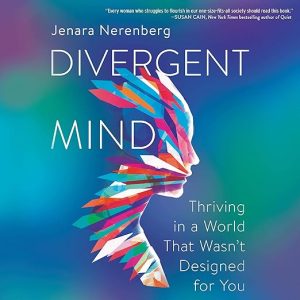
Sitting with a stack of unread email during what felt like a particularly fractured afternoon, I put on Divergent Mind by Jenara Nerenberg almost by accident, having queued this audiobook weeks earlier. Within twenty minutes I had stopped pretending to multitask and was simply listening. That's an experience worth naming in a review of a book about the specific ways that certain brains process the world differently: the audiobook about neurodivergence held the attention of a listener who was having a very neurodivergent kind of afternoon.
Nerenberg, a Harvard and Berkeley-educated journalist, came to this subject through her own late discovery that her decades-long anxiety diagnosis was covering for something more specific: the overlapping traits of autism and ADHD that present very differently in women than in the population from which most diagnostic criteria were drawn. That personal starting point gives the book a specificity that separates it from broader neurodiversity advocacy. This is about women specifically, about the masking and social conformity that delays diagnosis by years or decades, and about what happens when that recognition finally arrives.
The book's central argument is that between a diagnostic system calibrated primarily to younger male populations and the social conditioning that teaches girls to blend in and suppress behavioral differences, potentially millions of women are living with undiagnosed or misdiagnosed neurodivergence. The consequences of that misdiagnosis include depression, anxiety, low self-esteem, and shame that accumulates over years of feeling 'different' without being able to name why. One neurodivergent clinician reviewing the book described it as a text that would have made her own diagnosis 'obvious' had she read it when it was published, which is a specific and meaningful kind of validation for how clearly Nerenberg articulates patterns that previously had no name.
The range of conditions Nerenberg covers is broader than the autism-ADHD axis: high sensitivity, synesthesia, misophonia, sensory processing disorder, and dyslexia are all examined as part of the neurodivergent spectrum. One reviewer noted that the coverage of 'highly sensitive people' and misophonia is stronger than the autism-specific sections, which is a fair read of the relative depth. The book is more a survey of neurodivergent experience in women than a deep dive into any single condition, and that scope is both its strength and its limitation depending on what the listener brings to it.
Cohan's Even Register Across Research-Dense Chapters
Tegan Ashton Cohan's narration serves the material with consistent clarity and an even emotional register that suits both the personal narrative sections and the more research-dense chapters. Nerenberg moves between first-person disclosure, interview material with other neurodivergent women, and summary of scientific research, and Cohan navigates these tonal shifts without jarring the listener between modes. The six hours and thirty-seven minutes of listening time is paced appropriately for material that benefits from being absorbed rather than rushed through.
The practical sections toward the end, which address how to modify communication styles, design environments, and advocate for neurodivergent people in professional and personal contexts, are among the book's most useful. Nerenberg frames these not as accommodations extended from neurotypical structures but as changes that benefit everyone when neurodivergent perspectives are included rather than suppressed. This is the political claim embedded in the book's optimistic conclusion, and it's made persuasively with reference to specific ways that neurodivergent thinking generates value that conformist environments foreclose.
How Recognizable Experience Builds the Book's Case
Listeners who are already familiar with the neurodiversity literature, who have read Simon Baron-Cohen's work on autism or Edward Hallowell's on ADHD, will find some of Divergent Mind's foundational material familiar. The book's differentiation is in its consistent focus on women's experience and in the interview-driven texture that gives abstract concepts a specific human face. Those expecting clinical depth on any single condition should note that the survey approach means no area is covered exhaustively. The book is most effective as orientation and recognition rather than as specialist resource, and the most common response in reviews is a version of 'I wish I had read this years ago.'
The personal disclosure dimension of the book occasionally tips into emotional territory that the research scaffolding doesn't fully support. Some of Nerenberg's claims about social benefit and collective creativity when neurodivergent minds flourish are more aspirational than evidenced. These sections feel true in spirit even when the supporting evidence is anecdotal, but readers with a high bar for empirical grounding should factor that into their expectations. The book persuades through accumulation of recognizable experience rather than through controlled studies.
The Real Names Behind Each Neurodivergent Trait
Women who suspect their neurodivergence has been overlooked or misattributed to anxiety, depression, or simple difference, and those who received late diagnoses and are processing what that means, will find this audiobook both validating and practically useful. Mental health clinicians who work with women and want to understand how neurodivergent traits present differently across gender will find Nerenberg's survey a useful orientation. Parents of neurodivergent daughters, educators, and partners of neurodivergent women are also clearly in the intended audience. Listeners wanting deep clinical specificity on a single condition should use this as a starting point rather than a complete resource, and Cohan's narration is steady and clear enough to make the six-plus hours a comfortable investment.
A practical note for listeners considering this audiobook: the real names and real stories that Nerenberg uses to illustrate each neurodivergent trait are among the book's most valuable assets, because abstract descriptions of how misophonia or synesthesia present in women rarely convey what it actually costs to navigate those traits without a name for them. Cohan's narration handles these testimonials with appropriate care, giving each woman's account its own weight without editorializing over it.
Common Questions
Does this audiobook focus specifically on autism and ADHD, or does it cover a broader range of neurodivergent conditions?
It covers a broad range, including high sensitivity, synesthesia, misophonia, sensory processing disorder, and dyslexia alongside autism and ADHD. The breadth is a feature, not a flaw, but depth on any single condition is limited by the survey format.
Is this audiobook primarily for neurodivergent women, or is it useful for clinicians and family members as well?
Nerenberg addresses multiple audiences explicitly. The book works as recognition and validation for neurodivergent women, as professional orientation for clinicians, and as practical framing for partners, parents, and educators who want to better understand and support neurodivergent women in their lives.