
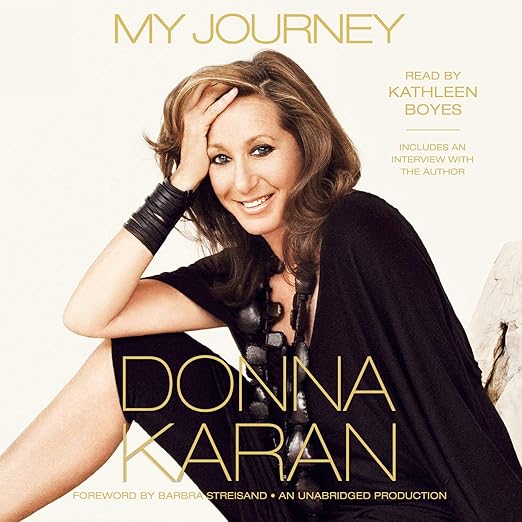
Donna Karan built an empire out of Seven Easy Pieces and then spent this audiobook memoir picking apart the woman underneath the label, and the result earns its Harper's Bazaar best-of-the-year recognition more through candor than glamour. My Journey runs nine and a half hours, narrated by Kathleen Boyes rather than Karan herself, and covers four-plus decades from an intern's desk at Anne Klein to the DKNY empire, with a foreword from Barbra Streisand bookending a childhood Karan describes as lonely despite a fashion-industry pedigree, a tailor father and a Seventh Avenue saleswoman mother who wanted her singing like Streisand or dancing like Martha Graham instead.
Est, Kabbalah, Leech Therapy, and DKNY
The memoir's real subject is not the clothes, despite four decades of them, but the gap between public triumph and private unraveling that Karan keeps circling back to. She writes candidly about a difficult mother, a traumatic childhood, two marriages, and what she calls a search for calm in the chaos, and the book earns credibility by refusing to resolve that search neatly. Reviewer prisrob's take on this captures it well, writing that celebrity memoirs like this one reveal their subjects 'really are pretty much like the rest of us,' parental loss and a mother named Queenie who came home exhausted from work shaping a driven daughter long before any runway did.
What keeps the book from tipping into industry-gossip territory, even with what one reviewer called juicy industry stories, is how directly Karan connects her spiritual searching to her design work rather than treating them as separate chapters of her life. Est, Kabbalah, silent retreats, and leech therapy all get named specifically, an unusual level of candor for a designer whose brand image was built on polish, and she draws an explicit line from that restless curiosity to the seasons of collections she kept producing at Donna Karan New York and DKNY. The chaos, in her own telling, was fuel rather than a distraction from the work.
Boyes Stays Out of the Way
Kathleen Boyes narrates rather than Karan, which shifts the listening experience away from hearing the designer's own voice but gives the memoir a steadier, more consistent read across nine and a half hours than a first-time narrator working from behind her own desk might manage. Reviewer Amanda J. specifically called the book 'very real, honest look at her amazing life,' and Boyes's narration serves that honesty by staying out of the way rather than performing the glamour the subject matter might tempt a lesser reading toward. The measured delivery lets Karan's own contradictions, ambition alongside self-doubt, land without editorial commentary layered on top.
Wintour and Clinton Vouch for Karan
The praise quotes packaged into this edition are worth taking seriously rather than dismissing as jacket-copy flattery, since they come from figures with genuine authority on the subject: Anna Wintour crediting Karan with creating a way of dressing that was womanly, practical, and empowering, and President Clinton speaking to her philanthropic work in Haiti through the Urban Zen Foundation. Hearing those specific, sourced endorsements read aloud alongside Karan's own account of the AIDS advocacy and cultural preservation work behind them gives the philanthropic chapters real weight, rather than the vague gestures toward giving back that lesser celebrity memoirs often settle for.
Positioned against other fashion-world memoirs, the ones built mainly around glamorous anecdotes and boldface names, My Journey distinguishes itself by spending real time on failure and doubt rather than only cataloging triumphs. Karan's willingness to describe reaching the height of professional and financial success and experiencing a personal awakening precisely then, rather than treating success as the story's natural endpoint, sets this apart from the more triumphant, chronological career memoirs the fashion genre often produces, where the climb itself is treated as the whole story rather than what comes after reaching the top.
A Narcissist Who Stepped on People
The three attached reviews all cut off mid-sentence in the source listing, which limits how much of the later reaction can be confirmed, though what survives is telling: reviewer Fashionista describes nearly skipping the book after encountering other reviews calling Karan 'a narcissist who stepped on people to get what she wanted,' before deciding, fortunately in her own telling, to read it anyway. Worth noting for anyone approaching this expecting a tidy hero's journey: Karan's own framing resists that shape, favoring instead a woman who dreamed big, fought to have it all, broke rules, and loved passionately, language that promises contradiction over comfort.
Four Endorsements, Three Ordinary Reader Reviews
This is also a memoir built for readers with at least some existing interest in fashion history or Karan's specific era, the 1980s rise of American womenswear, rather than a general celebrity-memoir audience with no prior context. Names like Seven Easy Pieces, Urban Zen, and the DKNY label carry weight for anyone who followed the industry through that period, but a listener with zero fashion background may find some of the industry-specific stakes harder to fully feel, even with Boyes's narration doing real work to keep the personal stakes legible regardless of prior familiarity with the brand names involved.
Worth distinguishing clearly for anyone browsing the praise attached to this listing: the four glowing lines from Vogue, StyleCaster, President Clinton, and Anna Wintour are professional endorsements gathered for the book's publication, while the three listener reviews, Amanda J., Fashionista, and prisrob, are ordinary readers responding after the fact. Both are worth reading, but they answer different questions, the professional quotes speak to Karan's cultural standing and the book's polish, while the reader reviews speak more directly to whether the memoir actually delivers emotional honesty once someone sits down with the full nine and a half hours.
StyleCaster Calls It Her Parting Gift
This suits anyone who has followed Donna Karan's career, or American fashion more broadly, and wants the interior version of a story usually told through runway photographs and magazine profiles. It also rewards listeners drawn to memoirs about reinvention in midlife and later, the spiritual searching Karan undertook after reaching financial and professional peaks is a genuinely distinct through-line from the standard rags-to-riches structure most business memoirs default to, and StyleCaster's own description of this as 'her parting gift' after she stepped down gives the whole book a valedictory quality worth sitting with rather than rushing through.
This also rewards listeners outside fashion specifically who are interested in creative entrepreneurship more broadly, anyone building something from nothing while managing the personal cost that kind of ambition tends to extract. Karan's account of channeling restless energy and childlike impulses into decades of seasonal collections offers a case study in sustaining creative output under real pressure, a theme that translates well beyond the specific vocabulary of hemlines and fabric to anyone trying to understand how ambition and personal wellbeing can coexist, however imperfectly, across a long career.
Listeners looking purely for practical business or design lessons, a how-to-build-a-fashion-brand playbook, should adjust expectations before starting, since this memoir prioritizes the emotional and spiritual reckoning over tactical career advice. The industry detail is real and specific, but it serves the personal narrative rather than the other way around. Anyone hoping for a structured lesson in brand-building will find more of that ambition unpacked implicitly through Karan's choices than explicitly taught, a fair trade for readers here primarily for the woman rather than the business school case study.
A Few Questions About My Journey
Does Donna Karan narrate her own audiobook memoir?
No. My Journey is narrated by Kathleen Boyes rather than Karan herself, giving the nine-and-a-half-hour memoir a steady, consistent reading across its full runtime.
Does the audiobook include the foreword by Barbra Streisand mentioned in the listing?
The foreword is part of the book's original content, so listeners can expect it included as part of the full audiobook edition alongside the main memoir chapters.







