Key Details
- Voice: Guy Pratt narrates his own stories with the comic timing of someone who has told them live for years.
- Big ideas: Session-musician life, rock and roll excess, four decades backing famous acts
- Atmosphere: Breezy and funny with real edge underneath
- Worth it?: A genuinely funny music memoir, especially rewarding for Pink Floyd fans and backstage-culture readers.
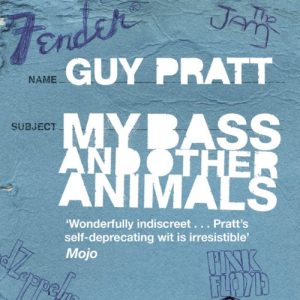
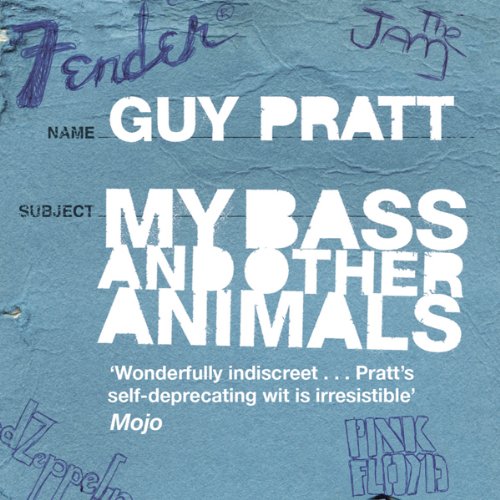
Guy Pratt built an entire career on being the bassist rock stars call when their regular player cannot make the gig, and that specific, slightly absurd career path is the engine behind this audiobook memoir. He has toured with Pink Floyd for decades, backed David Gilmour and Bryan Ferry, and somehow spent one full week as a member of The Smiths, and My Bass and Other Animals narrates that unlikely resume with the same wit that apparently makes him such good company on a tour bus.
A Wink at Gerald Durrell's Family Memoir
The title itself winks at Gerald Durrell's beloved 1956 memoir My Family and Other Animals, and that literary joke sets the tone accurately: this is comic memoir first, rock history second, more interested in the absurdity of the road than in reverent scene-setting about famous album sessions. Pratt's résumé alone is genuinely remarkable, sessions with Madonna and Michael Jackson, a stint supporting David Bowie's tour while playing with the Australian band Icehouse, a story involving Jimmy Page and a wheelchair at customs, but the book's real appeal is how he tells it rather than the name-dropping itself.
E. W. Cowan's review makes an observation worth repeating: the title promises other animals more than bass technique, and that is accurate to the book's actual balance. This skews toward character studies of the eccentric musicians, managers, and hangers-on Pratt crossed paths with over a four-decade career, rather than toward technical shop talk about basslines or gear. If you came in wanting a musician's-musician technical memoir, recalibrate; if you came in wanting stories about surviving the music industry's stranger corners with your sense of humor intact, this delivers exactly that.
His earliest credited collaboration, with Sylvain Sylvain, guitarist and co-founder of the New York Dolls, one of punk's genuinely foundational bands, tells you something about the range Pratt covers even before he gets to the more mainstream stadium acts. That range, from proto-punk grit to arena-rock polish to Bowie-adjacent new wave with Icehouse, all within roughly the same handful of years, is exactly the kind of chameleon career that makes for compelling memoir: Pratt was never one band's guy, he was the industry's guy, on call for whoever needed a bassist who could adapt fast.
Self-Narration Behind a Cracked Rib
Pratt narrates his own material, and self-narration is doing real work here rather than functioning as a novelty casting choice. Lotte Junger's review states it plainly: recovering from cracked ribs while reading this book was a big mistake because the laughter kept aggravating the injury, and that kind of comedic timing, knowing exactly where your own joke needs a beat before the next line, is much harder for an outside narrator to replicate secondhand than for the person who lived the anecdote and has likely told versions of it live for years.
The book grew directly out of a live show Pratt performed at the 2005 Edinburgh Festival, which then toured Australia to sold-out houses before becoming this written and narrated memoir, and that performance lineage shows in the audio pacing specifically. Comic memoirs written for the page sometimes lose momentum in translation to audio; one developed first as spoken performance in front of a real audience tends to keep its rhythm intact, since the writer already knows where a room laughs and where it needs a breath.
It also helps that Pratt built genuine stage-performance chops well before this became an audiobook: the touring show that spawned the book ran long enough, and successfully enough, to justify a full Australian tour, which means the anecdotes here were road-tested in front of real, paying, laughing audiences long before a microphone in a recording booth ever needed to sell them fresh.
Watching a Rotating Cast of Legends Up Close
Ken Coffman's review calls the book 'breezy and fun, but scary too,' and that second half of the description deserves real weight. Pratt is candid about the chemical excess and general debauchery of the touring lifestyle he survived, and while the tone stays comic rather than tragic throughout, listeners sensitive to drug content should know it is discussed frankly rather than glossed over for the sake of a lighter memoir.
This also assumes at least passing familiarity with the classic-rock and Britpop-era landmarks Pratt moves through, Pink Floyd's post-Roger Waters lineup, the Bryan Ferry and Robert Palmer solo years, the general shape of 1980s session-musician culture, to land every reference at full strength. None of it is inaccessible to a newcomer, but a listener who already knows this era of British music will catch more of the specific humor in who Pratt is describing and why it is funny that he ended up in that particular room.
Session-musician memoir is a smaller, less crowded category than frontman autobiography, and it rewards a specific kind of reader: someone more curious about how the machinery of the music industry actually operates, who gets called for which gig and why, than about a single band's internal mythology. If your appetite runs toward a definitive, career-spanning account of one artist's rise, this will feel scattered by comparison; if you want the view from the wings, watching a rotating cast of legends up close without ever needing to be the story's center, Pratt's vantage point is exactly the draw.
The span from Pink Floyd's arena-rock scale down to a comparatively young pop-rock act like McFly says something else about Pratt's career: this is not a musician who peaked in one specific decade and then coasted on nostalgia bookings. Working across genuinely different eras and audiences, from prog-rock's most theatrical scale to 2000s British pop-rock, requires a working session musician's adaptability that a purely nostalgia-driven memoir would not have earned.
Off to the Side of the Spotlight
This is a strong pick for classic-rock fans generally and Pink Floyd devotees specifically, and Lotte Junger's review confirms the Floyd-focused sections do not disappoint even for a self-described hopeless Floyd fan. It also works well for anyone who enjoys backstage-culture memoir as its own genre, in the vein of session-musician or roadie accounts that trade the frontman's ego for a more clear-eyed, funnier view from just off to the side of the spotlight.
Skip this one if you specifically want deep technical discussion of bass playing, songwriting process, or album production, since the book's energy goes toward the human stories rather than the craft mechanics. Listeners looking for a single-artist deep dive, on Pink Floyd alone, for instance, will find Pratt's account is necessarily broader and more scattered across many acts, which is the honest tradeoff of a career this varied.
A Few Questions About My Bass and Other Animals
Do I need to know Pink Floyd's full lineup history to enjoy this audiobook?
Some background helps you catch every reference, but Guy Pratt's storytelling carries the humor even for listeners with only casual classic-rock knowledge.
Is Guy Pratt's own narration part of what makes this audiobook work?
Very much so. His comic timing and lived-in delivery of his own anecdotes give the material a natural rhythm that a hired narrator reading the same stories secondhand likely could not replicate.
How much does this audiobook focus on drug and alcohol content?
The book discusses touring-era excess candidly rather than glossing over it, though the tone stays comic rather than dark throughout.
Does this audiobook focus mainly on Pink Floyd, or Pratt's whole career?
It covers his entire career across many acts and decades; Floyd is a major thread but far from the only one.