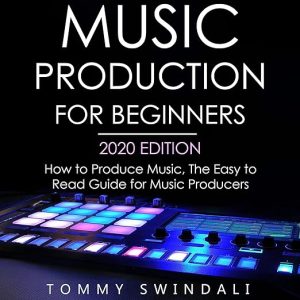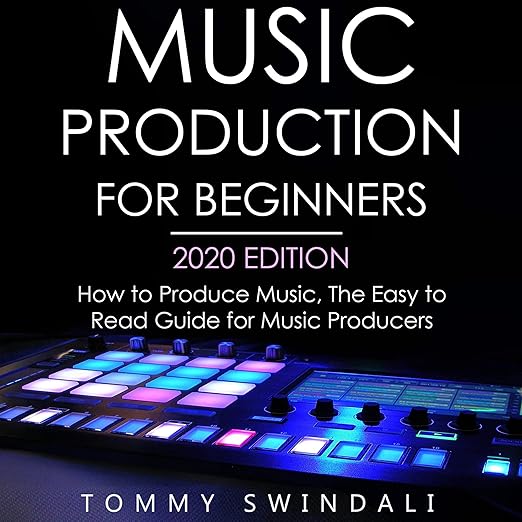
Tommy Swindali's Music Production for Beginners, 2020 Edition positions itself as the single-volume solution to the learning curve that has historically made home recording feel like territory reserved for professionals, and this audiobook captures that promise within its first few minutes. Austin R Stoler narrates the three-and-a-half-hour listen with the kind of practical enthusiasm the material calls for, and the book's central premise, that anyone with a computer and a genuine motivation can now produce release-quality music at home, is accurate as far as it goes. The question this audiobook needs to answer is how far the guidance actually takes the beginner from that premise to the capability it describes, and the answer is more honest than the marketing suggests.
The content covers DAW selection and software options current as of 2020, basic home studio equipment at budget price points, introductory music theory without requiring formal study, and the production chain from composition through mixing and mastering. It also touches on the music industry side: how to pursue distribution and placement for completed tracks. For an absolute beginner who has genuinely never encountered any of this material before, the audiobook provides a usable map of the territory. The map is not deeply detailed, but it identifies the major landmarks and gives the beginner enough orientation to know where to go next in their learning.
It Failed to Explain the Professional Standard
The audiobook's rating of 3.8 reflects a real split in its audience. One set of listeners, those who came with no prior context and needed a broad orientation, found it genuinely useful. Another set, including at least one reviewer with professional studio and record label experience, found it insufficiently rigorous: "It failed to explain what to look for in equipment, what you want to strive for, what the professional standard is." A third reviewer forced themselves through to chapter eight before stopping, finding the content thin enough that it did not improve with persistence.
Both assessments are defensible and point to the same underlying issue: the book is written for the absolute beginner with no prior knowledge, and it does not attempt to serve any listener beyond that. Within that specific audience, the audiobook does what it promises reasonably well. Outside that audience, it delivers very little. This is not unusual for entry-level how-to content, but it means the purchase decision needs to be honest about where the listener actually sits on the knowledge spectrum before investing time.
Stoler Narrates a Home Studio Under Five Hundred
The audiobook format is a reasonable fit for introductory production content because the core concepts, understanding signal flow, the role of a DAW, the function of different plugin types, the stages of the mixing and mastering chain, are conceptual rather than hands-on at this level. Stoler's narration keeps the pace moving without rushing, which is appropriate for listeners who are absorbing unfamiliar terminology and frameworks. The under-four-hour runtime means the listen is completable in a single extended session, which gives the beginner a complete orientation without the commitment that more comprehensive resources require.
The book's coverage of budget-conscious equipment choices is one of its more practically useful sections. The promise of a functional home studio setup for under five hundred dollars is achievable as of 2020 for entry-level work, and Swindali's guidance on where to prioritize spending within that budget is the kind of concrete advice that beginners specifically need when facing a market full of expensive gear and conflicting recommendations from online forums. That single chapter alone may justify the runtime for listeners who are in the pre-purchase research phase of their home studio journey.
No Exercises, Purely Conceptual Content
The 2020 edition date matters more in music technology than in most genres. Software recommendations, pricing information, and the list of relevant platforms for distribution all move quickly in this space, and the audiobook's specific recommendations are now several years old. The conceptual framework, the production chain, the role of each stage, the difference between mixing and mastering, these remain accurate. The specific tool recommendations require updating against current market conditions, which a listener can do with a modest amount of independent research once they have the conceptual orientation the book provides.
The audiobook does not include exercises or hands-on projects. It is entirely conceptual, which is a limitation for beginners who learn by doing. Listeners who want to begin actually making music rather than understanding the framework around music-making will need to supplement this immediately with DAW tutorials, practical exercises, and community resources. The audiobook is a starting orientation, not a complete curriculum, and approaching it as the latter will produce disappointment that belongs to the mismatch in expectations rather than to any particular failure of execution.
Zero Prior Exposure Is the Real Requirement
This audiobook is specifically suited to listeners who have zero prior exposure to music production and want a broad overview before committing to more specific learning paths. It works well as a pre-purchase orientation before investing in software or equipment, giving the absolute beginner enough vocabulary and conceptual grounding to evaluate more specific resources more intelligently. Listeners with any existing production experience, even hobbyist-level home recording, will find the content too introductory to be useful. Those seeking technical guidance on specific DAWs, mixing techniques, or production genres will need more specialized resources immediately. For its intended audience, approached with honest expectations about the depth it offers, it serves as a reasonable entry point into a field that has genuinely never been more accessible.