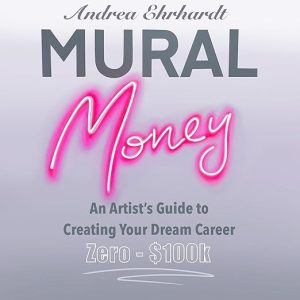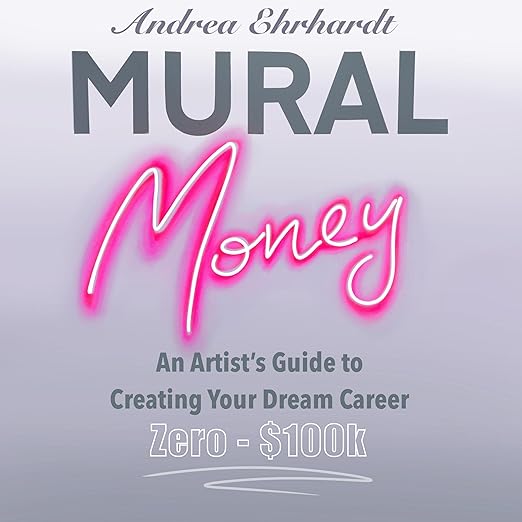
Why do so many capable painters stay broke? Andrea Ehrhardt's answer to that question runs fifteen hours and twenty-two minutes, which is an unusual quantity of audiobook for a subject most creative-business guides dispatch in four. Mural Money is narrated by Ehrhardt herself, and the length is the first thing worth understanding about it. This is not an inspirational nudge toward monetizing a hobby. It is a full course in operating an art business, delivered by someone who states plainly that she has built a six-figure practice doing exactly that, and the runtime is the honest consequence of trying to cover the whole thing.
Like Listening to Someone You're Homies With
Ehrhardt reads her own book, and in this genre that decision carries more weight than usual. A business guide for artists is essentially a transcript of the advice one practitioner would give another across a table, and Alicia Messmer's review captures the effect precisely, calling it "like listening to someone you are homies with chat it up." You cannot hire that quality. A professional reader would deliver identical sentences with cleaner diction and less credibility, because the entire proposition depends on the listener believing the speaker has actually priced a commission, actually chased a late invoice, actually talked a client back from asking for a discount.
Three Readers Outweigh One Unverifiable Number
The runtime is the other headline, and it is a long haul inside this category. The length maps onto scope rather than onto padding. Scott J. Rempe's review lists sections worked through along the way, including "Create your Brand, Find Your Niche, How to Attract Customers," and notes that the material can be taken linearly or dipped into by business area. That is the architecture of a reference course rather than a manifesto. The 4.6 average rests on 40 ratings, which is a small sample by any measure, and reads as what you would expect from a specialist title in a narrow niche rather than as a verdict on quality.
One thing the copy asks you to take on trust is the six-figure claim, since nothing in the listing substantiates it and none of the reviewers audit it either. What they do corroborate is application. Nataliia Callahan reports the book helping an actual business rather than an intention. Rempe describes working through named sections in whatever order a real problem demanded. Alicia Messmer's praise lands on how "real she is with her stories" and on the way Ehrhardt relays her methods, which describes a book that keeps returning to specific incidents instead of retreating into general principle. Three readers who put it to use make a sturdier evidence base than one unverifiable revenue figure, and it is the thing to weigh.
Money Mindset Comes Before the Tactics
The strongest material, according to the reviewer best positioned to judge it, is the psychological half rather than the tactical one. Rempe singles out Money Mindset as the best chapter, having met the same ideas already on Ehrhardt's podcast, and the copy backs that emphasis: she works on "any lingering mental blocks you might have around selling and pricing your artwork" before she works on tactics. That sequencing is correct and it is rare. Most art-business books open with social media and close with tax, whereas opening with the reason an artist habitually underquotes a commission addresses the thing that genuinely caps incomes in creative work.
Self-narration also solves a problem this particular material would otherwise face. A guide about claiming your worth, read by someone who never had to claim theirs, would ring hollow at intervals across fifteen hours, and that is far too long to sustain borrowed conviction. Nataliia Callahan, who read it twice, calls it "the most helpful and informative book about mural painting and business" and reports it changing a working practice rather than a hypothetical one. What fills the runtime is brand construction, audience definition, and the specific ambition of becoming the artist a particular area calls first, which is a more concrete target than most creative-business books ever set.
No Contents List to Jump Around In
Fifteen hours of business instruction has a navigation problem in audio that print simply does not have. The chunked approach Rempe describes, going straight to branding or to niche selection as a need arises, is effortless on a page with a contents list and awkward in a linear recording where chapter titles scroll past in a menu. If you bought this to solve one specific problem this month, expect to hunt for the answer. The material also assumes you will act on it, and acting means writing things down, so the honest recommendation is to treat the listen as a first pass and to keep a text copy available for the second.
Who exactly this is aimed at is the next thing to check, because the title and the description point in slightly different directions. The copy pitches broadly to any artist who wants to "make money with a paintbrush" while the title and the warmest review point squarely at muralists, and Callahan's headline calls it "the best book for muralists" without qualification. Both readings hold up, and the practical consequence is worth knowing in advance: an illustrator or a ceramicist will find the mindset and pricing chapters fully transferable and the market-specific chapters much less so. With so thin a base behind the average, read the reviews individually rather than trusting the number.
Artists at the Hobby-to-Professional Threshold
The core reader here is the working artist who has customers and no system: someone taking commissions, pricing by instinct, quietly aware that the business half is costing real money every year. Muralists extract the most direct value, since the title, the strongest review and the market-specific chapters all point their way. Artists standing at the hobby-to-professional threshold are the other obvious fit, which is precisely the transition Ehrhardt names in her opening pitch, and for them the psychological chapters will do considerably more good than another tutorial on posting schedules ever could.
Give it a miss when a short primer is what you actually need, because fifteen hours is a commitment to make deliberately rather than to discover four chapters in. Skip it too if your ambition is fine-art gallery representation, since the strategies here are built around direct client work and local market positioning rather than around the gallery system. My own reservation is the length rather than the content: the advice is specific, the self-narration earns its place, and yet a book this size asks for a structure that audio does not naturally supply. Go in expecting to relisten to sections, and the hours pay for themselves.
The Short Version
- Voice: Andrea Ehrhardt reads her own book, and one reviewer likens the effect to a friend talking shop; self-narration is load-bearing for advice about claiming your worth.
- Big ideas: Art-business strategy, pricing psychology, money mindset, brand building, niche selection.
- Atmosphere: Frank and conversational, closer to a long coaching session than a lecture.
- Worth it?: Strong, specific guidance for working artists and muralists in particular, provided you accept a fifteen-hour commitment.