The Short Version
- Voice: Self-narrated, which puts the framework's inventor in charge of its emphasis, and makes navigation rather than voice the variable to test in a sample.
- Big ideas: Leadership as amplification or subtraction, accidental diminishing, talent development, doing more with less
- Atmosphere: Brisk, corporate, quietly accusatory
- Worth it?: Worth the eleven hours if you manage people, and a long way to go if all you want is the vocabulary.
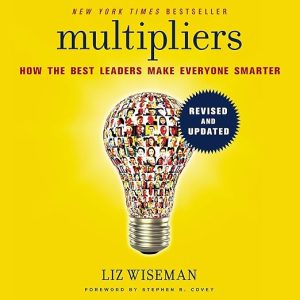
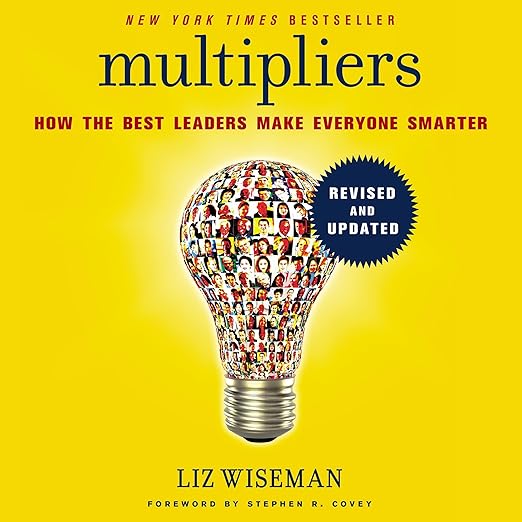
Eleven hours and twenty-four minutes is a long time to spend inside a single management framework, which is the first thing to know about this audiobook. Liz Wiseman reads her own book, a revised edition of a Wall Street Journal bestseller about two kinds of leader: the ones who drain intelligence out of a room and the ones who amplify it. The argument rests on data from more than 150 leaders and resolves into five disciplines. Whether eleven hours feels generous or excessive depends almost entirely on how much you want the case studies.
The Worst Medium for Looking Things Up
The sharpest description of this book does not come from the publisher. One reader who finished it calls it an encyclopedia for leaders, something to be referenced as needed rather than read once through, and adds that it works for anyone with a leadership mentality at any level rather than only for senior managers. That is a more useful frame than the jacket copy, and it flags the format problem head on. An encyclopedia is a thing you look things up in, and audio is the worst medium ever devised for looking things up.
The structure supports that reading. Wiseman sorts behavior into the diminisher and the multiplier, breaks the second into five learnable disciplines, and illustrates each with case studies drawn from the research. This edition adds two chapters, one on accidental diminishers and one on how to deal with diminishers, and both are more immediately usable than anything else on the file precisely because they address situations rather than personality types. The rest works cumulatively, which means the payoff arrives late and the early hours ask for patience.
Wiseman Names Their Own Competence the Problem
A November 2024 five-star singles out the distinction between know-it-alls and challengers, placing it in the fourth chapter and crediting it with naming something conventional management cultivates without meaning to. That pairing is the reason the book has lasted. Wiseman is not writing about bad managers. The subject is competent, well-intentioned, frequently brilliant people whose competence is the problem, who become the smartest person in the room by reflex rather than by design, and who leave meetings genuinely puzzled about why nobody else contributed anything.
In audio the framework survives better than I expected. The disciplines are few enough to hold in your head, the case studies are short, and the vocabulary is sticky in a way that helps: once you have a name for the accidental diminisher, you start catching the behavior in yourself before the chapter is over. That recognition is the real product, and it does not require a highlighter or a notebook to work. The promise the copy makes about doing more with less lands better as a diagnosis than as a technique.
Whole-Star Votes Can't Reach That 4.6
Arithmetic is the first thing to check on this page. The average reads 4.6 while the rating count reads two, and no pair of whole-star votes averages to 4.6. Round two of them together and you land on a whole number or a half, so the only rungs available at that count are 4.5 and 5.0, with nothing in between them. Something larger than two ratings is producing that figure, and until the display is corrected the score is not a number you can reason from.
Wiseman reads the book, which is the right call for material built on interviews and framework vocabulary, and also the call that makes eleven hours feel like eleven hours. An author reading research prose has to sell the same five terms over and over, and the risk is not a bad performance but a flattened one. Cue up a stretch where a case study begins rather than the introduction, and listen for whether the seam between argument and anecdote is audible, because that seam is what tells you where you are in a book you cannot see the shape of.
A response filed on February 20, 2026 is written in Spanish, and it makes a point the English entries do not: that routine and the chasing of targets let a leader forget the role is to develop other people rather than to keep a captive audience for one's own brilliant ideas. It is a good reading of the book. It is also a reminder that a single average here is being asked to carry readers working in more than one language.
Naming the Terms Without Teaching the Procedure
Managers with direct reports are the natural buyers, and the ones who will get the most out of it are the ones who already suspect they might be the problem. A four-star from February 2024 sums up the appeal in two short sentences: easy to follow concepts, easy to read. That is not faint praise in this category, where most titles are neither. The two new chapters also make it worth reacquiring if you read the first edition, because accidental diminishing is the failure mode most readers will recognize in themselves rather than in a colleague.
Look elsewhere if you want implementation detail. This is a diagnostic vocabulary rather than a system, and the case studies illustrate the terms rather than teaching a procedure you can run next week. The same goes for anyone allergic to the two-column business book shape, where every idea arrives as a pair of opposites, because eleven hours of that shape is a lot of shape. And if you want something to return to and search rather than absorb once, the material argues for a format you can scan, which audio is not.
Common Questions
What does the revised edition add to this audiobook?
Two chapters absent from the first edition, covering the diminisher you become by accident and the diminisher you have to work with, plus refreshed examples throughout. Both additions are situational rather than typological, which is exactly why they land as the most directly usable stretches on the file.
Is an eleven-hour audiobook the right format for a framework book?
It is a trade-off. Five disciplines are few enough to carry in your head, so the argument itself survives listening comfortably. The case studies are the problem: short, numerous, and exactly the material you would want to flip back to, which is the one thing audio will not let you do.
Do I need to have read the original Multipliers first?
No. The record presents this as a revised edition rather than a sequel, and the description restates the whole argument from the beginning. Readers of the first edition are buying two new chapters and refreshed examples; anyone new is buying the complete book with nothing assumed.
Is the book mostly research or mostly anecdote?
The copy puts a study base of more than 150 leaders behind the framework, then says case studies and practical techniques bring each principle to life. In practice the research supplies the five categories and the stories carry most of the running time, which is why the book feels longer than its argument.