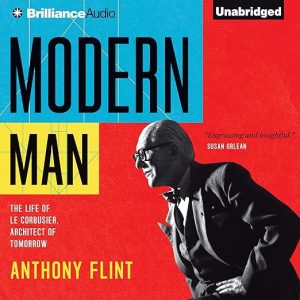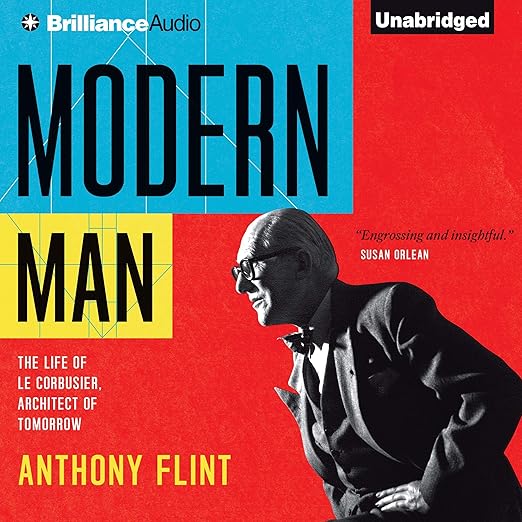
Le Corbusier invented new ways of building and thinking, and Anthony Flint's biography treats that invention as inseparable from a life that included Josephine Baker as a lover, high-stakes global commissions, and a legacy that remains genuinely controversial to this day. This audiobook, narrated by Mel Foster over eight and a half hours, works best as a psychological portrait first and an architecture lecture second.
Corbusier Reinvented Even His Own Name
Born Charles-Édouard Jeanneret-Gris in a Swiss watchmaking town at the end of the nineteenth century, Corbusier reinvented himself so thoroughly, name included, that Flint treats the self-invention itself as a subject worth examining rather than a footnote. The book positions him as the grandfather of modern architecture, but Flint's real interest, echoed directly in the synopsis's own framing, is in a man who wanted to remake the world according to a personal vision, dispelling Victorian style and replacing it with something the world hadn't seen before.
The synopsis pitches the book directly at listeners drawn to 'the complex personal lives and outsized visions of both groundbreaking artists and dazzling, charismatic innovators like Steve Jobs,' and that comparison is doing real work. Flint isn't just cataloguing buildings; he's tracing a specific personality type, brilliant, self-mythologizing, and difficult, that recurs across creative fields well beyond architecture.
Five Points That Reshaped Modernist Buildings
Corbusier's actual architectural legacy is worth grounding concretely: he articulated what became known as the five points of architecture, pilotis lifting buildings off the ground, roof gardens, open floor plans, ribbon windows, and free facades, principles that reshaped how modernist buildings got designed worldwide, from Villa Savoye outside Paris to his later urban planning work in Chandigarh, India. Flint's biography treats those innovations as inseparable from the specific, often difficult personality that produced them, refusing to separate the visionary from the man alumni, clients, and even his own wife found genuinely hard to live alongside.
Corbusier's urban planning philosophy, towers set apart from each other within open green space rather than dense traditional streets, went on to directly shape decades of postwar public housing construction worldwide, for better and frequently for worse; Flint doesn't shy away from tracing that influence forward into housing projects whose failures get blamed on Corbusier's original vision as often as on how badly later planners executed it. That afterlife, well beyond his own lifetime, is part of what keeps his legacy genuinely contested rather than settled.
The 'starchitect' comparison in the synopsis reaches forward to a very current phenomenon, celebrity architects like Zaha Hadid or Frank Gehry whose personal brand becomes inseparable from a building's civic value, and Flint's argument is that Corbusier essentially invented that template decades before the term existed. Watching a biography trace a now-familiar cultural pattern back to its actual origin point is one of the book's more quietly effective moves.
Calling this a psychological portrait rather than a standard career biography sets real expectations: chronology takes a back seat to motive throughout, and Flint circles back repeatedly to the same underlying question, what made a man this talented also this compelled to remake everything around him, rather than simply cataloguing buildings in the order he designed them.
Foster's Breezy Narration Threads a Needle
Mel Foster's narration draws a specific compliment from one reviewer, who calls the whole biography 'breezy' even while acknowledging its subject's mercurial, difficult life. That's a real needle to thread, given how contentious Corbusier's legacy remains, and a breezy tone risks feeling glib if handled wrong; the reviews suggest Foster and Flint together keep it accessible without flattening the real controversy underneath.
The book leans hard into biographical color that plays well in audio specifically, the Josephine Baker relationship, the international commissions, the sheer scale of Corbusier's ambition, and Foster's pacing gives that material room to land as genuinely dramatic rather than dry chronology.
Wrestling With Moses Prepared Flint for This
Flint's own background matters for how this book gets built: Wrestling with Moses, his previous book, traced Jane Jacobs's fight against Robert Moses over the future of New York City's streets, and that same interest in architecture and urban power as a genuinely dramatic subject, not just a technical one, carries directly into how he frames Corbusier's global ambitions here.
Corbusier's Chandigarh work, an entire planned Indian city built from scratch after partition, gets treated as the culmination of his most totalizing ambitions, the same difficult, uncompromising instinct scaled up from a single building to the size of a government commission, and Foster's pacing through that section keeps the sheer audacity of the project legible without losing the reader in urban-planning jargon.
Bland and Passionless, According to His Wife
Not every reader is convinced the book fully justifies its runtime. One reviewer gave it three stars and was blunt about it: 'Informative but boring. Not worth my money. Maybe it would be more interesting for an architect or architect student.' That's a real, specific caveat worth taking seriously if you're not already invested in architectural history.
A second reviewer, a working contractor, brings a craftsman's skepticism to the subject's actual output rather than his biography: 'The saying that art is in the eye of the beholder definitely applies to Le Corbusier's designs,' he writes, adding pointedly, 'His wife was right, they were bland and passionless.' Listeners expecting a straightforwardly admiring portrait should know the book, and its reviewers, leave real room for disagreement about whether Corbusier's actual buildings hold up.
The book's controversial subject means the reviews genuinely diverge on tone: some read it as a fair, warts-and-all psychological portrait, while Nancy Cowan's three-star review suggests the professional detail simply doesn't sustain interest for a general audience the way the Josephine Baker material might promise. That range of reaction is worth taking as a real signal about fit rather than noise to filter out.
Josephine Baker's own celebrity, an American-born entertainer who became a genuine icon of Jazz Age Paris, gives the relationship real historical texture beyond a scandalous footnote; Flint treats it as evidence of how thoroughly Corbusier moved through the era's cultural elite, not just its architectural circles.
Works Even Without Prior Architectural Interest
Architecture and design history enthusiasts, readers who enjoy ambitious-genius biographies in the Steve Jobs mold, and returning fans of Flint's own back catalog will find a lot to like in how he handles another outsized, controversial builder of the modern world.
Readers who enjoy biography built around a single, world-reshaping obsession, regardless of field, will likely find Corbusier's specific mix of genuine vision and genuine difficulty compelling even without prior architectural interest.
It's also a useful listen for anyone interested generally in how utopian design ideals curdle in practice, a pattern that recurs across urban planning history well beyond this one architect's specific story.
General listeners without any real interest in architecture or urban design history might find the professional detail slower going than the Josephine Baker headlines suggest; Nancy Cowan's blunt verdict, 'Informative but boring,' is worth taking seriously if lecture-paced nonfiction already tests your patience.
Key Details
- Read by: Mel Foster's delivery is called 'breezy' by one reviewer, keeping a controversial, detail-heavy biography accessible without flattening the real disagreement about its subject.
- At its heart: architectural ambition, self-reinvention, the cost of genius on those around it
- Vibe: Engaging but genuinely mixed in reception, closer to a character study than a straightforward tribute
- Short version: A strong pick for architecture and design-history listeners, a riskier one for anyone without existing interest in the field.
Good to Know
Do I need a background in architecture to follow this audiobook?
Not strictly, but reviewers are split on how engaging the material is without that interest already in place. One reviewer specifically suggests it would land better for an architect or architecture student than a general listener.
Does this audiobook cover Le Corbusier's actual buildings in detail, or mostly his personal life?
Both, but the emphasis leans toward psychological portrait and personal history, including his relationships and self-reinvention, with his architectural output examined more as evidence of his character than as a technical survey.
Is Modern Man a flattering biography of Le Corbusier?
No. Reviewers note real ambivalence in the book itself and in their own reactions, with one contractor reviewer going so far as to call the buildings themselves 'bland and passionless,' so listeners should expect a warts-and-all portrait rather than a tribute.
How does this audiobook compare to Anthony Flint's earlier book, Wrestling with Moses?
Both examine a single outsized, controversial figure reshaping the built world around a personal vision; listeners who enjoyed Flint's take on Jane Jacobs and Robert Moses will recognize the same appetite for architectural power struggles here.