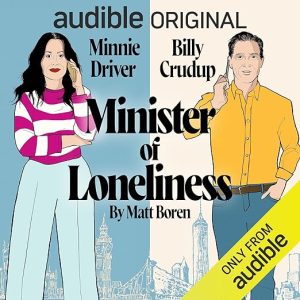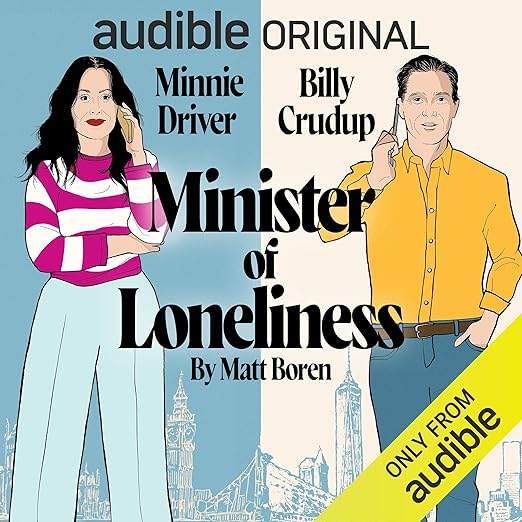
Matt Boren's Minister of Loneliness is structured as a performance piece before it is a conventional audiobook. Billy Crudup and Minnie Driver play out a love story across four phone conversations in this 1-hour-42-minute production, available in Dolby Atmos on compatible platforms. The form is precise: two characters who will never share physical space, a relationship that builds entirely through the quality of their attention to each other's words. The context is both comic and genuinely moving - Julia Fletcher is the UK's outgoing Minister of Loneliness, a government role designed to address the emotional epidemic in modern society, and she is conducting an interview with Henry Hall, a New York academic, as her unlikely potential successor.
A Closer Look at Minister of Loneliness
The conceptual premise is doing serious work here. Julia's job title positions her as someone professionally tasked with addressing emotional isolation in the public, and the dramatic irony is that the conversations with Henry reveal her own unaddressed version of the same condition. She is, as the synopsis notes, clearly passionate about the job she is leaving. The question Henry asks near the end - why is she leaving something she cares about so much? - is the one she hasn't prepared for, and that unprepared vulnerability is where the story's emotional center lives. Boren writes dialogue that allows Crudup and Driver to find the comedic language that develops between two intelligent adults discovering they enjoy each other's company. The professional interview frame - philosophical questions designed to reveal character - becomes a romantic catalyst, which is both the joke and the earnest thing the story is saying about how connection actually forms: through the quality of someone's questions and the honesty of your answers. Henry is described as an "iconoclastic, beloved professor" who displays "a vulnerability neither of them were expecting," and Crudup performs this as a man who has written about vulnerability as a subject without fully experiencing it as an ambush. Driver plays Julia's guardedness against her genuine interest with impressive precision throughout all four conversations, calibrating the distance between professional conduct and personal disclosure in ways that the phone call format makes legible without requiring visual cues. The four-conversation structure means each call is a discrete scene with its own arc, and the cumulative weight across the full runtime is considerable for a piece under two hours.
What Makes Minister of Loneliness Worth Hearing
Crudup and Driver are the entire argument for this audiobook. A lesser-cast version of the same script would produce something competent but forgettable. What these two performances create is the sense of two people discovering that a conversation they expected to be formal has become something they are reluctant to end. Driver calibrates Julia's professionalism against her guardedness against her wit with considerable precision - you hear exactly where the emotional armor is, and exactly when it begins to slip. Crudup's Henry is more immediately open, a writer and professor who has thought about vulnerability as a subject and is now confronted with it as an experience. The Dolby Atmos production on compatible devices adds a spatial quality to the phone call format that is worth seeking out if you have the hardware - the effect of hearing two voices occupying different sonic environments while speaking with each other is a formal expression of the story's subject matter. At 1 hour 42 minutes, this is a piece that rewards uninterrupted listening. The four-conversation structure means it can be paused between sections, but the accumulation of detail across all four calls is part of how the emotional payoff works. Returning to individual conversations after completing the full piece reveals how carefully the dialogue has been constructed to plant what comes later.
Things to Know Before Starting Minister of Loneliness
The production is spare by design. There is no narration beyond the conversations themselves, no scene-setting descriptions, no account of what these characters look like or how they sit when they talk. The story exists entirely in the performed dialogue, which means listeners who prefer more conventional storytelling frameworks may initially find the format austere. There's also a tonal balance the piece has to maintain - too much comedy and the genuine feeling evaporates; too much earnestness and the absurdist premise tips into sentiment. Boren and the performers manage this throughout, but the tonal precision requires a certain receptivity from the listener. Treat it as a recorded play rather than a traditional audiobook and the format makes complete sense. The rating of 4.6 from nearly 800 listeners, without any published written reviews attached to this listing, suggests the performances land effectively for a general audience - the emotional logic of two people discovering connection through an unusual professional context translates without critical framing to guide expectations.
Who Matt Boren Is Writing For
Listeners who value audio performance as a form in its own right will find Minister of Loneliness among the more accomplished examples of what the medium can do when it stops trying to replicate the experience of a conventional novel. Anyone with interest in the genuine intellectual puzzle of what it means to be a government minister tasked with addressing loneliness - a role that sounds satirical but is real - will find the premise rewards the runtime. The compact 1-hour-42-minute length makes this an easy single-session listen with no prior preparation required. Listeners who need a full traditional narrative arc with explicit resolution should be aware this is a chamber piece with a deliberately open ending. But within its chosen form, the production is exceptional - the kind of work that reminds you what two skilled actors can build from nothing but dialogue and space.