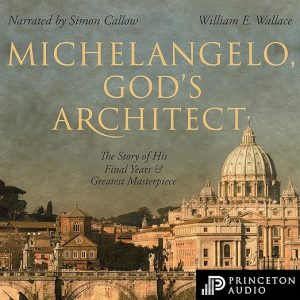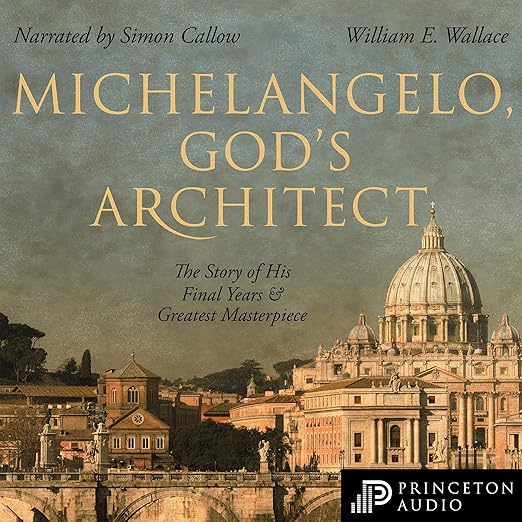
What does a seventy-year-old sculptor do when the commissions dry up and his contemporaries start dying around him? Michelangelo, as William Wallace tells it in this audiobook, responds by carving his own tomb, and then, almost by accident, ends up running the largest building project in Renaissance Europe. Michelangelo, God's Architect focuses deliberately on the least-covered stretch of the artist's life, his final two decades, when a painter and sculptor with no formal architectural training took over St. Peter's Basilica from a disastrous prior design and refused to die before securing his own vision for it. Actor Simon Callow narrates, bringing an outsider's theatrical instincts to a subject Wallace has spent a career studying.
Michelangelo as Businessman Rather Than Pure Genius
Wallace's real subject isn't Michelangelo the genius, a story told plenty of times elsewhere, it's Michelangelo the businessman and engineer, navigating church politics, flawed prior construction, and the practical mechanics of building the largest church ever attempted. The book's central drama plays out less in a studio than in meetings with resistant church officials, as an aging artist with no formal architectural credentials talks a pope into scrapping years of prior work and starting over. That's a genuinely under-told angle on a figure most listeners think they already know, and Wallace, who has written multiple prior books on Michelangelo, clearly relishes filling in a corner of the biography popular culture skips.
Cradle-to-grave completeness was never Wallace's goal, and the book is stronger for staying disciplined about it. Rather than rushing through the Sistine Chapel and the David to get to the good part, he simply starts near the end and stays there, treating Michelangelo's faith, his stubbornness, and his physical decline as inseparable from the engineering problems he was solving. One reviewer, an admitted Michelangelo enthusiast, opens their own review with a vivid historical detail about marble columns still being delivered to a Roman church construction site a month after the artist's death, a small illustration of just how much unfinished business Michelangelo left behind.
Faith and St. Peter's Fed Each Other
Wallace treats Michelangelo's deepening Catholic faith during these final decades as a genuine psychological throughline rather than a footnote, connecting the artist's increasingly devotional later poetry to the immense scale and purpose of the St. Peter's project itself. Building what he believed would be the physical center of the Catholic world gave a man in declining health and repeated grief a reason to keep working that a smaller commission couldn't have supplied; Wallace makes a convincing case that the scale of the project and the depth of Michelangelo's faith fed each other rather than existing as separate threads of the same late-life story.
The title's own framing, 'God's Architect' rather than simply 'The Architect' or a more neutral biographical label, signals upfront how seriously Wallace treats the religious dimension of this specific chapter in Michelangelo's life; St. Peter's wasn't just another commission but an assignment Michelangelo increasingly understood in explicitly devotional terms, building for God rather than for a patron's ego. That framing choice in the title itself previews the book's central argument before the first chapter even begins.
Callow Also Wrote Several Volumes on Orson Welles
Simon Callow's background as an actor and a biographer in his own right, his book on Orson Welles runs to several volumes, gives him a genuine feel for a subject who spent his final decades essentially directing an enormous, unfinished production. Callow brings theatrical gravitas without tipping into performance for its own sake, and his evident cultural fluency in Renaissance Italy and European art history makes complex architectural and political material feel inhabited rather than simply recited.
A former student of Wallace's, reviewing the audiobook years after taking his Art History 101 class at Washington University in St. Louis, credits the professor with genuinely opening his eyes to art as an undergraduate, and that same gift for narrative clarity carries through into the writing here. Wallace doesn't write like an academic protecting his turf with jargon; he writes like someone who wants a general audience to feel the same excitement he apparently generates in a lecture hall, and Callow's narration honors that accessible register rather than dragging it toward stuffiness.
Callow differentiates the voices of Michelangelo and the various cardinals and church officials he sparred with clearly enough to follow multi-person meetings without confusion, a real technical achievement given how much of the book's drama plays out in dialogue-heavy negotiation scenes rather than narrated action. His Michelangelo carries a weariness that never tips into self-pity, matching Wallace's own portrait of an old man too stubborn to slow down even as his body increasingly wanted him to.
Treat This as a Companion Volume Instead
The narrow chronological focus cuts both ways. Listeners expecting a full biographical arc, apprenticeship through the Sistine ceiling through old age, will need to look elsewhere or treat this as a companion to a more comprehensive Michelangelo biography rather than a standalone introduction to the man. Wallace assumes at least passing familiarity with the broader shape of Michelangelo's career before diving into these final, architecturally focused decades.
Stubbornness Recurs, Dome Engineering Gets Real Depth
At least one reviewer flagged real repetition across the book's chapters, and it's a fair complaint for a work covering a fairly contained twenty-year period in this much depth. Certain themes, Michelangelo's stubbornness, his distrust of rivals, his conviction that outliving his critics was itself a strategy, recur often enough that the argument can feel like it's circling rather than always advancing. The density of church politics and construction logistics also demands more sustained attention than a typical artist biography; this isn't a book built for background listening during other tasks.
Listeners should also expect real technical detail about Renaissance-era construction methods, dome engineering, structural load, the mechanics of correcting a partially built foundation, alongside the more character-driven material. Wallace doesn't dumb this down for a popular audience, which rewards listeners with genuine curiosity about how buildings of this scale actually got built in the sixteenth century but may occasionally slow the pace for listeners primarily interested in Michelangelo's personality and relationships rather than his engineering decisions.
Not a Book for Total Newcomers
Art history enthusiasts who already know the broad strokes of Michelangelo's career are the clearest audience, along with anyone specifically curious about how St. Peter's Basilica actually got built rather than just who's credited with designing it. Wallace's academic credentials, he holds an endowed chair in art history and has published multiple prior books on the same subject, give the material real scholarly weight without the audiobook ever feeling like a lecture transcript.
Newcomers looking for an introductory, birth-to-death Michelangelo biography should probably start elsewhere first and treat this as a deep dive to return to later, since Wallace's tight focus and assumption of prior context reward existing familiarity more than they build it from scratch. The repetition another reviewer flagged is real, though modest, and mostly shows up in how often certain personality traits get re-illustrated with new examples rather than in any structural confusion about where the book is headed.
Before You Listen
Does this audiobook cover Michelangelo's early career and the Sistine Chapel?
Only in passing. The book focuses deliberately on Michelangelo's final two decades and his work on St. Peter's Basilica, assuming listeners already have some familiarity with the earlier, more famous chapters of his career.
How much of the audiobook focuses on St. Peter's Basilica specifically?
A great deal of it. The struggle to redesign and construct St. Peter's after Michelangelo took over a mismanaged project in the 1540s is the book's central through-line.