Quick Take
- Voice: Hart reads her own memoir with the candid, quick-witted energy her fans know from Clarissa and Sabrina; the voice is warm and self-deprecating without becoming performatively humble, which is exactly the register a behind-the-scenes memoir requires.
- Big ideas: child stardom and self-preservation, growing up inside the entertainment industry, maintaining identity under relentless public attention
- Atmosphere: Affectionate and frank, with moments of genuine industry candor
- Worth it?: Melissa Joan Hart self-narrating is the obvious right choice for a memoir about authenticity, and the result is an audiobook that rewards both longtime fans and listeners coming to her story fresh.
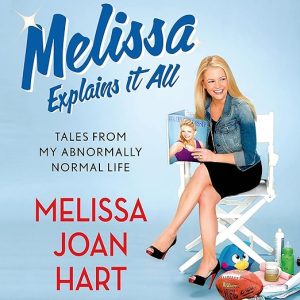
Melissa Joan Hart narrating Melissa Explains It All is one of those self-evident casting decisions that only becomes more right as the audiobook progresses. Hart made her name playing characters defined by a particular kind of frankness, Clarissa Darling's direct-to-camera address, Sabrina Spellman's casual disclosure of magic in a world of secrets, and the memoir carries that same quality. She explains, matter-of-factly, what her career has looked like from the inside, how she got the jobs, what went wrong, what the industry does to people who cannot hold their center, and how she managed, mostly, to hold hers. The self-narration at seven hours and six minutes never feels like someone performing their own life story; it feels like someone sitting down to tell you things they have been thinking about for a while.
The memoir begins, characteristically, with a four-year-old Melissa deciding that if there were no girls named Melissa on her favorite show, she would get on television her own way. That particular species of early self-determination, the kind that does not recognize the word improbable, runs through the entire book as its organizing principle. Hart describes a career built not through luck or famous parents but through specific drive applied to specific opportunities: booking three national commercials to fund a tree house, nailing the Clarissa audition by understanding exactly what the character required, managing the pressures of Sabrina's Teenage Witch without losing the work itself. The humor is consistent and not performative; she is genuinely funny about situations that could easily be framed as tragedies.
The Craft Is in the Sequencing, Not the Chronology
The craft of the memoir, and it is a well-crafted book rather than a quickly assembled celebrity product, is in the selection and sequencing of episodes. Hart does not attempt a comprehensive chronology of everything that ever happened to her; she selects the stories that illustrate specific aspects of how she built a career and stayed sane inside it. The guest appearances she describes, Saturday Night Live, The Equalizer, the Broadway period, are not name-dropped for their own sake but used as markers of the different registers her career has moved through. Each anecdote has a function in the larger argument the memoir is making: that staying grounded requires more than good intentions, it requires specific habits and relationships and the willingness to see the entertainment industry clearly rather than through the lens it would prefer you to use.
The sections about Sabrina are likely what most listeners are anticipating, and they deliver. Hart's account of working with Salem the Cat, of the set dynamics on a show that ran for seven seasons and required constant reinvention, of meeting her husband at the Kentucky Derby while Sabrina was still running, has the detail and specificity that good celebrity memoir requires. She is honest about what the show cost her in terms of time and personal development without being resentful about it, which is the harder emotional position to hold and the one that makes the book worth listening to.
The Psychology of Sustained Competence, Read Aloud
Hart's self-narration is not just appropriate; it is the book's primary pleasure. The prose has a conversational rhythm that suggests it was written to be spoken, and the delivery reinforces that. When she is building to a punchline, the audio version lands it better than the page because she has natural comic timing. When she is being honest about something uncomfortable, the voice does not become stagily vulnerable; it stays matter-of-fact in the way that suggests the discomfort was real and has been processed rather than being performed for the listener's benefit. Kelly T's review note about laughing through the first chapter is accurate to the experience of listening; Hart is funny in a way that requires no setup.
The audience for this book is broader than confirmed fans, though confirmed fans will obviously get the most from the specific references. The larger story, about how to build a long career in a field that devours most people who enter it, is relevant beyond the specifics of Clarissa and Sabrina. Hart's account of how she maintained a foot in Hollywood and a foot in reality is, at its core, a memoir about the psychology of sustained competence, and that is interesting regardless of whether you watched TGIF on Friday nights in the 1990s.
The Industry's Pressure on Young Women, Named Plainly
The memoir contains a frank discussion of the entertainment industry's particular pressures on young women, handled without the self-pity that would make it uncomfortable or the breezy minimization that would make it dishonest. Hart is specific about what she saw happen to people around her who did not have the stabilizing forces she had, and that specificity is one of the things that earns the memoir its credibility. It is not a book that pretends the industry is kinder than it is; it is a book about how one specific person navigated a specific set of pressures successfully.
The section on her early Broadway days, often overlooked relative to the television material, provides useful context for understanding Hart's orientation toward the craft of acting. She came to television with stage training and a particular attitude toward preparation that she traces back to those early experiences, and that backstory illuminates the professionalism that runs through the rest of the memoir. Listeners who are interested in the craft side of performance, not just the celebrity narrative, will find these sections particularly useful.
For This Memoir, the Voice Is the Point
Lifelong Melissa Joan Hart fans will find their investment in the book immediately rewarded, but the memoir functions well for listeners approaching it cold if they have any interest in behind-the-scenes entertainment industry writing or in coming-of-age memoir more broadly. Parents who watched Clarissa or Sabrina with their children and are now curious about the adult perspective on those years will find the book speaks to both their nostalgia and their curiosity. The self-narration is the essential delivery mechanism here; the print edition has the same content, but the audio version has the voice, and for this particular memoir, the voice is the point.
Before You Listen
Does Melissa Joan Hart narrating her own audiobook make a significant difference to the listening experience?
Yes. Hart has natural comic timing and a conversational delivery that makes the memoir feel like a direct conversation rather than a read text. Multiple reviewers note laughing hard during the opening chapter, which is a response to her voice and pacing as much as to the content itself. The self-narration is the clearest reason to choose the audio format.
How candid is the audiobook about the realities of being a child and teen star in Hollywood?
Quite candid, in a measured way. Hart discusses the pressures and what she saw happen to peers who did not have her stabilizing circumstances, without being sensational or resentful. Reviewers note that the book does not shy from the industry's real dynamics, but frames them through the lens of how she navigated them rather than as an exposé.