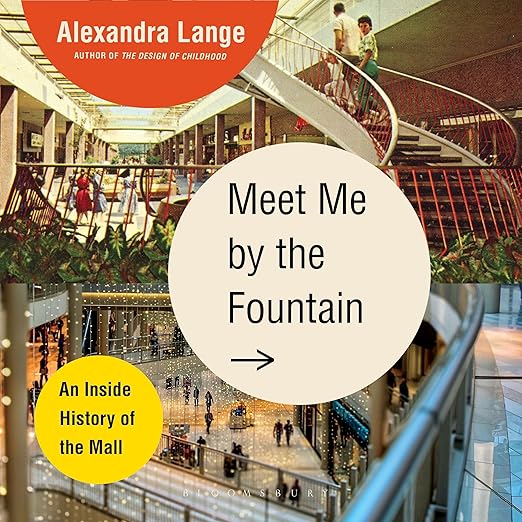
Southdale Center in Edina, Minnesota opened in 1956 as the country's first fully enclosed shopping mall, and it is still doing business today, a detail that sets the tone for everything Alexandra Lange does in the audiobook Meet Me by the Fountain. Narrated by Mikhaila Aaseng, this cultural history treats the mall not as a punchline about consumerism but as a genuine architectural and social experiment, one that reshaped how postwar America gathered, shopped, and killed time. Lange previously turned the same critical eye on playgrounds and classrooms in The Design of Childhood, and here she applies that same close reading to food courts, anchor stores, and parking lots, subjects most listeners have walked through a thousand times without ever really looking at.
The book was longlisted for the Porchlight Business Book Awards, and it arrives already carrying praise worth noting: the Los Angeles Times called it 'a smart and accessible cultural history'; Vulture praised its vision of a 'more meaningful public afterlife for our shopping centers.' Those aren't small blurbs to earn for a book about strip malls and department stores, and they signal what this audiobook actually is: serious design criticism wearing a nostalgia-trip disguise, aimed at anyone who grew up circling a fountain waiting for a movie to start.
Lange's Case for the Mall's Doubleness
Lange structures her account as a rise-and-fall-and-reinvention story, tracking the mall from its 1950s birth as 'the agora of the suburbs' through its role as a magnet for cultural critics like Joan Didion, Ray Bradbury, and George Romero, all the way to the dystopian husk imagery that now dominates think pieces about dead retail. What keeps the audiobook from turning into either eulogy or takedown is her insistence on contradiction: malls were engines of consumerism and also rare truly public indoor space, sites of exclusion and also some of the only free, climate-controlled gathering spots teenagers, retirees, and mall walkers ever had. That doubleness is the real argument, and it holds up across the whole runtime.
It helps that Lange writes like someone who actually likes her subject, even when she's being skeptical about it. The book comes from a critic described by the Los Angeles Review of Books as possibly 'the most influential design critic writing now,' and that authority shows up less as name-dropping credentials and more as an ability to explain, clearly and in sequence, why a food court is laid out the way it is, or why a mall developer in 1962 cared so much about sightlines to a fountain. At just under ten hours, the runtime leaves real room for that kind of patient explanation, not just the greatest-hits version of mall history.
The Fountain as the Mall's True Center
The book's title comes directly from that architectural instinct: fountains functioned as social anchors inside these buildings, meeting points and gathering spots, a literal center of gravity in a space designed around movement and consumption. Lange treats that detail as more than trivia, tracing the design philosophy behind it back through decades of mall architecture with genuine specificity rather than vague nostalgia.
Aaseng's Clarity Tracks Lange's Layered Sentences
Mikhaila Aaseng's narration matters more than it might for a punchier, more polemical book, because Lange's sentences are built for accumulation, one qualified observation stacking onto the next until a genuinely persuasive argument emerges. Aaseng reads with the kind of measured clarity that lets a listener track a complicated claim through several clauses without losing the thread, which is the same quality that made Rebecca LaChance's narration of Lange's earlier book, The Design of Childhood, work so well for the author's analytical register. This is not showy narration, and it doesn't need to be. Design criticism succeeds or fails on whether the listener can actually follow the argument, and Aaseng keeps that argument audible from the first chapter to the last.
Mall History With Real Entertainment Value
The historical material itself is genuinely well chosen. Listener Michael Jefferis singled out the Southdale origin story specifically, noting in his review that it's 'still in business and not (yet) a dead mall', a small detail that captures how Lange keeps returning to the gap between the mall's reputation as extinct and its actual, ongoing survival in plenty of American towns. That tension between myth and reality runs through the whole audiobook, and it's a more interesting argument than either the nostalgia pieces or the ruin-porn photography that usually gets attached to this subject.
A genuine entertainment value runs underneath the design-criticism label, too. Reviewer TchrGrdnNrd bought the audiobook as a holiday gift for an adult son with a niche interest in mall history, which says something true about the book's actual appeal: this isn't homework, it's the kind of pop-cultural-history listen that rewards curiosity without demanding a design degree first. That gift-giving instinct is worth trusting. Lange writes for the curious generalist before the design historian, and the audiobook format, easy to put on during a drive or a chore, suits that generalist audience especially well.
Missing the Zoning Fights and Financing Battles
Not every listener will find the depth they want here. Reviewer A M called the book 'comprehensive but shallow,' pointing out specifically that Lange 'does not discuss the disputes and deliberations when building a mall,' the zoning fights, community pushback, and financing battles that shaped individual projects on the ground. That's a fair complaint if you're coming to this expecting an urban-planning procedural. Lange is working at the level of cultural and design history across an entire industry, not a case study of any single mall's contentious approval process, and the audiobook is more satisfying if that expectation gets adjusted before pressing play.
The other thing worth flagging is pacing across registers within one book. Meet Me by the Fountain moves between architectural analysis, business history, and pop-culture reference at a clip that rewards attentive listening more than background listening. Give it your actual attention and those transitions read as confident range rather than a scattered book that can't decide what it wants to be.
From Design Historians to Commute-Friendly Listening
Urban planners, architecture students, and design history readers will find plenty to hold onto here, especially anyone who already owns Lange's The Design of Childhood and wants the same rigor applied to a subject with more nostalgia attached to it. Retail historians and anyone researching the decline of physical shopping should treat this as a serious primary source, not just a fun tangent.
It also works as a genuinely pleasant general-interest listen. The chapters break at reasonable lengths for a commute, Aaseng's narration is clear enough to follow without strain, and the subject is familiar enough that no design background is required to stay oriented. Anyone with a formative teenage memory set inside a shopping center will recognize the emotional pull immediately.
One honest caveat before you commit ten hours to this: readers hunting for the messy, on-the-ground political fights behind specific mall projects, the zoning board meetings, the community opposition, the developer financing battles, should look elsewhere or treat this as a starting point rather than the full picture. A M's shallowness critique is worth taking seriously if granular local history, not cultural sweep, is what you actually came for.