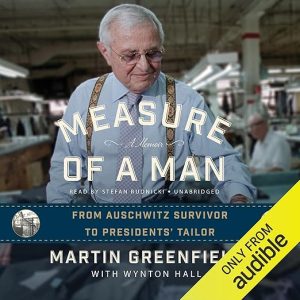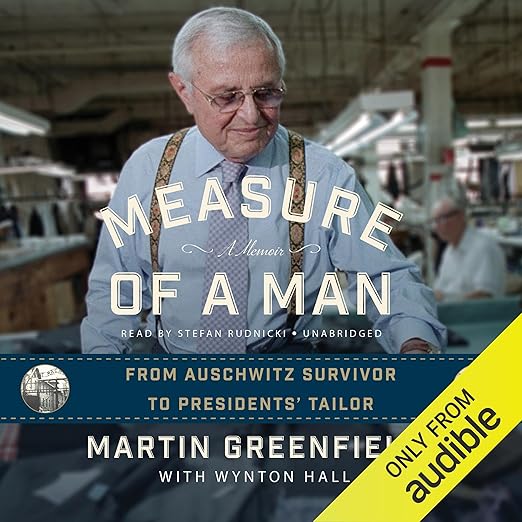
Stealing an SS soldier's shirt sounds like a small, reckless act until you learn what it set in motion for a fifteen-year-old Auschwitz prisoner. That single impulsive decision, made by a teenage Martin Greenfield after he'd already been separated forever from his parents, sisters, and baby brother, is where this audiobook memoir locates its real origin story. He learned to sew wearing that stolen shirt under his prisoner uniform, and in doing so learned something that would define the rest of his life: clothes carry real power, sometimes enough to help save it.
That single decision threading through the rest of the book gives Measure of a Man an unusual narrative spine for a Holocaust memoir: most survivor accounts organize around endurance and eventual liberation, while this one organizes around a specific, learnable skill discovered under duress and carried forward deliberately for the rest of a very long life.
Where This One Lands
Reviewer Andrea Smith's assessment of the book's structure is worth taking seriously: it splits cleanly into two sections, the Holocaust experience and the later tailoring career, and the first section is described as incredibly compelling while the second feels comparatively lighter. That's not necessarily a flaw so much as an honest description of how trauma narrative and success narrative occupy different emotional registers, and Greenfield, now eighty-six at the time of writing, doesn't try to force them into the same intensity.
The through-line connecting both halves is genuinely elegant: a skill learned purely for survival inside a concentration camp becomes the foundation of an entire fashion empire. From sweeping floors at a New York clothing factory to founding what the synopsis calls America's premier handmade suit company, Greenfield's trajectory reads less like a rags-to-riches cliché and more like a specific, hard-won application of a single lesson learned under the worst possible circumstances.
The scale of what that company became is worth naming directly: Greenfield has dressed presidents including Eisenhower, Clinton, and Obama, and celebrities including Paul Newman, Martin Scorsese, Leonardo DiCaprio, and Jimmy Fallon, now working alongside his own sons. That specific roster gives the second half of the book real concrete texture even where reviewers find it less emotionally dense than the first.
It's also worth noting how unusual this trajectory is even among successful immigrant success stories: Greenfield didn't simply build a business adjacent to his survival, he built it directly out of the one concrete skill his survival taught him, which gives the American-dream half of the book a specificity that vaguer self-made-success narratives often lack.
Measure of a Man carries a genuine double meaning: it's both a literal tailoring term, the precise physical measurements that make a suit fit correctly, and an old moral idiom for assessing someone's true character. Greenfield's memoir plays both meanings straight rather than choosing one, letting the craft of exact measurement stand in for the harder, more abstract work of assessing what a person is actually made of.
A quiet symmetry in Greenfield's later life is worth naming, one the book seems to lean into deliberately: a teenager who lost his entire immediate family in the camps eventually built a business he now runs alongside his own sons, a genuine act of reconstruction that gives the memoir's closing chapters an emotional resonance separate from, but connected to, its opening horror.
The Best Parts of Measure of a Man: A Memoir
Narrator Stefan Rudnicki is a close to ideal match for exactly what this memoir needs. His established range spans intimate, quiet material, reading a private letter, through monumental historical events, describing mass atrocity, without jarring the listener during the transition between registers. That's precisely the tonal bridge Measure of a Man requires, moving from Auschwitz to a Manhattan tailoring empire without either half feeling like a different book.
Reviewer E. Corder's description of the writing style, crisp sentences and short paragraphs so vivid the reader can practically see the scenes, suggests source material that suits audio narration particularly well: unadorned, direct prose rather than dense literary style that might resist a spoken format.
The book's stated wry sense of humor, alongside its soul-baring honesty, is a genuinely difficult tonal combination for a Holocaust memoir to sustain without either undercutting the horror or making the humor feel forced. Rudnicki's demonstrated ability to hold complexity without over-dramatizing suggests he's well positioned to let that humor land as genuine character rather than comic relief.
Within the broader canon of Holocaust survivor memoirs, most organize around endurance, faith, or eventual liberation as the central throughline. Greenfield's account stands out for grounding its survival story in a specific, transferable craft skill discovered under duress, which gives Measure of a Man a structural throughline, tailoring as both literal trade and extended metaphor, that few entries in this genre attempt as directly.
What Gives Us Pause
At six hours and five minutes, this covers an eighty-six-year life in a genuinely compact runtime, and Andrea Smith's review of the tailoring section feeling lighter may partly reflect that compression: a life this eventful, split across two very different eras, inevitably has to move faster through the second half than a dedicated business memoir would.
Reviewer E. Corder also notes some repetition here and there, worth knowing going in even though it doesn't appear to undercut the overall assessment. This is common in first-person survivor narratives working through material that resists easy linear telling, and shouldn't be mistaken for careless editing.
Listeners should be prepared for genuinely harrowing material in the book's first half: Greenfield's direct encounter with Josef Mengele and permanent separation from his family are not softened for the audiobook format, and the wry humor that emerges later doesn't apply retroactively to those early chapters.
It's also worth noting how rare it is for a memoir to sustain reader trust across two such different registers convincingly, survival horror and business triumph, without one undercutting the other's emotional credibility. Reviewer Jeanne Chambers' comparison of Greenfield to her own grandfather suggests the book succeeds at making both halves feel like the same coherent person rather than two separate stories stitched together.
Who Should Listen to Measure of a Man: A Memoir
Listeners drawn to Holocaust survivor testimony, and to American-dream success stories built on a genuinely specific skill rather than vague ambition, will find both halves of this memoir rewarding despite their different emotional weights. Fashion and craft history enthusiasts curious how a hand-tailoring business reaches the level of dressing presidents will get real specificity in the book's second half.
Skip it if you're looking for an exhaustive business biography of Greenfield's clothing empire specifically; the tailoring career, while well covered, is treated with less depth than the Holocaust section, according to at least one reviewer. Listeners sensitive to direct accounts of concentration camp trauma should also go in aware the material doesn't soften for the format.